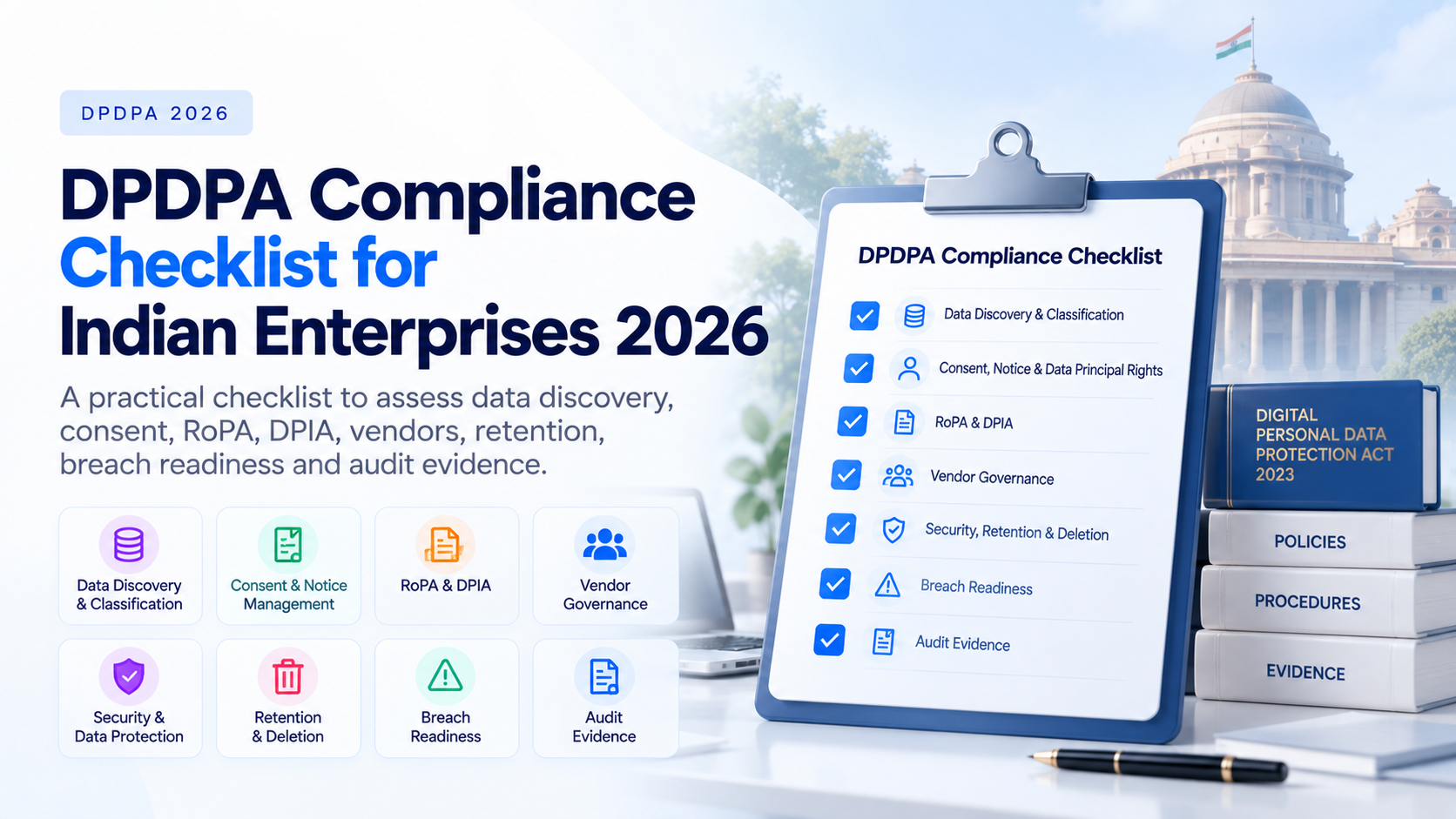
Use this DPDPA compliance checklist for Indian enterprises to assess data discovery, consent, RoPA, DPIA, vendors, retention, breach readiness and audit evidence.
Overview
DPDPA compliance is no longer only a legal-documentation project.
Indian enterprises now need to prove how personal data is collected, used, shared, retained, protected, deleted and governed across real systems, teams and vendors.
A privacy policy may explain the organisation’s intent, but it does not prove operational readiness.
A consent checkbox may capture a user action, but it does not show whether downstream systems, processors and retention workflows respect that choice.
A vendor register may list third parties, but it does not always show which personal data each processor receives, for which purpose and for how long.
This is why a practical DPDPA compliance checklist should cover the full operating model: data discovery, classification, purpose mapping, consent, Data Principal rights, RoPA, DPIA, vendor governance, retention, deletion, security, breach readiness and audit evidence.
Want to know where your DPDPA gaps are before implementation?
Run a DPDPA readiness assessment with OpenBlockAI Discovery Studio.
Discovery Studio helps enterprises discover personal data, map systems and vendors, identify RoPA and DPIA gaps, assess retention issues and create audit-ready evidence for remediation.
This checklist is designed for Indian enterprises preparing for DPDPA compliance in 2026, especially BFSI, fintech, healthcare, SaaS, telecom, e-commerce, HRTech, travel, insurance, retail and other data-heavy businesses.
DPDPA Compliance Checklist: Where Enterprises Should Start
The first mistake many enterprises make is starting with documents before understanding their data.
DPDPA readiness should begin with a clear operating baseline.
Before selecting tools, drafting policies or building consent journeys, leadership should be able to answer:
- What personal data do we collect?
- Where does it sit?
- Which systems process it?
- Which departments own it?
- Which vendors or processors receive it?
- Which purpose applies to each processing activity?
- What notice, consent or other applicable basis supports processing?
- How do users exercise their rights?
- How long do we retain the data?
- What happens when consent is withdrawn or the purpose is complete?
- Which high-risk processing activities need deeper review?
- What evidence can we produce for audit, Board review or regulator response?
Use this starting checklist to assess your current readiness.
- Appoint business owners: Identify accountable owners across legal, privacy, IT, security, product, HR, marketing, operations and procurement.
- Define compliance scope: List entities, business units, products, apps, data repositories, vendors and geographies in scope.
- Create a data-source inventory: Include databases, SaaS tools, APIs, emails, shared drives, logs, documents, endpoints and vendor exports.
- Map processing purposes: Link personal data to specific business purposes such as onboarding, KYC, servicing, fraud, marketing, HR, analytics or support.
- Identify Data Fiduciary and Processor roles: Determine where your organisation decides purposes and means, and where it processes data for another entity.
- Review existing notices and consents: Identify gaps in clarity, purpose specificity, language, withdrawal and evidence.
- Build an evidence room: Centralise policies, system maps, consent records, vendor contracts, DPIA notes, RoPA inputs, security controls and remediation logs.
For a quick scoring approach, read DPDPA Readiness Self-Assessment.
Data Discovery and Classification Checklist
Data discovery and classification are the foundation of DPDPA compliance.
You cannot apply consent, retention, deletion, security or vendor controls properly if you do not know where personal data exists.
Enterprises should not limit discovery to production databases.
Personal data may also sit in laptops, spreadsheets, PDFs, emails, shared drives, cloud folders, logs, test data, scanned forms, customer-support files, HR folders, call-centre exports and vendor files.
Use this checklist for data discovery and classification.
- Identify structured sources: Databases, data warehouses, CRMs, HRMS, ERPs, LMS, loan systems, policy systems, hospital systems, billing systems and analytics platforms.
- Identify unstructured sources: Emails, shared drives, PDFs, scanned forms, spreadsheets, documents, call recordings, chat exports, support tickets and file repositories.
- Scan endpoints: Laptops, desktops, local folders, downloads, synced cloud folders and employee working files.
- Classify personal data: Group data into contact, identity, KYC, financial, health, HR, behavioural, children’s, vendor-shared and derived categories.
- Detect India-specific identifiers: PAN, Aadhaar-related references, UPI IDs, account numbers, phone numbers, email addresses and other customer identifiers.
- Map data owners: Identify which department, system owner or business team is responsible for each data source.
- Identify duplicate copies: Find repeated customer or employee data across exports, reports, emails and shared folders.
- Flag high-risk locations: Open shared drives, old exports, unsecured folders, test environments, vendor exchange folders and uncontrolled endpoint copies.
- Connect data to purposes: Do not classify data only by field type. Link it to the reason it is processed.
- Record discovery evidence: Maintain proof of what was scanned, what was found, where it was found and what action was taken.
Still relying on spreadsheets for personal data inventory?
For deeper guidance, read Data Classification for DPDP and Endpoint Scanning for DPDP.
Consent, Notice and Data Principal Rights Checklist
Consent and notice readiness must be connected to actual processing activities.
A generic privacy notice, bundled consent or one-time checkbox may not be enough for enterprise DPDP readiness.
Organisations should know what the user was told, which purpose was involved, what action the user took, how withdrawal works and whether processors also stop processing where required.
Use this checklist for consent, notice and Data Principal rights.
- Map consent-based processing: Identify all activities where consent is the basis for processing personal data.
- Separate purposes: Avoid bundling service, marketing, profiling, analytics, partner sharing and optional communication under one broad consent.
- Review notice clarity: Ensure the notice explains the personal data, purpose, rights and grievance or contact mechanism in clear language.
- Support language access: Prepare notices and consent requests in English and relevant Indian languages for your customer base.
- Preserve notice versions: Store the exact notice version shown when consent was captured.
- Record consent evidence: Capture purpose, notice version, language, channel, timestamp, user action and consent status.
- Enable withdrawal: Make withdrawal visible, accessible and operationally connected to downstream systems.
- Sync consent status: Ensure CRM, marketing, support, analytics, operations and vendor systems receive updated consent status.
- Prepare Data Principal rights workflows: Access, correction, erasure, grievance and other applicable requests should have clear routing and closure evidence.
- Track request timelines: Maintain logs of when requests were received, assigned, acted upon and closed.
- Handle children’s data carefully: Identify journeys involving children and prepare verifiable parent or guardian consent workflows where applicable.
- Keep grievance evidence: Record complaint categories, owners, responses and closure notes.
Consent should not live only in a form field.
It should become a current instruction that systems and vendors can follow.
For consent-specific implementation, read Consent Management Software India and Multilingual Consent Software for DPDP.
RoPA, DPIA and Vendor Governance Checklist
RoPA, DPIA and vendor governance are where DPDP readiness becomes operational.
Enterprises need to move beyond policy statements and show how each processing activity works in practice.
RoPA checklist
- List processing activities by business function, product, system or workflow.
- Identify categories of personal data used in each activity.
- Map the purpose of processing.
- Identify systems, departments and owners involved.
- Record categories of Data Principals such as customers, employees, patients, borrowers, users, agents or vendors.
- Map processors and vendors involved in the activity.
- Capture retention expectations and deletion triggers.
- Link notices, consent records or other applicable processing basis.
- Record security controls and access restrictions.
- Maintain evidence that the processing record is based on actual data discovery, not assumptions.
DPIA readiness checklist
- Identify high-risk processing activities.
- Flag children’s data, financial data, health data, identity documents, profiling, AI use, automated decision support, large-scale monitoring and extensive vendor sharing.
- Assess impact on individuals.
- Review necessity and proportionality of the processing.
- Check whether data minimisation has been applied.
- Assess consent, notice and rights implications.
- Review security, access, retention and deletion controls.
- Record risk mitigation actions and accountable owners.
- Keep evidence of approvals and unresolved risks.
Vendor and processor governance checklist
- Create a processor and vendor register.
- Map which vendor receives which personal data fields.
- Record the purpose of sharing.
- Check vendor contracts for confidentiality, security, deletion, breach notification, sub-processor and audit obligations.
- Identify vendors that receive exports, API feeds, reports or manual files.
- Map vendor access to production systems and shared repositories.
- Review retention and deletion obligations at vendor level.
- Track whether withdrawal, deletion or suppression instructions reach vendors.
- Maintain evidence of vendor reviews and remediation actions.
Need RoPA, DPIA and vendor evidence from real data flows?
Use Discovery Studio to map processing activities, vendors, DPIA triggers and audit evidence.
For related guidance, read DPDP RoPA.
Security, Retention, Deletion and Breach Readiness Checklist
Security and retention are not separate from privacy readiness.
If personal data is retained longer than necessary, stored in uncontrolled files, copied into test systems, exposed to too many users or shared with vendors without visibility, compliance risk increases.
Use this checklist for security, retention, deletion and breach readiness.
Security safeguards checklist
- Identify systems and repositories containing personal data.
- Apply role-based access controls and least-privilege access.
- Review administrator and privileged access.
- Maintain logs of access, changes, exports and deletions where relevant.
- Use encryption, masking, obfuscation, tokenisation or other safeguards where appropriate.
- Review endpoint, email, shared-drive and cloud-folder exposure.
- Restrict production personal data in test, analytics and development environments.
- Monitor unauthorised exports and high-risk sharing.
- Maintain evidence of security controls and reviews.
Retention and deletion checklist
- Define retention rules by data category, purpose and legal requirement.
- Identify personal data whose purpose is complete.
- Find old exports, duplicate files, stale reports and unnecessary endpoint copies.
- Map deletion obligations across systems, backups, vendors and shared repositories.
- Track deletion, suppression or restriction actions with evidence.
- Ensure withdrawn consent triggers relevant downstream actions where required.
- Review archival and backup retention logic.
- Maintain exceptions where retention is required by law or business necessity.
Breach readiness checklist
- Create a breach-response playbook for personal data incidents.
- Define internal escalation owners across legal, security, IT, privacy, operations and communications.
- Maintain incident logs and investigation evidence.
- Identify affected systems, data categories, Data Principals and vendors quickly.
- Prepare notification workflows where applicable.
- Test breach-response tabletop exercises.
- Review vendor incident reporting obligations.
- Close remediation actions and preserve evidence.
The purpose of this checklist is not only to reduce risk.
It is to make privacy controls traceable, testable and defensible.
Build DPDPA Readiness with Discovery Studio
A complete DPDPA compliance checklist is useful only if it connects to real enterprise data.
Otherwise, it becomes another questionnaire where every department says “yes” without evidence.
Discovery Studio by OpenBlockAI helps enterprises convert this checklist into an evidence-backed readiness baseline.
It supports:
- Personal data discovery across structured and unstructured sources.
- Endpoint scanning across laptops, files, emails, shared drives and repositories.
- Data classification by category, risk, purpose and control requirement.
- System and vendor data mapping.
- RoPA inputs based on actual processing activities.
- DPIA trigger identification for higher-risk processing.
- Retention and deletion gap analysis.
- Vendor and processor governance evidence.
- Consent and notice gap review.
- Audit-ready remediation tracking.
For Indian enterprises, DPDPA readiness should not start with fear of penalties.
It should start with clarity.
Where is personal data?
Why is it processed?
Who receives it?
What control applies?
What evidence proves it?
Ready to turn this checklist into an evidence-backed DPDPA readiness plan?
Run a DPDPA readiness assessment with Discovery Studio.
Speak with OpenBlockAI about DPDPA compliance, data discovery, RoPA, DPIA and vendor governance.
A strong DPDPA programme is not built only through policies.
It is built through data visibility, operational controls and evidence that can stand up to review.