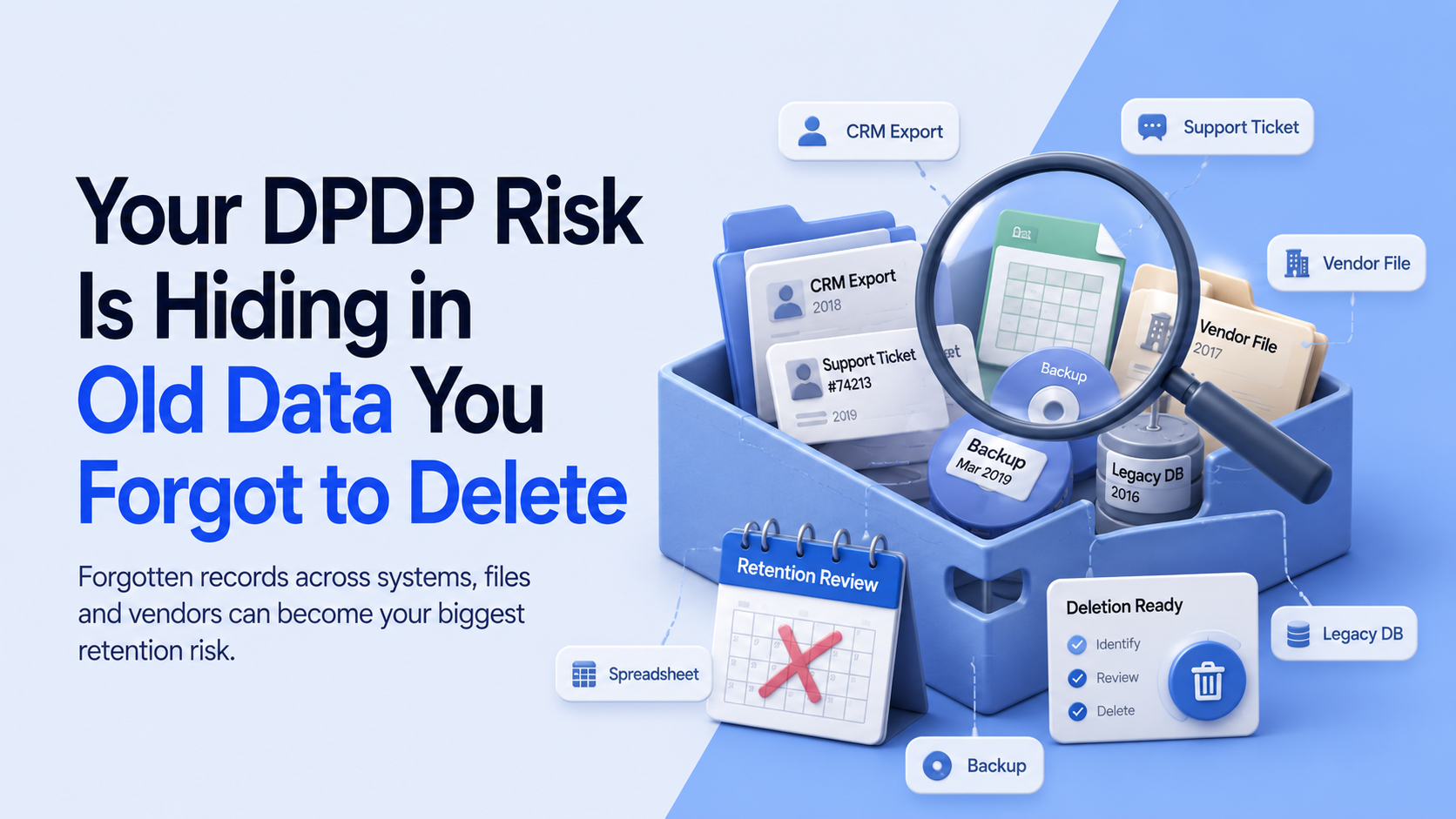
Most DPDP discussions focus on new consent flows, privacy notices and customer onboarding journeys. But a bigger risk may be sitting quietly inside old spreadsheets, CRMs, support tickets, vendor exports, logs and backups. This article explains why forgotten personal data can become a serious DPDP governance issue, why deletion fails without discovery, and how Discovery Studio helps enterprises build retention, deletion and audit readiness before implementation.
Overview
Most DPDP conversations begin with the data being collected today.
A new signup form.
A consent notice.
A customer onboarding flow.
A marketing opt-in.
A vendor integration.
All of this matters.
But many enterprises are carrying a quieter risk in the background.
Old personal data.
Data collected years ago.
Data copied into spreadsheets.
Data exported to vendors.
Data stored in CRMs after the lead went cold.
Data sitting inside archived support tickets.
Data retained in logs, backups, emails and shared drives.
Data that no team actively uses, but no team has deleted either.
Under the Digital Personal Data Protection framework, this old data can quickly become a governance problem.
Because if an organisation cannot explain why personal data is still being retained, where it sits, who can access it, which vendor holds it and when it should be deleted, the privacy programme is not operationally ready.
Retention is not a policy line. It is an operating discipline.
Many organisations already have a retention clause in their privacy policy.
It may say personal data will be kept only for as long as necessary.
It may say data will be deleted once the purpose is complete.
It may say legal or regulatory retention requirements will be followed.
But the real question is not whether the policy says this.
The real question is whether the organisation can prove this across actual systems.
Can you show which database table holds the data?
Can you show which CRM field contains it?
Can you show which vendor received it?
Can you show which file export was shared?
Can you show whether the original purpose is still active?
Can you show who owns deletion?
Can you show whether the data has crossed its retention period?
Can you show what evidence exists for deletion or continued retention?
This is where most teams struggle.
Where old personal data hides
Old personal data rarely sits in one obvious place.
It spreads slowly across the organisation.
A sales team exports leads into a spreadsheet.
A support team attaches identity proof to a ticket.
A product team stores logs for debugging.
A marketing team uploads campaign lists into a campaign tool.
A finance team stores invoices, bank details and payment records.
A vendor receives an onboarding file.
A data team copies customer records into a warehouse.
An operations team stores documents in Google Drive or Microsoft 365.
A legacy application keeps old records because nobody owns cleanup.
A backup system keeps personal data long after the active system has changed.
Individually, each copy may look small.
Together, they create a retention blind spot.
That blind spot becomes risky when a customer asks for deletion, withdraws consent, closes an account, raises a grievance or when the organisation has to demonstrate DPDP readiness during an audit.
Why deletion fails without discovery
Deletion sounds simple until the organisation tries to execute it.
If a customer withdraws consent, closes an account or asks for erasure, the privacy team needs to know every place where that customer's personal data exists.
But if personal data is scattered across databases, CRMs, emails, documents, cloud storage, logs, vendors, support tools and backups, deletion becomes a manual investigation.
Teams begin asking each other
Is the data still in the CRM?
Is it in the data warehouse?
Did marketing export it?
Did a vendor receive a copy?
Is it attached to archived support tickets?
Is it stored in employee laptops or shared drives?
Is it sitting in old onboarding folders?
Is it present in backup or log systems?
If the answer is unclear, deletion is not reliable.
And if deletion is not reliable, audit evidence becomes weak.
The DPDP readiness question every enterprise should ask
The practical question is not only
Do we have consent?
The stronger question is
Do we know what personal data we are still retaining, why we are retaining it and when it should be deleted?
This question connects directly to purpose limitation, data minimisation, retention governance, vendor accountability and audit readiness.
It also connects to cost.
The more personal data an enterprise keeps unnecessarily, the more it has to secure, govern, search, explain and defend.
Old data increases compliance cost.
Old data increases breach exposure.
Old data increases vendor risk.
Old data increases operational complexity.
Old data makes every future privacy request harder to execute.
What retention readiness should include
A DPDP-ready retention review should not be limited to a document or spreadsheet.
It should create a live operational baseline that privacy, legal, technology, product, security and business teams can use.
At minimum, teams should map
Data category.
System or source.
Purpose of processing.
Collection channel.
Data owner.
Business workflow.
Vendor or processor access.
Retention period or trigger.
Legal or regulatory retention requirement.
Deletion owner.
Deletion method.
Backup or log treatment.
Audit evidence.
Open risk.
Without this, retention remains an assumption.
With this, retention becomes governable.
Where Discovery Studio fits
Discovery Studio by OpenBlockAI is built for this exact pre-implementation problem.
It helps enterprises discover personal data across structured and unstructured sources including databases, CRMs, APIs, cloud storage, PDFs, spreadsheets, documents, emails, shared drives and internal systems.
It classifies DPDP-relevant fields such as Aadhaar, PAN, date of birth, contact details, financial records, health data, device IDs and behavioural data.
It then connects personal data to source, purpose, workflow, processor, retention rule, deletion gap and audit evidence.
This gives teams a clear readiness baseline before they implement consent management, DSR workflows or privacy automation.
With Discovery Studio, organisations can
Build a validated data inventory.
Map data flows and data lineage.
Identify personal data retained without a clear purpose.
Find systems with missing retention rules.
Detect vendor and processor access gaps.
Generate RoPA-ready inputs.
Identify DPIA triggers.
Create a retention and deletion-readiness report.
Build an audit evidence checklist.
Prioritise remediation by risk and business impact.
The goal is simple.
Do not wait for a deletion request or audit to discover where old data lives.
Find it before it becomes a problem.
Why industries should care
BFSI and fintech
Banks, NBFCs, payment companies and lending apps hold KYC records, loan applications, transaction histories, device identifiers, risk scores, support tickets, collections data and partner files.
Some records may need to be retained for regulatory or legal reasons.
But old marketing exports, abandoned onboarding records, duplicate KYC files and processor copies still need review.
Discovery Studio helps these teams distinguish necessary retention from unnecessary exposure.
SaaS and digital platforms
SaaS companies retain data across signup, product analytics, logs, support tools, billing systems, CRM, integrations, AI features and data warehouses.
When a customer churns, data may remain across multiple systems.
Discovery Studio helps identify where it remains, why it remains and whether deletion or restriction is required.
Healthcare and healthtech
Patient data can sit inside EMR systems, diagnostic workflows, appointment systems, insurance or TPA files, pharmacy workflows, lab reports and vendor platforms.
Because healthcare data is sensitive and fragmented, retention review must be precise.
Discovery Studio helps map data categories, workflows, vendors and deletion gaps before patient rights requests or audits arise.
E-commerce and marketplaces
Marketplaces hold order records, delivery details, seller access records, return requests, loyalty data, abandoned carts, recommendation profiles and marketing lists.
Some data must remain for tax, warranty, fraud or dispute reasons.
But promotional datasets and profiling records may not need indefinite retention.
Discovery Studio helps teams separate operational necessity from privacy risk.
Telecom and consumer internet
High-volume platforms hold mobile numbers, device IDs, app behaviour, support tickets, campaign records and consent preferences.
At this scale, even a small retention gap can become a large governance issue.
Discovery Studio helps create inventory and evidence across high-volume systems.
The business case for retention discovery
Retention readiness is not only about compliance.
It reduces data sprawl.
It lowers breach exposure.
It improves vendor accountability.
It makes deletion requests easier to execute.
It helps teams defend why certain data must remain.
It gives auditors evidence instead of assumptions.
It improves trust because the business is not keeping personal data forever by default.
It also helps technology teams clean systems, reduce storage noise and make governance practical.
The operational standard enterprises should aim for
A DPDP-ready retention and deletion programme should meet five practical standards.
First, personal data should be discovered across systems, files, vendors and backups.
Second, every retained dataset should be linked to a clear purpose, owner and workflow.
Third, retention rules should be mapped to real systems, not only policies.
Fourth, deletion or restriction actions should be assigned to clear owners.
Fifth, every decision should create audit-ready evidence.
If any of these five are missing, retention governance is incomplete.
Final takeaway
DPDP readiness is not only about the data you collect today.
It is also about the data you forgot yesterday.
Old personal data sitting in CRMs, spreadsheets, logs, support systems, emails, vendors and backups can become a hidden compliance risk.
Before implementing consent or DSR workflows, enterprises need to discover what personal data exists, why it exists, who has access, how long it should stay and what evidence proves the decision.
Discovery Studio helps build that baseline.
Because under DPDP, forgotten data is still your responsibility.
Start your DPDPA readiness assessment with Discovery Studio: https://www.openblockai.com/dpdpa-readiness-assessment
Book a demo with OpenBlockAI
https://calendly.com/openblockai/consentica
If your retention gaps involve consent withdrawal or customer preferences, explore Consentica: https://www.openblockai.com/consent-management