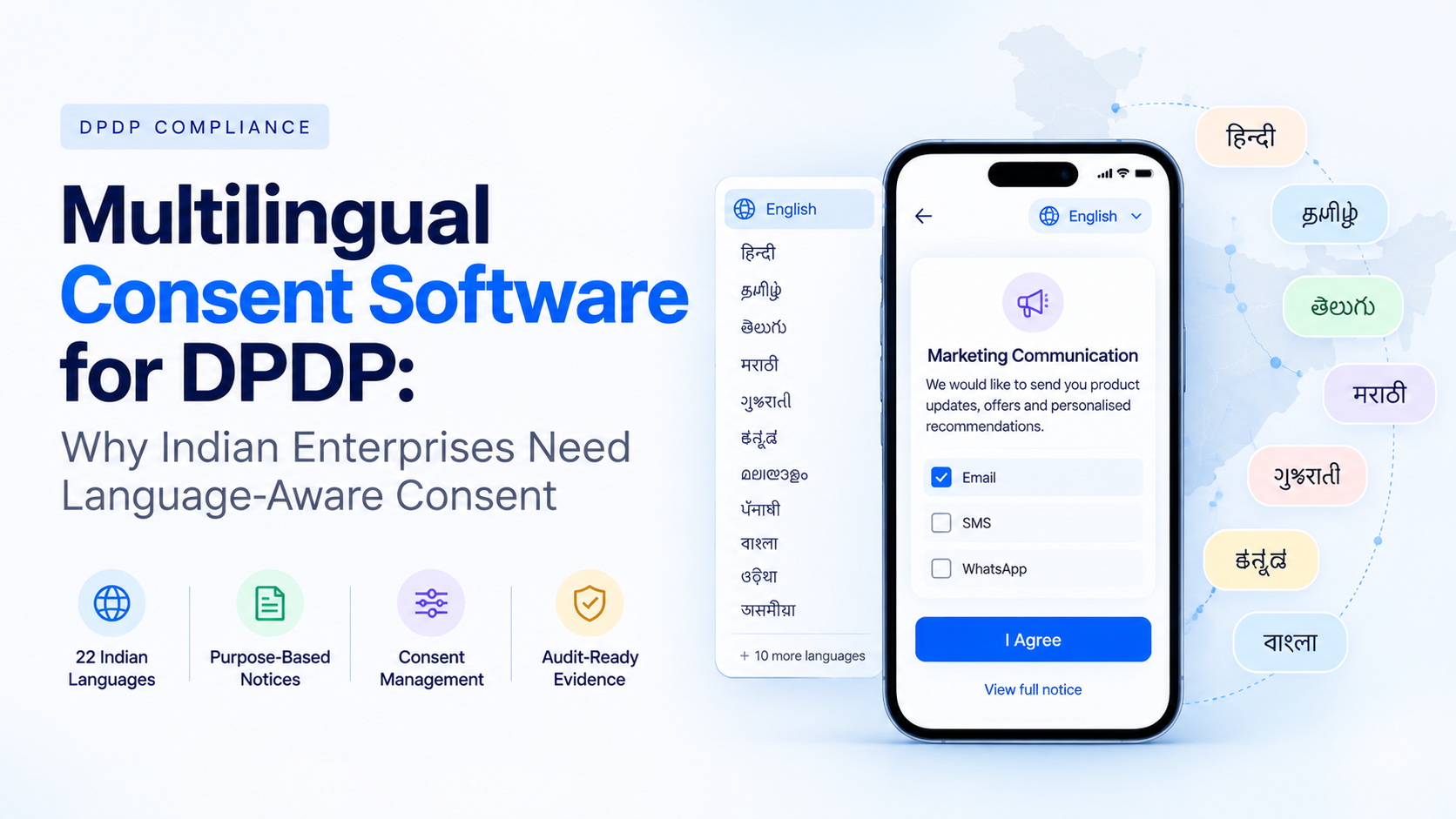
Learn why multilingual consent software matters under DPDP and how Indian enterprises can manage language-aware notices, consent records and withdrawal.
Overview
India is not a one-language consent market.
A customer may understand Hindi, Tamil, Bengali, Marathi, Telugu, Kannada, Malayalam, Gujarati, Punjabi, Assamese, Odia or another Indian language better than English.
If a business asks for consent only in English, the interface may look complete, but the user may not clearly understand what they are agreeing to.
This is why multilingual consent software for DPDP is becoming important for Indian enterprises.
Under DPDP, consent should not be reduced to a checkbox. The user should be able to understand the notice, the purpose, the choice, the withdrawal mechanism and the consequence of their action.
For enterprises, this creates an operational challenge: consent journeys must work across languages, channels, products, vendors, customer segments and evidence records.
Need multilingual consent journeys for Indian users?
Explore Consentica for DPDP-ready multilingual consent management.
Consentica helps enterprises create purpose-based consent journeys in English and 22 Scheduled Indian languages, preserve language evidence and sync consent status across systems.
This guide explains why language-aware consent matters, what multilingual consent software should capture and how Indian enterprises can build consent governance that users can actually understand.
What Is Multilingual Consent Software?
Multilingual consent software helps organisations present, capture, manage and prove consent in more than one language.
In a DPDP context, this means the platform should not only translate a privacy notice.
It should preserve the complete consent journey in the language shown to the user.
A practical multilingual consent software system should help organisations manage:
- Purpose-based consent notices in multiple Indian languages.
- Language selection at the point of data collection.
- Notice version history for each language.
- Consent records linked to the exact language shown.
- Withdrawal and preference management in the user’s preferred language.
- Audit evidence showing purpose, notice version, language, channel, timestamp and user action.
- Consent status sync across internal systems and processors.
For example, a fintech app may show an account-servicing notice in Hindi, a marketing consent in Marathi and a credit bureau consent in English depending on the user journey.
A healthcare provider may need appointment, diagnostic, insurance and communication consent journeys in different languages across app, call centre, branch or assisted onboarding.
A telecom or consumer internet company may need language-aware consent at scale across app, web, IVR, assisted and API-led channels.
Multilingual consent software should make all of this manageable without forcing teams to maintain disconnected PDFs, screenshots, spreadsheets or manual translation trackers.
For a broader consent-software buyer guide, read Consent Management Software India: DPDPA Buyer’s Guide for 2026.
Why Language-Aware Consent Matters Under DPDP
Language-aware consent matters because consent is not only about recording a click.
It is about whether the user had a fair opportunity to understand the request.
For Indian enterprises, this becomes especially important because users may interact through different languages, literacy levels and assisted journeys.
1. Consent should be understandable
If a user cannot understand the notice, the consent journey becomes weak from a trust and evidence perspective. A clear multilingual notice helps users understand what data is being collected, why it is being processed and how they can exercise choices.
2. Language evidence supports audit readiness
It is not enough to say that a notice was available in multiple languages. The organisation should be able to show which language was actually displayed to the user when consent was captured.
3. Regional users need practical access
Many Indian users do not complete important journeys only in English. Banking, lending, insurance, healthcare, e-commerce, telecom, travel and government-linked services often involve users who prefer regional languages.
4. Assisted journeys need language control
Consent may be captured through branch staff, DSAs, agents, call centres, field teams, QR forms or IVR flows. A multilingual consent platform helps standardise the message across assisted journeys instead of leaving wording to each agent.
5. Withdrawal should also be understandable
Multilingual consent should not stop at capture. Users should also be able to review, update or withdraw consent through clear language-aware interfaces.
6. Vendors and systems need the same consent state
If the user changes a language-specific consent preference, the latest consent status should still sync with CRM, marketing, support, operations and processor workflows.
Consent is stronger when the user understands the choice.
For comparison of consent platforms in India, read Best DPDPA Consent Management Platforms in India 2026.
What Multilingual Consent Software Should Capture
A multilingual consent platform should preserve more than the translated text.
It should maintain evidence of the full consent event.
1. Purpose
The platform should capture the specific purpose for which consent was requested. Examples may include account updates, marketing communication, credit assessment, service reminders, health communication, analytics, partner offers or profiling.
2. Language shown
The record should show whether the notice was displayed in English, Hindi, Tamil, Bengali, Marathi, Telugu, Kannada, Malayalam, Gujarati, Punjabi or another supported language.
3. Notice version
Each language version should be versioned. If a Hindi notice changes later, the earlier Hindi version should remain linked to the consent captured at that time.
4. Channel
The platform should capture where consent was collected: website, mobile app, QR code, branch, call centre, IVR, assisted journey, API or offline-to-digital flow.
5. User action
The consent record should show whether the user accepted, rejected, partially accepted, updated, renewed or withdrew consent.
6. Timestamp and policy history
Audit evidence should include when the action happened and which policy or notice version was active.
7. Withdrawal and preference change
If the user withdraws consent or updates language preferences, the system should preserve the updated status and notify connected systems where required.
8. Downstream enforcement
Consent status should not remain inside the consent platform. APIs, webhooks and integrations should help CRM, marketing, support, operations and vendor workflows act on the latest status.
9. Assisted consent evidence
For branch, agent, field or call-centre journeys, the platform should help prove what was presented and what the user selected, instead of relying only on staff notes.
10. Customer access
Users should be able to review, update or withdraw consent through a clear Privacy Centre or consent preference interface.
A multilingual consent platform should therefore answer one evidence question:
Can you prove the exact purpose, language, notice version, channel and user action for each consent record?
Multilingual Consent Checklist for Indian Enterprises
Use this checklist before choosing multilingual consent software for DPDP readiness.
- Language coverage: Does the platform support English and Indian language journeys relevant to your customer base?
- Purpose-based notices: Can notices be created separately for each processing purpose?
- Language-version control: Can each language notice be versioned and preserved for evidence?
- Clear user choice: Can the user accept, reject, update or withdraw consent clearly?
- Multi-channel capture: Can the platform support web, app, QR, branch, call centre, IVR, assisted and API-led journeys?
- Privacy Centre: Can users review and manage consent in a language-aware interface?
- Audit trail: Does the platform preserve purpose, language, notice version, channel, timestamp and action?
- Consent Check API: Can downstream systems check current consent status before processing?
- Webhooks: Can consent changes trigger updates in CRM, marketing, support or operational systems?
- Vendor sync: Can relevant processors receive updated consent or withdrawal status?
- Assisted journey controls: Can branch, agent and call-centre teams use approved language versions instead of free-form scripts?
- Withdrawal flow: Can users withdraw consent as clearly as they gave it?
- Reporting: Can teams see consent performance and gaps by language, purpose and channel?
- Evidence exports: Can legal, compliance or audit teams reconstruct the consent event later?
- Implementation speed: Can the platform go live quickly without months of integration work?
If a platform only translates notices but does not preserve language evidence, it may not be enough for enterprise consent governance.
Want to test multilingual consent before a full integration?
Explore Consentica for language-aware DPDP consent management.
For proof and audit-trail guidance, read DPDP Consent Proof: Can You Prove What the Customer Actually Agreed To?.
Build Language-Aware Consent Governance with Consentica
Consentica by OpenBlockAI is built for Indian enterprises that need consent management beyond English-only notices and website banners.
It helps organisations create, capture, update, withdraw, sync and prove consent across multilingual and assisted customer journeys.
Consentica supports:
- Purpose-based consent notices.
- Consent journeys in English and 22 Scheduled Indian languages.
- Versioned notices linked to purpose and language.
- Web, mobile app, QR, branch, call-centre, IVR and assisted journeys.
- Privacy Centre for consent review, updates and withdrawal.
- Consent Check API for real-time status verification.
- Webhooks and system integrations for downstream consent sync.
- Audit-ready consent history with purpose, language, channel, timestamp and policy version.
- Vendor and processor status updates.
- Minor and guardian consent workflows where relevant.
For Indian enterprises, multilingual consent should not be treated as a translation project.
It should be treated as consent infrastructure.
The user’s language choice should be linked to the notice version, consent purpose, channel, timestamp, withdrawal flow and downstream system status.
That is how organisations move from consent capture to consent governance.
Ready to launch multilingual DPDP consent journeys?
Explore Consentica for multilingual consent software in India.
Speak with OpenBlockAI about DPDP consent governance for your organisation.
The best multilingual consent software is not the one that only shows translated text.
It is the one that helps the organisation prove what the user saw, what they understood, what they selected and how that choice was enforced across systems.