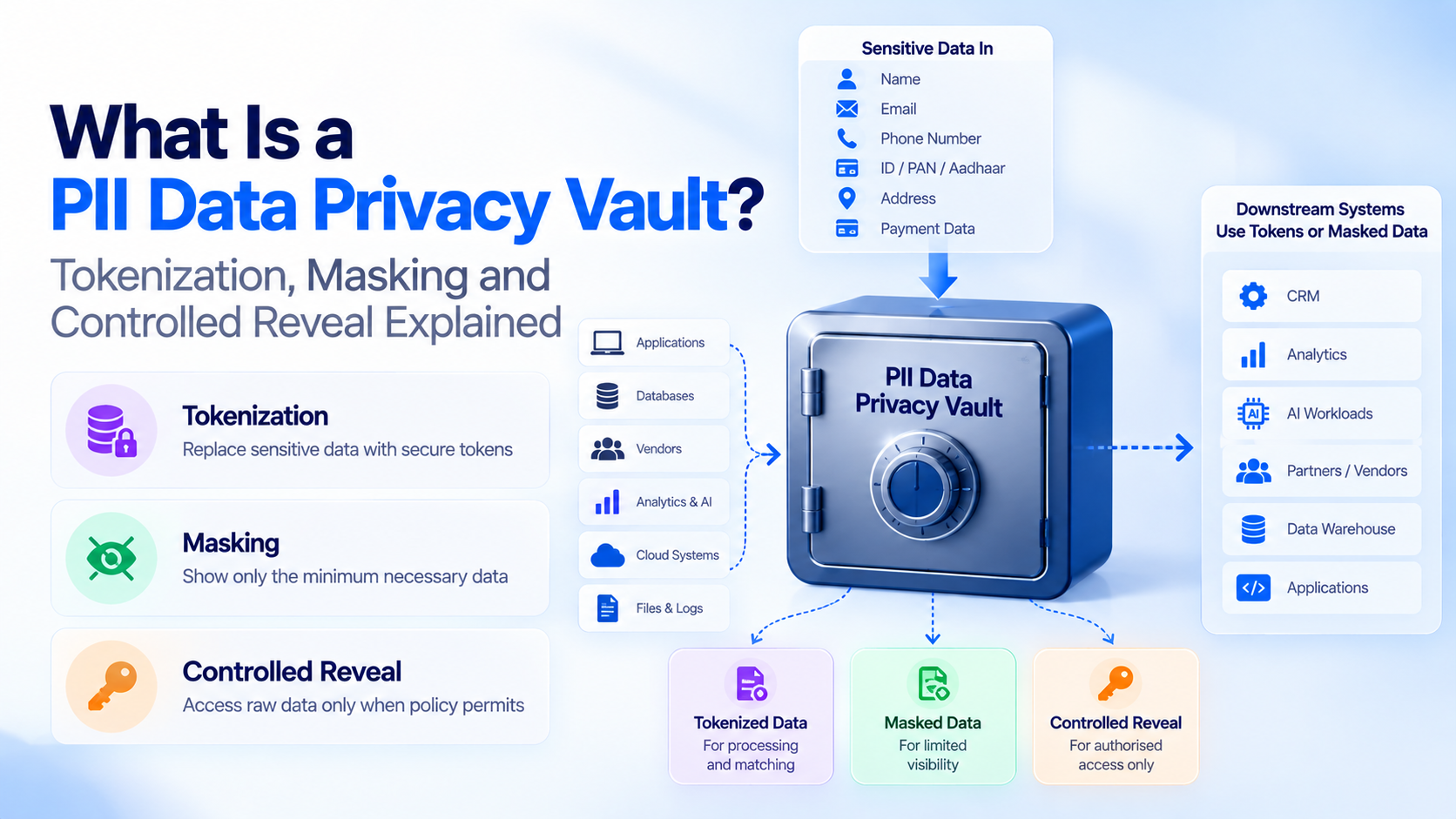
Understand what a PII Data Privacy Vault is, how tokenization, masking and controlled reveal reduce raw PII exposure, and why enterprises use privacy vaults for apps, AI, vendors and compliance.
Overview
Most enterprises do not have one PII problem.
They have hundreds of PII copies.
A user submits personal data through an app, web form, API, onboarding flow, support ticket, uploaded document or partner integration. That data may start inside one system, but it quickly spreads across CRMs, databases, support tools, logs, analytics systems, AI workloads, data warehouses, test environments, spreadsheets, vendor files and internal dashboards.
Encryption can protect storage. Access control can restrict users. Masking can hide values in selected interfaces.
But if raw PII continues to move everywhere, the enterprise still has a privacy architecture problem.
This is where a PII Data Privacy Vault becomes important.
A PII Data Privacy Vault is a controlled data layer that stores sensitive personal data inside a protected vault and allows downstream systems to operate on tokens, masked values or governed references instead of raw PII.
The goal is simple:
Do not secure raw PII everywhere. Reduce where raw PII exists.
Want to reduce raw PII exposure across applications, AI workloads, logs and vendors?
Explore Privault — OpenBlockAI’s Tokenized PII, PHI and PCI Data Privacy Vault.
Privault helps enterprises tokenize sensitive data at source, keep raw values inside a controlled vault, govern every reveal by policy and maintain audit-ready evidence of sensitive-data access.
This guide explains what a PII Data Privacy Vault is, how tokenization, masking and controlled reveal work, and why enterprises use privacy vaults to protect personal data across modern application, vendor and AI architectures.
What Is a PII Data Privacy Vault?
A PII Data Privacy Vault is a secure system that stores sensitive personal data separately from the applications and workflows that use it.
Instead of copying raw PII into every application database, the organisation stores raw values inside the vault and gives downstream systems a token or reference value.
For example:
- A mobile number may be replaced with a format-preserving token.
- An email may be replaced with a deterministic token that supports matching or lookup.
- A PAN, Aadhaar-related identifier or identity document reference may be replaced with a random or policy-controlled token.
- A name or address may be masked or revealed only when a defined policy allows it.
The vault becomes the protected source for sensitive fields, while operational systems continue to function with governed substitutes.
A practical PII vault should support:
- Secure sensitive data storage for PII, PHI, PCI and other regulated fields.
- Field-level tokenization so different data fields can follow different protection rules.
- Masking so users and systems can see only the minimum necessary data.
- Controlled reveal so raw values are shown only when policy permits.
- Policy-bound access based on role, purpose, department, application, partner, region and time.
- Audit trails showing who accessed which field, for what purpose and when.
- APIs and integration so applications can collect, tokenize, retrieve and reveal data through controlled workflows.
In simple terms, a PII Data Privacy Vault separates identity from daily processing.
The raw value stays inside the vault.
Applications, vendors, analytics tools and AI systems use tokens unless raw access is explicitly justified and approved.
Why Enterprises Need a PII Vault Instead of Raw Data Everywhere
Many enterprises already use encryption, access control, firewalls and data-loss-prevention tools.
Those controls are important, but they do not always solve raw PII sprawl.
Raw personal data can still appear across:
- Application databases.
- CRM and ERP systems.
- Customer-support tools.
- Marketing systems.
- Analytics platforms.
- Application logs.
- Data warehouses and BI dashboards.
- AI and machine-learning pipelines.
- Test and staging environments.
- Vendor APIs and processor files.
- Internal spreadsheets and exports.
Every additional copy increases risk.
If a support tool stores raw phone numbers, it becomes a sensitive-data store.
If logs contain email addresses or identity fields, the logging system becomes a privacy risk.
If a vendor receives raw customer data when a token would be enough, third-party risk increases.
If an AI workload receives raw PII when it only needs a reference or masked attribute, privacy exposure increases.
A PII vault changes the default model.
Instead of asking every system to store and protect raw PII, the vault keeps sensitive values in one controlled layer and gives other systems only what they need.
This helps organisations:
- Reduce raw-data duplication.
- Limit unnecessary access to sensitive values.
- Improve vendor and processor governance.
- Protect production, test and analytics environments.
- Control re-identification and reveal events.
- Create audit evidence for sensitive-data access.
- Support privacy-by-design architecture.
For related implementation guidance, read PII in Application Logs and Production PII in Test Environments.
Tokenization, Masking and Controlled Reveal Explained
A PII Data Privacy Vault usually combines three important ideas: tokenization, masking and controlled reveal.
1. Tokenization
Tokenization replaces a raw sensitive value with a token.
The token can be stored and used by downstream systems without exposing the original value.
For example:
- Raw phone: 9876543210
- Token: 98XX-TKN-4321
The application may use the token for workflows, matching, references or vendor communication without storing the raw phone number.
Different token types may be used depending on the field and workflow:
- Random tokens for stronger unlinkability.
- Deterministic tokens where matching or lookup is needed.
- Format-preserving tokens where systems expect a familiar field format.
- Reference tokens where the system only needs a stable ID, not the original value.
2. Masking
Masking hides part of the sensitive value while showing enough information for a user or system to complete a task.
For example:
- Email: r****@company.com
- Phone: ******3210
- Account number: XXXX-XXXX-1234
Masking is useful for support teams, dashboards, reports and low-risk workflows where full data is not required.
But masking alone is not the same as vaulting. If raw data still exists in every system behind the mask, exposure may remain.
3. Controlled reveal
Controlled reveal means raw PII is revealed only when a defined policy allows it.
For example, a customer-support user may be allowed to view a masked phone number by default, but full reveal may require a valid purpose, approved role, limited duration and audit logging.
Controlled reveal should answer:
- Who requested access?
- Which application or user requested it?
- Which field was revealed?
- For what purpose?
- Under which policy?
- For how long?
- Was the event logged?
This is where a PII vault becomes more than token storage.
It becomes a governance layer for re-identification.
Need policy-bound reveal instead of permanent raw-data access?
See how Privault governs every sensitive-data reveal with role, purpose, time and audit controls.
How a PII Data Privacy Vault Works in Enterprise Architecture
A PII Data Privacy Vault changes how sensitive data flows through enterprise systems.
A typical architecture may work like this:
Step 1: Capture sensitive data
The user submits sensitive data through an app, web form, API, call-centre flow, onboarding journey or uploaded document.
Step 2: Store raw value inside the vault
The raw value is sent to the PII vault, where it is encrypted, isolated and governed by field-level policies.
Step 3: Generate token
The vault returns a token, masked value or reference ID to the application.
Step 4: Downstream systems use tokens
CRM, support, analytics, AI workloads, logs, vendors and internal applications use the token instead of raw PII wherever possible.
Step 5: Reveal only when authorised
If a valid business process requires raw data, the application requests controlled reveal. The vault evaluates the policy before returning the value.
Step 6: Log the access event
Every reveal, detokenization or sensitive-data access event is logged for audit and governance.
This architecture helps enterprises reduce the spread of raw PII while keeping applications functional.
It also helps answer a question many companies struggle with:
Who can re-identify the customer, under what condition and with what evidence?
For organisations that do not yet know which fields should be vaulted first, Discovery Studio for data discovery and classification can help identify sensitive fields, systems, vendors and high-risk data flows before Privault implementation.
PII Data Privacy Vault Use Cases
A PII Data Privacy Vault can support multiple enterprise use cases.
1. BFSI and fintech
Banks, NBFCs, lenders, wallets and fintech platforms process identity, financial, account, KYC, bureau, repayment and risk data. A PII vault can reduce raw-data exposure across lending systems, CRMs, vendor workflows, collections, analytics and partner APIs.
2. Healthcare and healthtech
Healthcare organisations process PHI, patient identifiers, prescriptions, diagnostic records, appointment data and insurance details. A privacy vault can support PHI tokenization, masked access and controlled reveal for authorised workflows.
3. SaaS products
SaaS platforms often store customer-user data across app databases, integrations, support tools, logs and analytics. A PII vault helps reduce raw identity exposure while preserving product functionality.
4. AI and LLM workloads
AI systems may consume user content, documents, transcripts, support tickets or operational records. A PII vault can help ensure AI workflows use tokens or de-identified values where raw PII is not necessary.
5. Vendor and processor governance
Vendors often do not need raw PII. They may only need a token, masked value or reference ID. A privacy vault helps enterprises share minimum necessary data and govern reveal events.
6. Logs and observability
Application logs, traces, crash reports and support diagnostics may accidentally contain personal data. A vault-led tokenization model helps reduce raw PII in observability tools.
7. Test and staging environments
Production PII should not be copied into test environments without control. Tokenized references can help product and engineering teams test workflows without exposing raw personal data.
8. Support and operations
Support agents may need partial data for verification but not full raw records by default. Masking and controlled reveal help align access with the actual task.
The common principle is the same across use cases:
Give systems enough data to work, but not more raw PII than they need.
PII Data Privacy Vault Buyer Checklist
Use this checklist before choosing a PII Data Privacy Vault.
- Data categories: Does the vault support PII, PHI, PCI and other sensitive fields relevant to your business?
- Field-level tokenization: Can different fields follow different token policies?
- Token types: Does it support random, deterministic, format-preserving or reference tokens where required?
- Masking: Can users and systems see masked values by default?
- Controlled reveal: Can raw values be revealed only under policy?
- Policy conditions: Can policies use role, purpose, application, department, partner, geography and time?
- Time-bound access: Can raw access expire automatically?
- Audit logs: Can every reveal show who accessed what, why, when and for how long?
- API integration: Can existing applications integrate without complete re-architecture?
- Search and matching: Can deterministic or searchable tokens support legitimate workflows?
- Vendor governance: Can vendors receive tokens or masked values instead of raw PII?
- AI workload protection: Can the vault reduce raw PII exposure in AI, analytics and model workflows?
- Retention and deletion: Can policies support lifecycle controls by field or purpose?
- Deployment model: Does the solution support SaaS, private VPC or on-premise deployment if required?
- Discovery-first implementation: Can the team identify which fields should be vaulted before integration?
A strong vault decision should not be based only on encryption.
The real question is whether the platform can reduce raw-data exposure while supporting real business workflows.
Evaluating a PII vault for your application architecture?
Speak with OpenBlockAI about Privault architecture, field-level tokenization and controlled reveal.
Build Tokenized PII Protection with Privault
Privault by OpenBlockAI is designed for enterprises that want to reduce raw PII exposure across applications, AI workloads, analytics systems, support tools, vendors and processors.
It helps organisations move from raw-data sprawl to controlled sensitive-data infrastructure.
Privault supports:
- Tokenized PII, PHI and PCI protection.
- Field-level tokenization.
- Random, deterministic and format-preserving token policies.
- Masking and controlled reveal.
- Role-based and policy-bound access.
- Purpose-bound and time-bound detokenization.
- Partner and vendor access restrictions.
- Region-aware and deployment-aware data governance.
- Audit logs for sensitive-data access.
- APIs and integration with downstream applications.
- Retention and lifecycle controls.
Privault can also be implemented after Discovery Studio has identified which sensitive data exists, where it sits, which systems consume it, which vendors receive it and which fields should be protected first.
This discovery-first approach helps teams avoid tokenizing blindly.
Instead, they can build a practical tokenization policy matrix based on field type, workflow need, search requirement, risk level and access policy.
Ready to keep raw PII inside a controlled vault?
Explore Privault — Tokenized PII, PHI and PCI Data Privacy Vault.
Talk to OpenBlockAI about PII vault implementation for your enterprise.
A PII Data Privacy Vault is not only a security tool.
It is privacy infrastructure.
It helps enterprises decide where raw data should exist, who can re-identify it, why access is allowed and what evidence proves the decision.