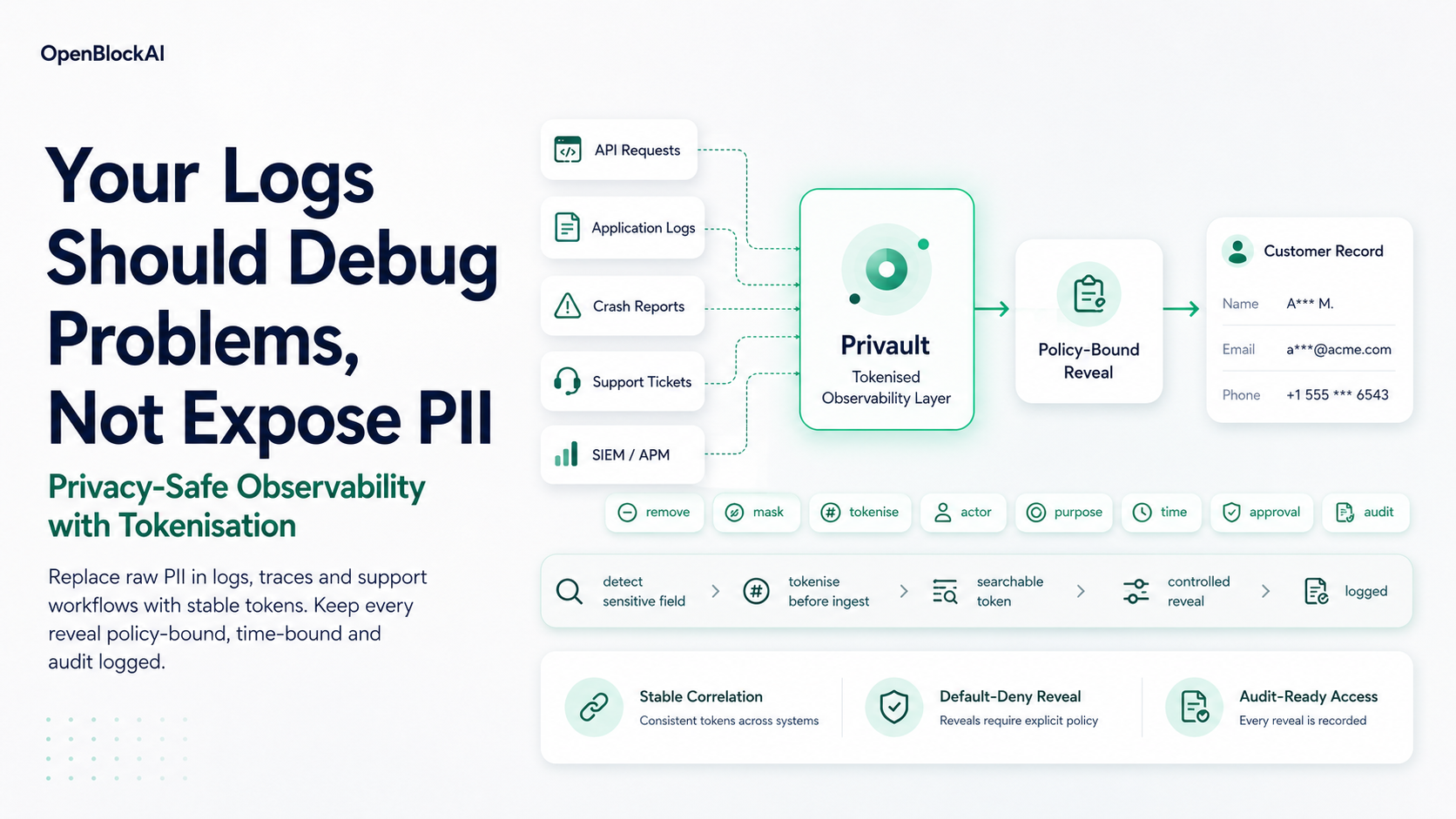
Application logs, API traces, crash reports, support tickets and observability dashboards often become hidden stores of raw PII, PHI and PCI data. This blog explains why logs should help investigate incidents without becoming another customer database — and how Privault helps enterprises use tokenisation, masking, policy-bound detokenisation and audit-ready reveal controls to reduce sensitive-data exposure across engineering, security, support and vendor workflows.
Overview
Most engineering teams know they should not put passwords, card numbers or authentication secrets into logs.
The harder problem is everything that does not look like a secret at first.
A customer phone number inside an API error.
A patient identifier in a failed integration message.
An account number inside a webhook payload.
A delivery address copied into a support ticket.
A complete JSON request stored because the production issue was difficult to reproduce.
Each decision feels operationally reasonable.
Together, they can turn logs, traces, dashboards and support tools into a shadow personal-data estate.
The risk is not that logging is unnecessary.
Logs are essential. They help teams investigate fraud, detect abuse, prove what happened, restore services and understand failures.
The risk is that raw identity becomes the default unit of observability.
For organisations working across DPDP, GDPR, HIPAA, PDPL, PCI security expectations, cybersecurity controls and third-party risk management, this is no longer only an engineering issue.
It is a privacy architecture issue.
Privault by OpenBlockAI helps reduce this exposure by replacing raw PII, PHI and PCI fields with usable tokens while keeping sensitive values inside a protected vault.
Where does PII enter the logging stack?
Personal data can enter operational systems through more paths than most data inventories capture.
- HTTP request and response bodies.
- URL query parameters.
- Request headers and authentication metadata.
- Database exception messages.
- Mobile crash reports.
- Webhook payloads.
- Session-replay tools.
- Customer-support tickets.
- Screenshots and screen recordings.
- Fraud-investigation notes.
- API gateway traces.
- Message queues and dead-letter queues.
- Monitoring alerts sent into email or collaboration tools.
- AI incident assistants that summarise logs.
The primary database may have strong encryption and tightly controlled access.
The same customer record can still be copied into a logging platform that engineers, contractors, support teams or vendor-support personnel can search.
This creates a basic governance contradiction.
The most sensitive system is protected, while its operational exhaust becomes widely visible.
This is especially relevant for BFSI, fintech, healthcare, SaaS, telecom, e-commerce and travel platforms where applications generate high-volume operational logs across payment flows, KYC journeys, patient workflows, fraud dashboards, support tickets and third-party observability systems.
Before treating logs as low-risk technical data, teams should ask a simple question: does our logging stack now hold the same personal data we worked hard to protect in production?
Why is redaction or masking not always enough?
Teams often start with redaction.
Redaction removes or replaces sensitive values before they are stored. It is useful when the value has no legitimate analytical purpose.
For example, a full card number, password, access token or identity-document image should not be available in routine logs. These values can often be removed entirely.
The limitation is that complete redaction may destroy correlation.
If every phone number becomes [REDACTED], investigators may not know whether ten failed events affected one customer or ten different customers.
Masking has a similar trade-off.
Showing only the last four digits may help a support agent recognise an account, but it may not provide a reliable unique join across systems.
Encryption protects stored data, but anyone or any service with normal decryption access may still see the raw value. It also does not automatically reduce how many systems possess the original data.
This is where tokenisation creates a different operating model.
Instead of logging raw values such as a phone number, account number, patient identifier or customer email, an application can log a stable token.
The token can remain consistent where correlation is needed. Engineering, fraud, DevSecOps and incident-response teams can search for the token, join related events and reconstruct a timeline without seeing the customer’s actual identity.
The original value remains inside a protected privacy vault.
Revealing it becomes a separate, governed action.
Where teams need to reduce raw sensitive-data exposure beyond logs, they can also evaluate Privault for tokenised PII, PHI and PCI protection.
How does Privault enable privacy-safe observability?
Privault by OpenBlockAI is designed as a tokenised PII, PHI and PCI data vault.
It helps enterprises reduce the spread of raw sensitive data across applications, logs, observability tools, support systems, AI workflows, vendors and third-party platforms.
In a token-first logging architecture, raw sensitive fields are replaced before they cross the observability boundary.
For example:
- A customer phone number becomes a stable customer token.
- An account number becomes a searchable account reference token.
- A patient identifier becomes a protected PHI token.
- A payment-related value becomes a PCI-safe token reference.
- A support case can preserve event continuity without exposing the full customer identity.
This allows teams to retain operational value without giving broad internal or vendor access to raw personal data.
A practical token-first logging model should include:
- Sensitive-field classification: identify fields that may contain PII, PHI, PCI or confidential identifiers.
- Field-level decisioning: decide whether each value should be removed, masked or tokenised.
- Upstream protection: tokenise before data reaches log collectors, APM tools, SIEM platforms, support tools or analytics pipelines.
- Stable correlation: preserve consistent tokens where teams need to connect events across systems.
- Default deny for reveal: most engineers should not need to detokenise data for routine debugging.
- Policy-bound detokenisation: require purpose, role, approval, geography, scope and time limits when reveal is necessary.
- Audit-ready reveal logs: record who revealed what, why, through which application and when access expired.
The goal is not zero observability.
The goal is useful observability without unnecessary raw identity exposure.
Privault helps make raw identity exceptional, controlled and auditable.
Make Logs Privacy-Safe
Your logs should tell you what happened.
They should not quietly become another customer database.
Privacy-safe observability does not mean telling engineers to stop logging.
It means asking how much raw personal data observability actually requires.
In many cases, teams need correlation, sequence and context — not the person’s real identity.
A practical privacy-safe logging checklist should ask:
- Do production logs contain names, phone numbers, email addresses, addresses, account numbers or patient identifiers?
- Are full API requests or responses stored by default?
- Which logging, APM, SIEM, support and session-replay vendors receive this data?
- Can contractors and vendor-support teams search the same fields?
- Are log-retention periods aligned to a documented purpose?
- Can sensitive fields be removed before ingestion?
- Which fields need stable correlation rather than raw visibility?
- Is detokenisation purpose-bound, time-bound and auditable?
- Can AI tools access logs or tickets containing personal data?
- Can the organisation prove who revealed a customer’s identity and why?
For banks, fintechs, healthcare platforms, SaaS companies, telecom operators and consumer platforms, this is both a cybersecurity and privacy-governance issue.
Raw PII in logs increases breach impact, complicates third-party risk, weakens data minimisation and makes incident response harder to evidence.
Privault helps organisations replace raw PII, PHI and PCI data with usable tokens, keep sensitive values inside a protected vault and govern every reveal through role, purpose, policy and audit controls.
Explore Privault for privacy-safe tokenisation across applications, logs and observability workflows.
Speak with OpenBlockAI about reducing raw PII exposure across your operational stack.