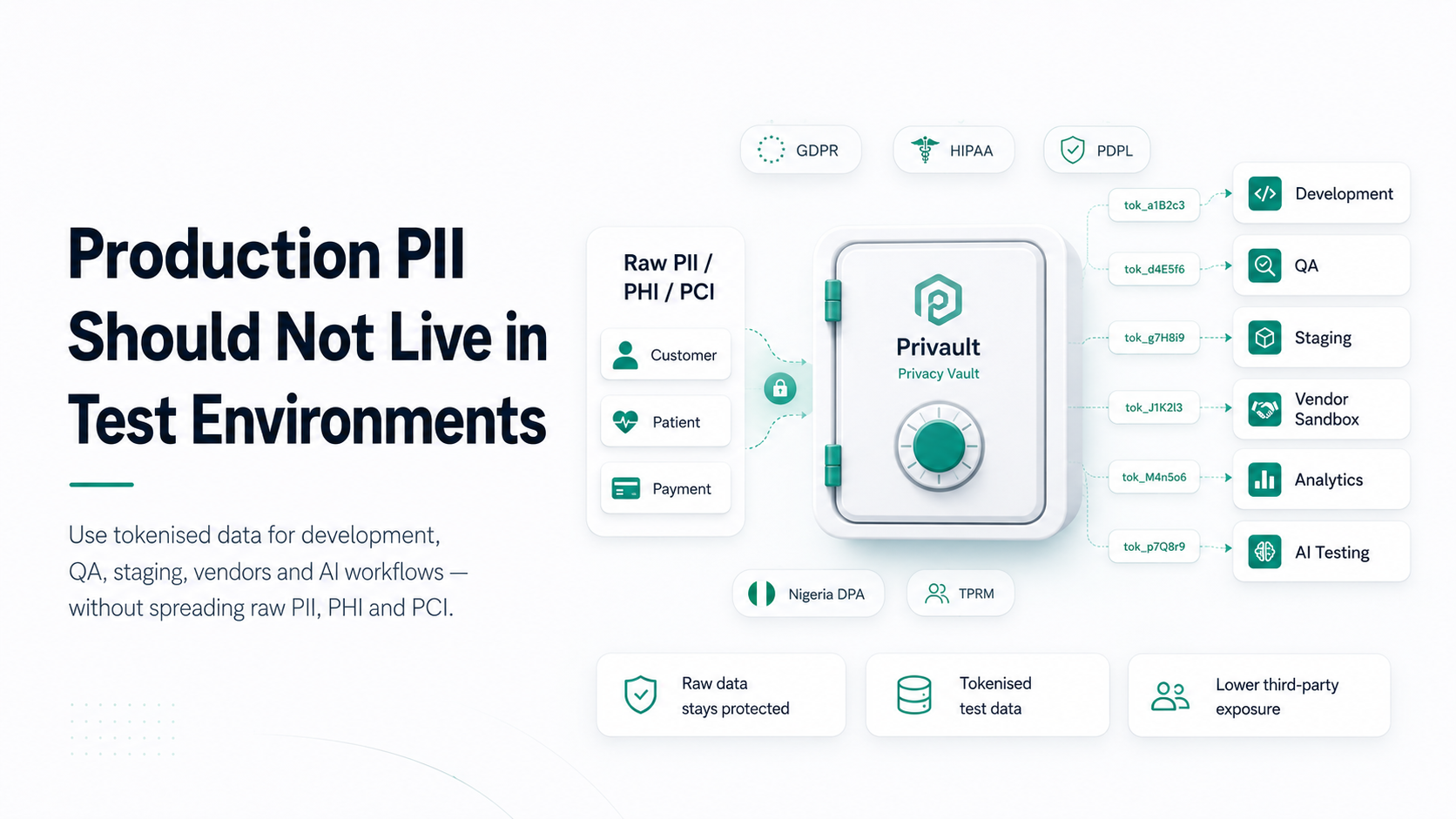
Production systems are usually protected, but the same customer, patient or payment data often gets copied into development, QA, staging, analytics sandboxes, vendor environments and AI testing workflows. This blog explains why non-production PII exposure is a cybersecurity and TPRM risk under GDPR, HIPAA, PDPL and the Nigeria Data Protection Act — and how Privault helps enterprises use realistic test data without spreading raw PII, PHI and PCI.
Overview
Production is usually the most protected environment in an enterprise.
Access is restricted. Changes are reviewed. Activity is monitored. Administrators are limited. Security teams know it matters.
Then the same customer database is copied into staging.
A snapshot is shared with QA. A CSV is attached to a support ticket. A developer downloads records to reproduce a bug. A vendor receives a database export. An analytics team opens the data in a notebook. An AI coding or testing tool sees values copied into prompts, logs or test cases.
This is how a well-protected production system quietly becomes dozens of less-protected PII environments.
The privacy and cybersecurity risk is not only where the original database lives.
It is everywhere the data is copied next.
For global enterprises, this is no longer only a software testing problem. It is a GDPR, HIPAA, PDPL, Nigeria Data Protection Act, cybersecurity and TPRM problem.
If raw PII, PHI or PCI data is copied into development, QA, staging, analytics sandboxes, vendor environments or AI experimentation workflows, the organisation has expanded its sensitive-data attack surface.
Privault by OpenBlockAI is designed to reduce that exposure by keeping sensitive values inside a protected privacy vault and allowing applications, test environments and downstream workflows to use tokenized references instead of raw identity data.
Why is non-production PII a cybersecurity risk?
Engineering teams do not copy production data because they want unnecessary access to personal information.
They do it because real applications are complicated.
- A lending workflow may depend on hundreds of field combinations.
- A payment system must preserve account relationships and transaction history.
- A hospital platform must reproduce a patient journey across appointment, diagnostic, insurance and pharmacy systems.
- A telecom application must test scale, uniqueness, billing and device relationships.
- A SaaS platform may need production-shaped data to reproduce a customer-specific bug.
Simple fake records often fail to reproduce the problem.
So teams take the fastest route: clone production, mask a few obvious fields and continue testing.
The issue is that personal data is rarely limited to a name and email address.
It may exist inside free-text notes, logs, PDFs, JSON payloads, screenshots, document attachments, support conversations, API traces, analytics events and linked identifiers.
Non-production environments are also usually more open than production.
- More developers may have access.
- Contractors may receive temporary credentials.
- QA vendors may need to reproduce workflows.
- Support teams may access diagnostic exports.
- Data scientists may receive extracts.
- Demo teams may use realistic records.
- AI tools may process copied code, logs or test cases.
This creates a basic contradiction.
The organisation restricts access to production PII, then creates lower-control copies of the same data across development, QA, staging, vendor sandboxes and analytics workflows.
From a cybersecurity perspective, every copied dataset becomes another breach surface.
From a TPRM perspective, every vendor sandbox or outsourced QA environment becomes another third-party exposure point.
From a privacy perspective, every unnecessary raw-data copy becomes harder to justify, govern, delete and audit.
Why does this matter for GDPR, HIPAA, PDPL and Nigeria Data Protection Act readiness?
Different jurisdictions use different legal language, but the operational expectation is moving in the same direction: organisations should know where personal data exists, why it is processed, who can access it, how it is protected and whether the exposure is necessary.
Under GDPR, non-production PII exposure directly connects to data minimisation, purpose limitation, storage limitation and integrity and confidentiality. If a test environment contains raw personal data without a clear need, the organisation may be increasing risk beyond what is necessary for the testing purpose.
Under HIPAA, healthcare organisations and business associates must protect electronic protected health information. If PHI is copied into QA, staging, analytics notebooks, vendor test systems or AI testing workflows, the organisation needs strong safeguards, access controls and evidence that the exposure is necessary and protected.
Under Saudi Arabia’s PDPL, organisations need stronger visibility into personal data processing, disclosure, transfer, retention and controller obligations. Non-production copies can create hidden processing locations that privacy and security teams may not have mapped.
Under the Nigeria Data Protection Act, accountable processing requires organisations handling personal data to understand their processing activities, protect data and manage controller and processor responsibilities. Test and vendor environments cannot be ignored simply because they are not customer-facing.
This is also a serious third-party risk management issue.
Many non-production datasets are shared with implementation partners, QA vendors, cloud service providers, outsourced support teams, analytics contractors and AI tooling providers.
A vendor may not need the real customer, patient or cardholder identity to complete the task.
They may only need a stable, realistic, format-compatible reference.
That is where tokenization becomes a practical cybersecurity and privacy-engineering control.
How does Privault reduce test data and third-party risk?
Privault by OpenBlockAI is a tokenized PII, PHI and PCI privacy vault.
It helps enterprises reduce the spread of raw sensitive data across production-adjacent systems, non-production environments, vendors, AI tools and analytics workflows.
Instead of copying raw values into every environment, Privault enables applications and test systems to work with tokenized references.
The real value stays inside a protected vault.
The application receives a token that can preserve the format, uniqueness and relationship needed for testing.
For example:
- A real customer identifier can be replaced with a stable token.
- A phone number can be represented in a format-compatible way without exposing the actual subscriber.
- A patient identifier can remain linked across test workflows without revealing the patient.
- A payment reference can preserve application behaviour without exposing PCI-related values.
- A borrower or policyholder record can remain consistent across CRM, loan, claims and support systems without exposing raw identity everywhere.
The test environment operates on tokens rather than raw PII.
Detokenization should be denied by default in development, QA, staging and vendor sandboxes.
If an exceptional support or investigation workflow truly requires reveal, access should be governed by identity, service, purpose, environment, approval and audit logging.
This helps enterprises build a smaller raw-data trust boundary.
Privault supports privacy-first architecture by helping organisations:
- Store sensitive PII, PHI and PCI values inside a protected vault.
- Return application-compatible tokens instead of raw values.
- Reduce copied PII across development, QA, staging and analytics environments.
- Limit vendor and contractor exposure to raw customer or patient identity.
- Apply policy-bound access to detokenization.
- Restrict reveal by user, service, purpose and environment.
- Maintain audit-ready reveal logs.
- Support cybersecurity and TPRM evidence for sensitive-data handling.
The goal is not to stop engineering, QA, analytics or vendors from doing their work.
The goal is to give them the realism required for testing without giving every environment the identity behind the record.
Realistic testing is necessary.
Raw identity exposure is not.
Book Demo
Production PII should not become the default fuel for software testing, vendor support, analytics sandboxes or AI experimentation.
Synthetic data should be used where it can meet the requirement. Masking should be used where irreversible transformation is appropriate. Tokenization should be used where teams need production-like structure, stable relationships and application compatibility without broad access to the underlying person.
Privault helps global enterprises shrink the number of systems, users and vendors that can see raw PII, PHI and PCI.
This is especially relevant for organisations working across GDPR, HIPAA, PDPL, Nigeria Data Protection Act, cybersecurity controls and TPRM programmes.
Explore Privault for tokenized PII, PHI and PCI protection.
Book a privacy architecture discussion with OpenBlockAI.
If your development, QA, staging or vendor environments still contain production PII, this is the right place to start.