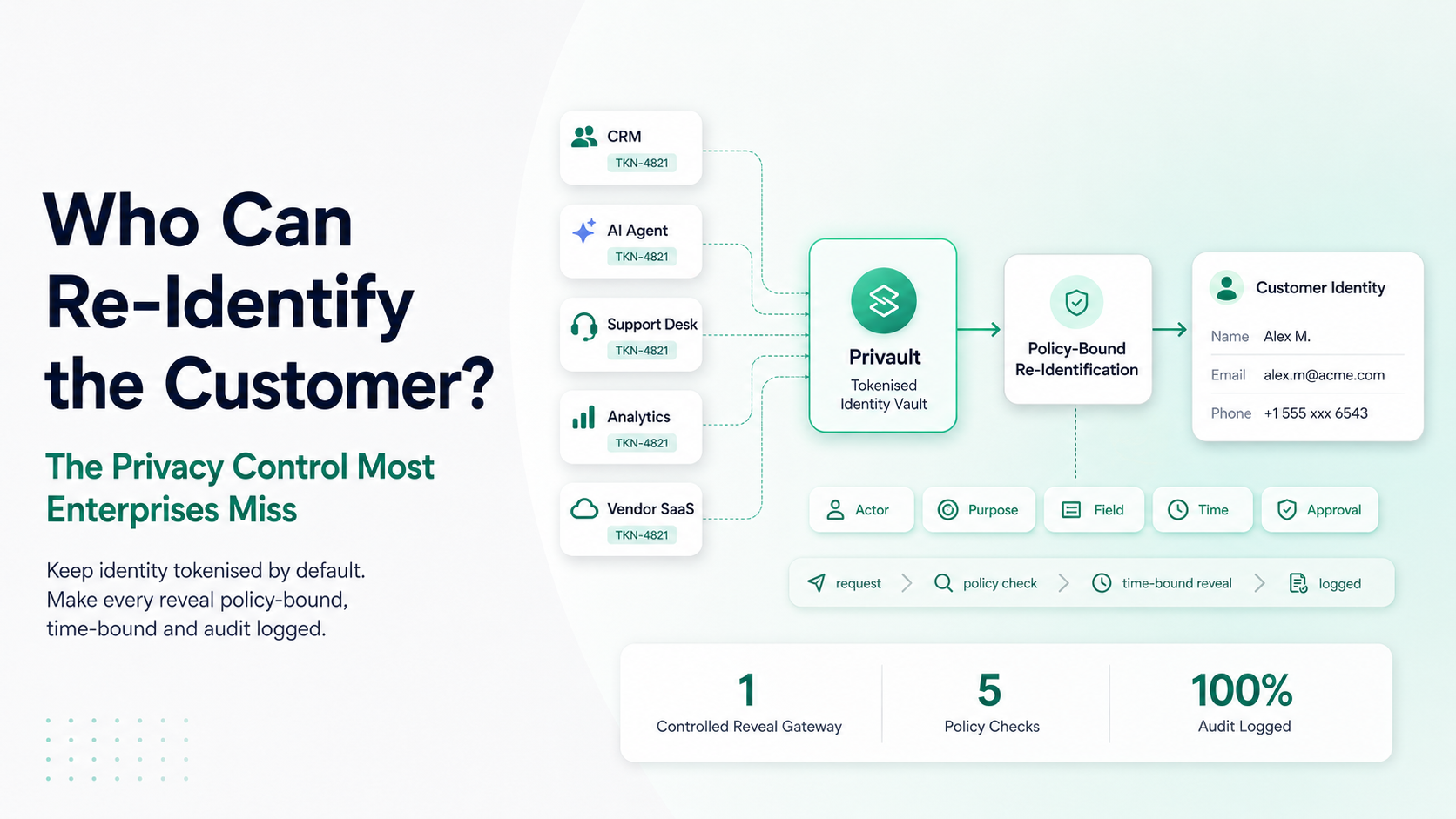
For UK and US enterprises, privacy risk is no longer only about who can access a database. Under GDPR, HIPAA, NHS data-security expectations and PCI-driven security controls, organisations need to know who can re-identify a customer, patient or user from a token, ID or reference.
Overview
Most enterprises can tell you who has access to a database.
Far fewer can answer a more important question.
Who can turn a customer reference, patient ID, token or account record back into a real person?
That question matters because identity data no longer stays inside one core system.
A CRM may show a customer’s name, phone number and email address.
A support platform may show the same identity.
An analytics pipeline may carry customer identifiers.
A healthcare workflow may process patient records and PHI.
A billing system may hold payment-related PCI data.
A vendor may download a reconciliation file.
An AI agent may inherit access through a service account.
An OAuth-connected SaaS tool may quietly receive data that was never necessary for its task.
The problem is not only that sensitive data exists.
The problem is that real identity is available in too many places, to too many actors, for too many loosely defined reasons.
For UK and US organisations, this question directly connects to GDPR data minimisation, HIPAA safeguards for PHI, NHS data-security expectations and PCI-related controls around sensitive payment data.
A privacy vault is not only about storing sensitive data securely.
It is about reducing how often raw PII, PHI and PCI data appears across CRMs, support tools, AI agents, SaaS platforms, vendors and analytics systems.
This is the privacy control many enterprises miss.
Why is re-identification the real privacy question?
Access to data and access to identity are not the same thing.
A system may need to recognise that two records belong to the same customer, patient or user without needing to know the person’s full identity.
A support workflow may need account context, but not full government identifiers.
An analytics system may need linkage, but not names or phone numbers.
A healthcare platform may need continuity of patient care, but not every workflow needs unrestricted PHI visibility.
A payment workflow may need transaction matching, but not broad PCI exposure.
A fraud model may need a stable customer reference, but not unrestricted raw PII.
A vendor may need to reconcile transactions, but not receive the complete customer profile.
The stronger privacy question is not only: who can open the system?
It is: who can reveal the real person behind the record?
When re-identification is uncontrolled, raw identity spreads across teams, tools, vendors, AI workflows and exports.
That creates a bigger exposure surface and makes audit evidence harder to defend.
For GDPR, this weakens data minimisation and privacy-by-design practices.
For HIPAA, it increases the exposure of protected health information across unnecessary systems and users.
For NHS-linked workflows, it creates avoidable patient data visibility across operational and vendor environments.
For PCI-related workflows, it increases the number of places where sensitive payment context may appear.
Why is role-based access control not enough?
Role-based access control is important, but it does not always answer whether raw identity needed to be present in the first place.
Finance may see finance data.
Support may see support data.
Developers may see production logs.
Healthcare operations may see appointment or diagnostic information.
Vendors may receive files for operational work.
AI services may inherit permissions from applications or service accounts.
But many of these workflows do not need full identity all the time.
The issue is that traditional access models often focus on system access, not purpose-bound identity reveal.
A user may have permission to open a tool, but that should not automatically mean they can see every sensitive field.
A service account may run a workflow, but that should not automatically mean it can reveal customer or patient identity.
A vendor may support operations, but that should not automatically mean they should hold raw PII permanently.
An AI agent may need context, but that should not automatically mean it can read full identity, PHI or payment-related data.
This is why enterprises need identity minimisation, not only access control.
How does PII tokenization support GDPR, HIPAA and NHS readiness?
PII tokenization replaces a sensitive value with a surrogate token.
Instead of spreading raw identity across every application, systems can work with a reference that has no useful meaning on its own.
The real identity stays inside a protected privacy vault.
Applications use tokens for workflow continuity.
Only approved actors, systems or services can request re-identification when a legitimate purpose requires it.
The important point is not just that a token exists.
The important point is how the organisation governs the path back to identity.
Detokenisation should be treated as a privileged event.
Who is requesting the reveal?
Which system is involved?
What purpose justifies the request?
Which field is actually needed?
Is the data PII, PHI or PCI-related?
Should the result be masked or partially revealed?
How long should access last?
Was the action logged for later review?
This turns re-identification from a hidden technical function into a governed privacy control.
For GDPR-focused teams, tokenization can support data minimisation and privacy-by-design by reducing unnecessary raw personal data exposure.
For HIPAA-focused teams, tokenization can help limit PHI visibility across systems, vendors and workflows when combined with strong safeguards and audit trails.
For NHS-linked organisations, a privacy vault can support cleaner information governance by helping teams separate patient record continuity from unrestricted patient identity exposure.
For PCI-related environments, tokenization can help reduce the footprint of sensitive payment data across business applications.
Where does this risk appear across industries?
In healthcare, healthtech and NHS-linked environments, patient journeys may span appointments, diagnostics, insurance, pharmacies, labs, virtual care, support teams and vendor platforms.
Many processes need record continuity, but not every actor needs unrestricted patient identity or PHI visibility.
A token-first privacy vault helps healthcare teams preserve operational workflows while keeping patient re-identification controlled and auditable.
In US healthcare, HIPAA-driven workflows require careful handling of PHI across covered entities, business associates, SaaS tools and AI-enabled operations.
In UK healthcare, NHS-linked data environments need strong data-security and information-governance evidence across systems and suppliers.
In BFSI, fintech and insurance, the same customer may move across onboarding, KYC, underwriting, fraud, claims, collections, support and partner systems.
That does not mean every system needs the customer’s complete raw identity.
Tokens can preserve linkage while controlled re-identification is reserved for approved workflows.
In SaaS and technology platforms, support tools, analytics systems, AI copilots, guest accounts and OAuth applications can receive more customer data than necessary.
A token-first architecture helps preserve workflow context while reducing raw PII exposure.
In e-commerce and marketplaces, sellers, delivery partners, fraud teams and support agents may all touch the same buyer journey.
The business should ask whether every participant truly needs the real phone number, address or email, or whether tokenized references and controlled reveal can support the workflow.
In telecom and consumer internet, subscriber identity exists at massive scale.
At that scale, even a small re-identification gap can become a large governance issue.
How does Privault make identity reveal governed?
Privault by OpenBlockAI is designed as privacy-first infrastructure for tokenized PII, PHI and PCI data.
It helps enterprises reduce raw sensitive-data exposure across applications, teams, vendors and AI workflows.
With Privault, sensitive identity can remain concentrated inside a protected vault while business systems use tokens wherever possible.
Re-identification becomes policy-bound.
A support workflow may reveal only the last four digits of a phone number.
A healthcare workflow may reveal patient identity only for an approved care, billing or operational purpose.
A regulated KYC process may receive a full field for a defined purpose.
An analytics job may never be allowed to re-identify.
A vendor request may require additional approval.
An AI agent may be limited to tokenized context.
A break-glass event may be time-bound and heavily logged.
The goal is not to make data unusable.
The goal is to make raw identity exceptional.
Enterprises are adding more applications, more integrations, more AI agents and more external collaborators.
That makes broad raw PII, PHI and PCI access harder to govern through database permissions alone.
A token-first architecture changes the default.
Systems use references.
Identity stays protected.
Re-identification becomes deliberate.
Policy decides who can reveal what.
Audit evidence records the event.
For UK and US enterprises preparing for GDPR, HIPAA, NHS data-security expectations or PCI-driven controls, this creates a stronger foundation for privacy engineering and sensitive-data governance.
The privacy control most enterprises miss is not simply who can access data.
It is who can turn data back into a person.
Explore Privault for tokenized PII, PHI and PCI protection: https://www.openblockai.com/privault-tokenized-pii-data-vault
Talk to OpenBlockAI about a token-first sensitive-data architecture: https://www.openblockai.com/contact