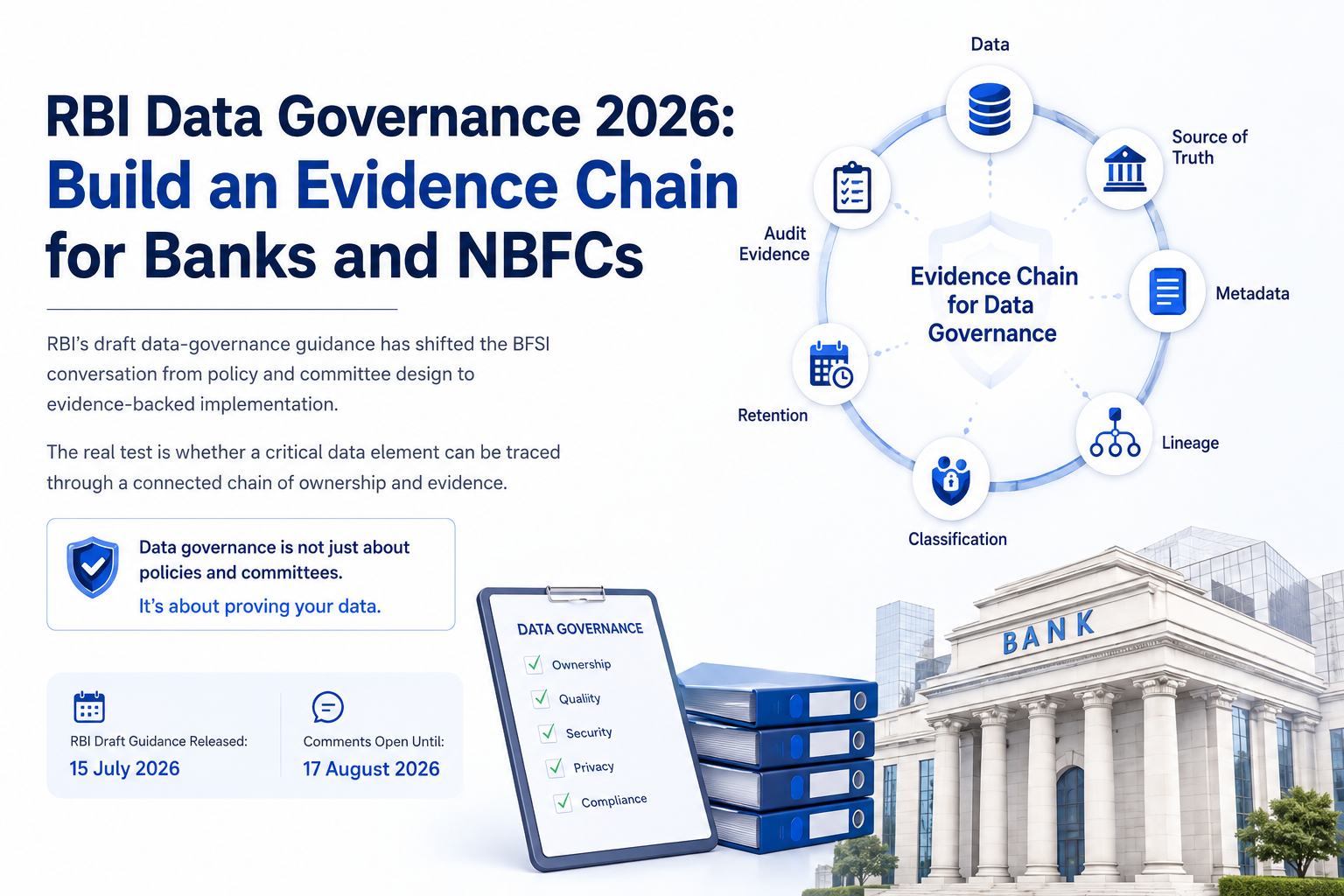
RBI’s draft data-governance guidance has shifted the BFSI conversation from policy and committee design to evidence-backed implementation. Banks, NBFCs and other regulated entities now need to connect data ownership, source of truth, metadata, lineage, classification, vendor sharing, retention and audit evidence. This blog explains why data governance starts with an evidence chain — and how Discovery Studio helps regulated entities build a readiness baseline before automation.
Overview
The Reserve Bank of India’s draft Guidance on Regulatory Expectations for Data Governance has placed a clear implementation question in front of banks, NBFCs and other regulated entities:
Can the institution prove how an important data element moves from source to decision?
The draft, released on 15 July 2026 for public comments until 17 August 2026, has pushed the BFSI conversation beyond policy wording and maturity presentations.
For many institutions, the first response will be familiar.
A policy will be reviewed. A committee structure will be proposed. Data owners will be nominated. A maturity assessment will be commissioned. A technology platform may be evaluated.
All of that can be useful.
But none of it, by itself, proves that the institution understands its data.
The real test is whether a critical number, customer attribute, risk indicator, regulatory field or personal-data element can be traced through a connected chain of ownership and evidence.
Data → Source of Truth → Metadata → Lineage → Classification → Vendor Sharing → Retention → Audit Evidence
That chain is where data governance becomes operational.
Why does RBI data governance need an evidence chain?
A data-governance framework usually explains principles, committees, roles, standards, escalation paths and control requirements.
An evidence chain connects those expectations to the institution’s real environment.
Take a customer-income field used in a lending decision.
A defensible governance record should help answer:
- Where was the income value collected?
- Was it customer-declared, document-derived, account-aggregator sourced or calculated?
- Which system is the authoritative source?
- What business definition applies?
- Who owns the data domain?
- Which technology team acts as custodian?
- What validations or transformations occur?
- Which underwriting, reporting, fraud or analytics systems consume it?
- Is it shared with a bureau, service provider, group entity or model vendor?
- How is it classified?
- How long is it retained?
- What evidence demonstrates each answer?
- What happens when the value is corrected?
If these answers sit across separate spreadsheets, architecture diagrams, contracts, tickets and employee knowledge, the institution may have documentation but not a reliable governance baseline.
This is why regulated entities need a connected data-governance readiness baseline before treating the framework as implemented.
A policy defines expectations.
An evidence chain proves implementation.
Where do banks and NBFCs usually break the chain?
Most banks and NBFCs are not starting from zero.
They already have data dictionaries, system inventories, regulatory-report mappings, vendor lists, security classifications, access-control matrices, retention schedules, privacy records and issue-management processes.
The difficulty is that these artefacts were created for different purposes by different functions.
Finance may define a field according to reporting use. Technology may define it according to a database column. Business may use a product-specific meaning. Risk may calculate a derived version. A vendor may receive the field under a different label. Privacy may classify it based on personal-data impact. Records management may apply a retention schedule at the application level rather than the field or purpose level.
Each view can be locally correct and still create enterprise inconsistency.
The chain usually breaks in seven areas.
1. Source of truth is treated as only a system name.
Institutions often say “core banking is the source” or “CRM is the source.” But a customer address may originate in onboarding, be verified through a document, corrected in a branch, replicated into the core system, cached in a service layer and exported to a collection partner.
2. Metadata stays technical and disconnected from business purpose.
A table name or column name is not enough. Governed metadata must connect business definition, technical field, owner, source, classification, purpose, quality rule, lineage path and evidence.
3. Lineage covers pipelines but misses business decisions.
Automated lineage may show database movement, but banks also rely on spreadsheets, maker-checker workflows, overrides, vendor calculations, offline reconciliations and report-specific mappings.
4. Classification does not change controls.
A field marked sensitive should influence access, export restrictions, logging, test-data use, vendor sharing, encryption, retention and incident response. If it does not change behaviour, classification remains descriptive rather than operational.
5. Vendor governance stops at the register.
A vendor register may list the service provider, contract owner and risk rating. It may not show exact fields shared, transfer route, sub-processors, access roles, derived data, return requirements or deletion evidence.
6. Data-quality issues lack ownership and closure evidence.
A data-quality dashboard may show completeness or reconciliation errors. Governance needs to know which critical element failed, who owns remediation, what process is affected and what evidence confirms closure.
7. Board reporting shows maturity without traceability.
A maturity score without evidence can create false comfort. Board-level oversight needs traceable assurance, not only more dashboards.
How does Discovery Studio support RBI data governance readiness?
Discovery Studio by OpenBlockAI is designed for the stage before fragmented knowledge becomes an operational governance programme.
It helps regulated entities gather cross-functional inputs, map systems and data flows, define ownership, connect vendors and retention, capture evidence, expose contradictions and create a structured readiness baseline.
For RBI-regulated entities, Discovery Studio can support:
- Identification of critical and personal data domains.
- Assignment of accountable owners and custodians.
- Mapping of source systems and downstream use.
- Capture of metadata definitions and business meaning.
- Documentation of lineage and transformation points.
- Connection of third-party sharing to actual data fields.
- Assessment of retention, quality and evidence gaps.
- Structured ownership and remediation actions.
- Evidence-room preparation for management and audit review.
- Implementation-ready baseline before deploying larger governance tooling.
The point is not to replace an enterprise data catalogue or automated lineage platform.
The point is to make those investments implementation-ready and regulator-defensible.
Discovery Studio helps the institution know what it needs to govern, what it can already prove and what must be fixed before automation scales the programme.
For banks, NBFCs, co-operative banks, credit information companies and fintech vendors supporting regulated entities, this kind of evidence-backed readiness baseline can reduce duplicated discovery across data governance, DPDP readiness, vendor governance, retention, privacy, security and audit programmes.
Build a Regulator-Ready Evidence Baseline
Regulated entities do not need to wait for final guidance to improve visibility.
A practical 60-day preparation approach can start with priority data domains and critical data elements rather than trying to catalogue every field at once.
Days 1–10: Define scope and governance.
Identify applicable entities, priority domains, critical data elements, executive sponsorship, working-team roles, evidence standards and decision rights.
Days 11–25: Collect and reconcile existing artefacts.
Bring together policies, glossaries, system inventories, data-flow diagrams, regulatory mappings, vendor records, quality reports, privacy records, retention schedules and prior audit findings.
Days 26–40: Validate with business and technology.
Confirm definitions, owners, source systems, transformations, downstream use, third-party sharing, classification, retention and known exceptions. Record contradictions instead of hiding them.
Days 41–50: Score evidence and identify gaps.
Separate verified facts from assumptions. Flag missing lineage, unclear ownership, stale metadata, unvalidated vendor flows, unresolved quality issues and absent closure evidence.
Days 51–60: Create the implementation backlog.
Prioritise remediation by regulatory, customer, financial, operational and privacy impact. Define which gaps need policy changes, ownership decisions, process redesign, technical controls, vendor action or platform automation.
The RBI draft has elevated the data-governance conversation across Indian financial services.
The next step is not simply to write a framework.
It is to build a connected, evidence-backed understanding of the institution’s data.
Data → Source of Truth → Metadata → Lineage → Classification → Vendor Sharing → Retention → Audit Evidence
When one link is missing, governance becomes harder to defend.
When the chain is visible, ownership becomes clearer, remediation becomes measurable and Board assurance becomes more credible.
Explore Discovery Studio to build an evidence-backed data-governance readiness baseline.