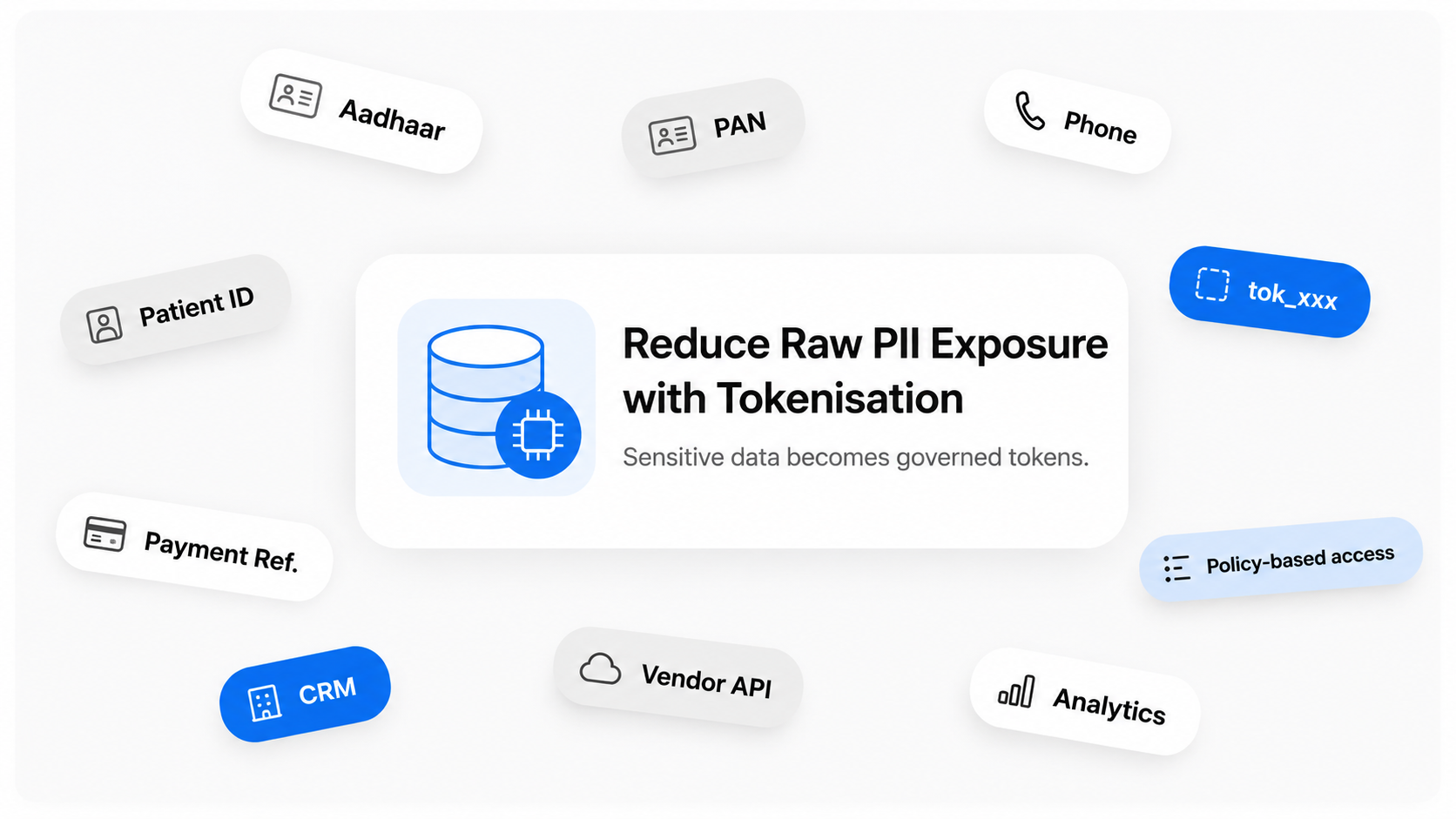
Every enterprise says it protects customer data. But look closely at how data actually moves inside the business. One customer record becomes ten copies of raw PII across CRMs, support tools, vendor workflows, analytics platforms and partner APIs. This article explains why that is your biggest privacy risk under DPDP — and how tokenisation through Privault helps you fix it.
Overview
Every enterprise says it protects customer data.
But look closely at how data actually moves inside the business.
A customer submits a form.
That data enters the website backend.
Then it moves to a CRM.
Then to a support tool.
Then to a marketing system.
Then to a vendor spreadsheet.
Then to a partner API.
Then to an analytics dashboard.
Then to a data warehouse.
Then to an internal operations sheet.
In a few weeks, one customer record has become ten copies of raw personal data.
That is where the real privacy risk begins.
The problem is not only data collection
Most privacy conversations focus on collection.
Did we collect the right consent?
Did we show the notice?
Did we explain the purpose?
Did we store the consent record?
These questions matter.
But the bigger operational question is what happens after collection.
Where does the data go?
Who can see it?
Which vendor receives it?
Which system stores a copy?
Which field is actually needed?
Which team can reveal it?
Can access be revoked instantly?
Can we prove every reveal later?
Under DPDP and modern privacy expectations, organisations need to reduce unnecessary exposure of personal data, not only document that the data was collected properly.
Raw PII sprawl is the hidden enterprise problem
Raw personal data spreads because business systems are designed for convenience.
Sales teams want full contact details in CRM.
Support teams want phone numbers and emails in tickets.
Finance teams want payment references.
Operations teams want identity fields in spreadsheets.
Vendors want customer data for fulfilment, claims, onboarding, verification or servicing.
Analytics teams want identifiers for reporting.
Each request may feel reasonable in isolation.
But together, they create uncontrolled copies of sensitive data.
For BFSI and fintech, this may include Aadhaar, PAN, bank account numbers, KYC documents, device IDs, repayment details, bureau data and transaction metadata.
For healthcare, this may include patient IDs, diagnostic reports, prescriptions, insurance claims, TPA records, lab reports and health histories.
For SaaS and digital platforms, this may include customer profiles, employee records, billing details, support conversations, product usage data and integration logs.
The issue is simple
If raw PII lives everywhere, privacy control lives nowhere.
Why traditional controls are not enough
Many organisations assume encryption, masking and role-based access control solve the problem.
They help, but they do not fully solve raw data sprawl.
Encryption protects data when stored or transmitted, but the data is often decrypted inside applications where employees, vendors or systems can still access it.
Masking hides some fields, but it may not support controlled reveal, purpose-based access or detailed audit proof.
Role-based access control limits users, but it often does not control access by purpose, partner, geography, field sensitivity or time.
Spreadsheets, exports, APIs and vendor workflows can still create copies outside the main security perimeter.
This is why privacy engineering needs a stronger model.
Instead of asking every system to store raw PII safely, ask a better question
Why should every system store raw PII at all?
The tokenisation model
Tokenisation replaces sensitive data with a governed token reference.
The raw value stays protected inside a secure vault.
Downstream systems use the token instead of the original value.
When a user, system or partner genuinely needs to reveal the original value, access is checked against policy.
That policy can consider role, purpose, department, partner, geography, time and business context.
This changes the privacy model.
The CRM does not need to store the raw PAN.
The vendor does not need the real account number.
The support tool does not need the complete health record.
The analytics system does not need direct identifiers.
The partner API does not need permanent access to raw customer details.
They can operate on governed tokens.
Raw data is revealed only when policy allows.
Why this matters for DPDP readiness
DPDP pushes organisations toward purpose limitation, data minimisation, security safeguards, consent control, breach accountability and evidence readiness.
Tokenisation supports these goals because it reduces how far sensitive data travels.
If a downstream tool is breached, tokenised records are less useful than raw personal data.
If a vendor no longer needs access, token reveal can be revoked without rebuilding every integration.
If an auditor asks who accessed a field, the organisation can show a traceable reveal history.
If a business purpose changes, access policies can be adjusted centrally.
If sensitive data is no longer needed in a workflow, the workflow can continue using token references.
This is how privacy moves from policy to architecture.
Where Privault fits
Privault is OpenBlockAI's tokenised PII, PHI and PCI data vault for regulated enterprises.
It is designed to remove exposed raw personal data from downstream systems and replace it with governed tokens.
With Privault, enterprises can
Tokenise sensitive fields at the point of collection.
Keep raw PII, PHI and PCI inside a controlled vault.
Let CRMs, apps, vendors, processors and analytics tools operate on token references.
Control every reveal by role, purpose, department, partner, geography and time.
Maintain an audit-ready record of who accessed what, which field was revealed, why it was revealed and for how long.
Reduce vendor and processor exposure by sharing governed references instead of raw personal data.
Revoke access instantly when a partner, department, actor or API key becomes risky.
Support field-level tokenisation using random, deterministic or format-preserving tokens.
The goal is not to slow the business down.
The goal is to let business systems work without spreading raw sensitive data everywhere.
Industry examples
Banking and NBFCs
A lender may need to process KYC documents, bank account numbers, PAN, Aadhaar, repayment data, bureau data and collection records.
But DSAs, recovery partners, CRM users, support agents and analytics systems do not always need direct raw access to every field.
Privault can allow the workflow to continue using governed tokens while reveal rights remain policy-bound and auditable.
Fintech and payments
Payment platforms, wallets and lending apps often connect with merchants, KYC providers, payment processors, risk engines, support platforms and data warehouses.
Without tokenisation, sensitive identifiers spread across the stack.
With Privault, payment and identity data can be tokenised so each downstream system receives only what it needs.
Healthcare and healthtech
Hospitals, healthtech platforms, labs, insurers, TPAs, pharmacies and diagnostic vendors handle sensitive PHI.
A patient record should not be copied in raw form across every workflow.
Privault helps keep health identifiers and sensitive records under central access governance while allowing operational teams to continue working through token references.
SaaS and digital platforms
SaaS companies often store customer data in product databases, CRMs, billing tools, support systems, analytics platforms and AI workflows.
Privault helps reduce direct exposure of personal identifiers across these systems while preserving usability for approved teams and workflows.
Tokenisation is not just a security feature
Tokenisation is often treated as a payment-security concept.
But under modern privacy expectations, it is bigger than that.
It is a data minimisation strategy.
It is a vendor-risk reduction strategy.
It is an audit-readiness strategy.
It is a privacy-by-design architecture.
It gives enterprises a practical way to say
Raw personal data does not need to live everywhere.
Final takeaway
The next stage of privacy readiness is not only about collecting consent or preparing documents.
It is about reducing exposure.
If raw PII, PHI and PCI sit inside every CRM, support tool, vendor workflow, analytics platform and partner API, the organisation carries unnecessary risk.
Privault helps enterprises move toward a cleaner model
Store sensitive data once.
Tokenise it at source.
Let systems operate on governed references.
Reveal raw values only when policy allows.
Prove every access later.
That is how privacy infrastructure should work.
Explore Privault for tokenised PII, PHI and PCI protection: https://www.openblockai.com/privault-tokenized-pii-data-vault
Book a demo with OpenBlockAI
https://calendly.com/openblockai/consentica
For organisations that have not yet mapped sensitive fields across systems and vendors, start with a DPDP readiness assessment before tokenisation planning: https://www.openblockai.com/dpdpa-readiness-assessment