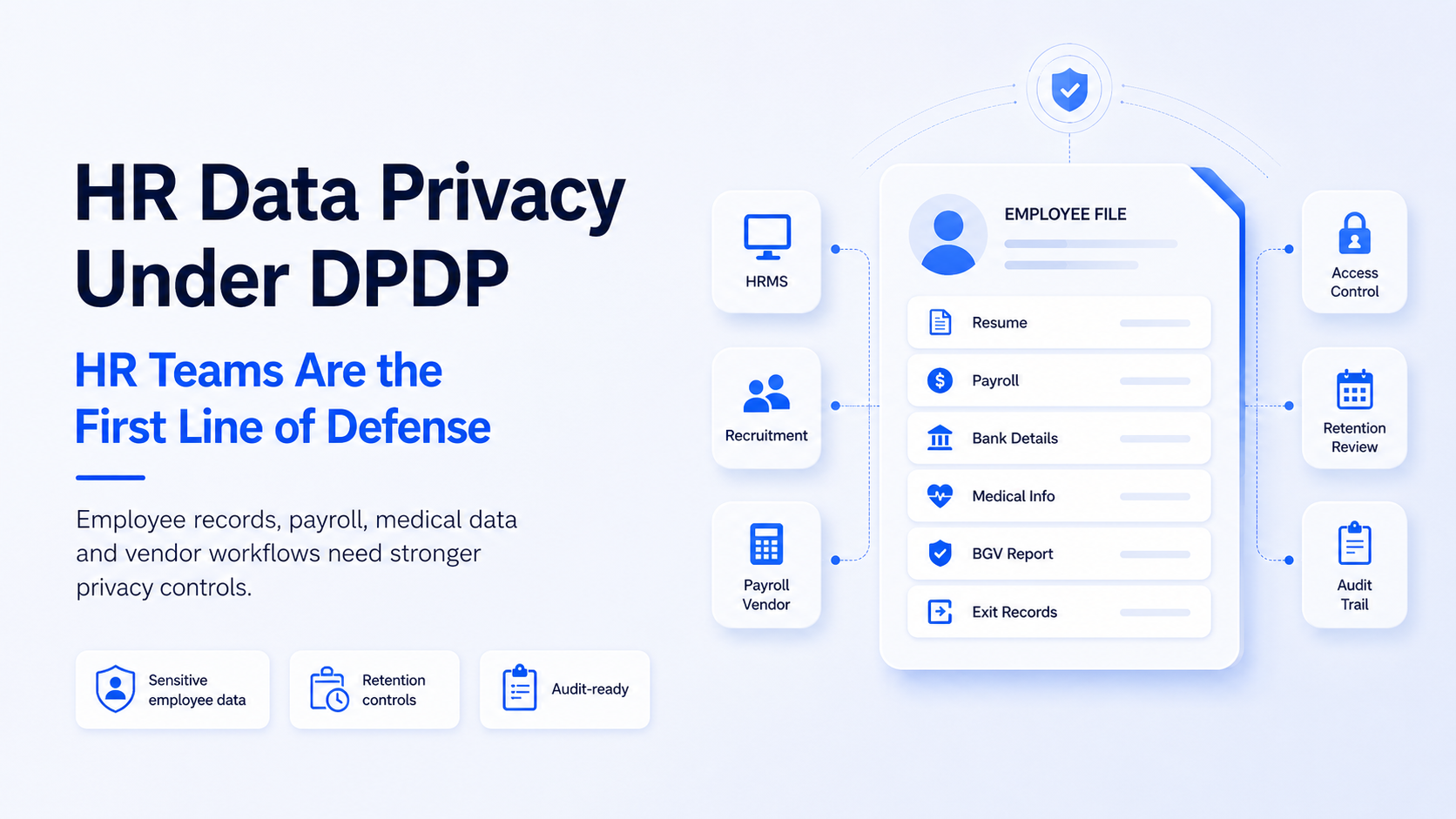
HR teams handle some of the most sensitive personal data inside an organisation, including resumes, identity documents, salary records, bank details, medical information, performance reviews and exit records. In the DPDP era, HR data privacy is no longer only an IT or legal responsibility. This blog explains why HR professionals must become the first line of defense against employee data breaches and how organisations can build stronger controls across HRMS, payroll, recruitment, vendors and retention workflows.
Overview
For a long time, data protection was seen mainly as an IT, security or legal responsibility.
But in the DPDP era, that view is no longer enough.
Human Resources teams manage some of the most sensitive personal data inside an organisation.
Every employee file, resume, offer letter, identity document, salary record, bank detail, medical declaration, insurance record, background verification report, performance review and exit document contains information that needs to be handled carefully.
This makes HR one of the most important stakeholders in enterprise data privacy.
A data breach is no longer only a technical incident.
It is a business risk, a compliance risk and a trust risk.
When employee data is exposed, the impact is personal. It can affect financial security, reputation, workplace trust and employee confidence in the organisation.
That is why HR professionals must become the first line of defense against employee data breaches under DPDP.
For organisations starting their compliance journey, a practical first step is to assess where employee data is collected, stored, shared and retained through a DPDPA readiness assessment.
Why is HR at the centre of DPDP data privacy?
Every stage of the employee lifecycle involves personal data.
- Recruitment and resume screening.
- Background verification.
- Employee onboarding.
- Payroll and salary processing.
- Benefits and insurance administration.
- Attendance and leave management.
- Performance reviews.
- Learning and development.
- Employee engagement tools.
- Exit formalities and record retention.
As organisations digitise HR operations, this data moves across HRMS platforms, payroll systems, recruitment tools, background verification partners, insurance providers, employee engagement applications and cloud storage.
The challenge is not only that HR collects personal data.
The challenge is that HR data often spreads across multiple systems, files, vendors and teams.
A candidate resume may start in an email inbox, move into an ATS, get exported into a spreadsheet, be shared with a hiring manager and later remain in a drive folder after the role is closed.
An employee’s bank details may sit in payroll software, finance records, email attachments and vendor systems.
A background verification report may be stored by HR, the verification agency and internal compliance teams.
Without proper mapping and governance, HR teams may not know exactly where employee data lives, who can access it, how long it is retained and which vendors process it.
This is why HR privacy under DPDP must be treated as an operational responsibility, not only a policy statement.
A structured employee data mapping and DPDP readiness exercise can help HR, IT, legal and compliance teams build one shared view of employee data across systems, files and vendors.
Where do HR data breaches usually happen?
Not every HR data breach happens because of a sophisticated cyberattack.
Many incidents begin with everyday working habits.
- Employee information shared through unsecured spreadsheets.
- Resume folders stored in open drives.
- Excessive access to HRMS records.
- Payroll data shared over email without controls.
- Background verification documents retained longer than required.
- Personal devices used for HR tasks.
- Weak passwords or shared credentials.
- Former employees retaining access to HR platforms.
- Vendor exports not tracked after processing.
- Medical or insurance data stored without clear access restrictions.
These risks increase when HR, finance, IT, recruitment, payroll vendors and business teams all touch employee data without a common privacy operating model.
The problem becomes more serious when sensitive employee data is treated like routine administrative data.
Salary records, bank account details, identity documents, health information, disciplinary records, performance reviews and background verification reports require stronger controls than general workplace communication.
Even a single careless export, misdirected email, open folder or over-permissioned HRMS account can expose confidential employee information.
For HR teams, the question is no longer only do we have employee records?
The better question is: where does employee data flow, who can access it, why is it retained and can we prove it is protected?
Where highly sensitive employee identifiers, bank details or medical records are unnecessarily replicated across systems, organisations can also consider a privacy-vault approach such as Privault for tokenised PII protection.
How can HR teams reduce employee data risk?
HR data protection begins with practical controls that fit the employee lifecycle.
Collect only what is necessary.
HR teams should follow minimum data collection. If a document, field or attribute is not required for recruitment, employment, payroll, benefits, compliance or business operations, collecting it increases risk without adding value.
Limit access by role.
Not every HR team member, manager or vendor needs access to all employee records. Access should be based on need, role and purpose. Payroll data, medical information, background verification reports and disciplinary records should have stricter controls.
Strengthen retention practices.
Resumes, interview notes, onboarding forms, employee files, payroll records, medical declarations, insurance documents and exit records should not be retained indefinitely. HR should define retention schedules and align them with legal, operational and business needs.
Secure HR technology platforms.
HRMS, payroll, ATS, background verification, insurance and employee engagement systems should support strong authentication, periodic access reviews, audit logs and vendor security checks.
Review third-party vendors.
HR data is often shared with payroll providers, recruitment partners, background verification agencies, insurance companies, consultants and HRTech platforms. HR should know what data each vendor receives, why they receive it, how long they keep it and what contractual safeguards apply.
Vendor review should not remain a procurement checklist. It should connect each HR vendor to employee data categories, purpose, access level, retention expectation and audit evidence. This can be mapped through Discovery Studio’s DPDP readiness assessment.
Build privacy awareness inside HR.
HR professionals should be trained on DPDP readiness, secure data handling, phishing, social engineering, incident reporting, access control and vendor data sharing.
Create an incident response process.
If employee data is exposed, the organisation should know how to report, investigate, contain and document the incident quickly. Delayed or unclear response can increase the impact of a breach.
These steps make HR a stronger privacy partner for legal, compliance, IT and security teams.
Make HR Data DPDP-Ready
The future role of HR is changing.
HR professionals are no longer only responsible for hiring, culture, engagement and performance.
They are also becoming stewards of employee trust and guardians of employee personal data.
In the DPDP era, organisations need to understand how employee data is collected, stored, shared, retained, deleted and protected across the full HR lifecycle.
This requires more than an HR privacy policy.
It requires visibility across HRMS platforms, payroll systems, recruitment tools, background verification vendors, insurance providers, emails, spreadsheets, shared drives and archived records.
OpenBlockAI Discovery Studio helps organisations build this visibility through DPDP readiness assessment, personal data discovery, data mapping, vendor review, retention-gap assessment, RoPA inputs and audit evidence preparation.
For HR teams, this means moving from scattered employee records to a structured understanding of:
- What employee data is collected.
- Where it is stored.
- Who can access it.
- Which vendors process it.
- Which records should be retained.
- Which data should be deleted or restricted.
- What evidence supports HR data governance.
Protecting employee data is no longer optional.
It is a core HR responsibility.
The question is no longer whether HR should be involved in data privacy.
The question is: is your HR team prepared to lead it?
Explore OpenBlockAI Discovery Studio for DPDP readiness and employee data mapping.
Explore Privault if your HR data risk involves raw PII spread across multiple systems and vendors.
Speak with OpenBlockAI about HR data privacy, vendor governance and DPDP readiness.