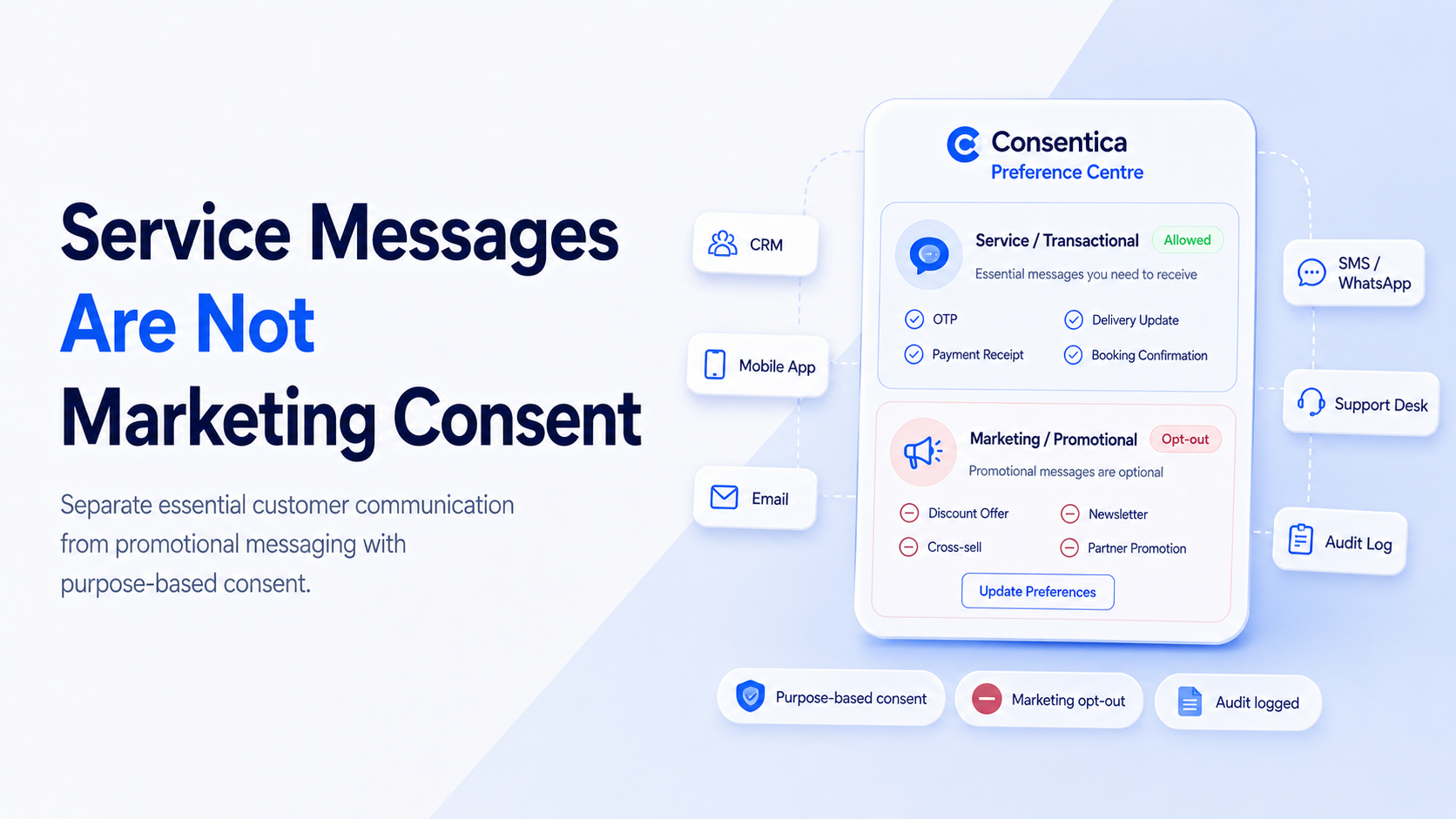
Most enterprises send transaction alerts, payment receipts, delivery updates, support notifications and promotional campaigns through the same systems. But under DPDP readiness, service communication and marketing consent should not be treated as one blanket approval. This blog explains why purpose-based consent, preference management, opt-out sync and audit-ready records are becoming essential for BFSI, fintech, SaaS, e-commerce and customer-facing digital businesses.
Overview
Most businesses send many types of messages to the same customer.
A transaction alert. An OTP. A payment receipt. A loan repayment reminder. A booking confirmation. A delivery update. A support notification. A product announcement. A discount campaign. A cross-sell offer. A partner promotion.
Inside the business, these messages often move through the same CRM, marketing automation tool, mobile app, SMS vendor, WhatsApp provider, support desk or customer engagement platform.
But from a privacy and trust perspective, they are not the same.
A service message helps the customer complete or manage an existing relationship. A marketing message tries to influence the customer toward a new purchase, offer, upgrade, product or campaign.
That difference matters under DPDP readiness because consent cannot be treated as one blanket approval for every future communication.
If a customer shares a phone number for a payment receipt, that does not automatically mean they want promotional loan offers. If a shopper shares an address for delivery, that does not automatically mean they want loyalty profiling. If a SaaS customer signs up for billing alerts, that does not automatically mean they want product marketing emails.
This is why purpose-based consent is becoming a business requirement, not just a privacy term.
Why are service messages different from marketing consent under DPDP?
The simplest way to understand the issue is this:
A customer can need service communication without agreeing to marketing communication.
- A payment alert is not a loan offer.
- A delivery update is not a loyalty campaign.
- A booking confirmation is not a travel package promotion.
- A billing notification is not a newsletter.
- A diagnostic report alert is not a wellness-plan campaign.
Service messages usually support an active customer journey. They may help the customer complete a payment, receive an order, access support, manage an account, confirm a booking or stay informed about an existing transaction.
Marketing messages are different. They promote new offers, cross-sell products, trigger campaigns, encourage upgrades, support profiling-led recommendations or involve partner-led communication.
The risk begins when both categories sit under the same consent flag.
The right question is not simply can we message this customer?
The better question is: for what purpose can we message this customer, through which channel, and with what proof?
That is the foundation of DPDP-ready communication governance.
Why does one consent field create DPDP risk?
Many enterprises still manage communication preferences through one simple field.
- Marketing consent: yes.
- SMS consent: yes.
- Email consent: yes.
- App notification consent: yes.
These fields look clean inside a CRM, but they hide the questions that matter most.
- What purpose did the customer actually approve?
- Was the choice for service communication, marketing, profiling, partner sharing or product updates?
- Which notice was shown to the customer?
- Which channel captured the decision?
- Was the option pre-selected or clearly chosen?
- Did the customer later withdraw only marketing consent or all communication?
- Which systems received the updated preference?
- Can the business prove the answer later?
A single consent field may help a campaign go live faster, but it does not create strong governance.
This becomes especially important for BFSI and fintech teams. A customer may need security alerts, EMI reminders, payment receipts, card statements, KYC updates or loan servicing communication. But that does not mean the customer has agreed to receive credit card offers, insurance promotions, personal loan cross-sell campaigns or partner-led product messages.
The same risk appears across e-commerce, SaaS, travel, hospitality and healthcare journeys. Order updates, billing alerts, appointment reminders and booking confirmations should not automatically become promotional consent.
For DPDP readiness, this is no longer only a CRM hygiene issue. It is a trust, compliance and customer protection issue.
How does Consentica govern purpose-based preferences?
Consentica by OpenBlockAI helps enterprises manage purpose-based consent across customer journeys.
It is designed for DPDP-ready consent capture, preference management, Privacy Centre workflows, withdrawal, downstream consent sync and audit-ready evidence.
With Consentica, enterprises can separate service communication from marketing, profiling and partner-sharing purposes instead of relying on one bundled checkbox.
A modern consent and preference layer should include:
- Purpose-wise consent capture.
- Clear distinction between service messages and marketing communication.
- Separate preferences for email, SMS, WhatsApp, app notifications and phone calls.
- A Privacy Centre where users can review and update choices.
- Consent records with timestamp, notice version, channel, purpose and user decision.
- Marketing opt-out workflows that trigger suppression across downstream systems.
- APIs and webhooks so CRM, marketing, support and vendor tools can check live consent status.
- Audit logs that prove what was approved, changed or withdrawn.
With Consentica, teams can maintain time-stamped consent records, sync consent status across business systems, trigger suppression when marketing consent is withdrawn and keep audit-ready evidence for customer decisions and downstream enforcement.
The goal is simple.
Customers should receive the service messages they need. They should not be forced into marketing messages they did not choose.
Service messages are not marketing consent under DPDP.
The future of customer communication is not more messages. It is better-governed messages.
Book Demo
Consentica helps enterprises move from generic consent flags to purpose-based communication governance.
Use it to separate service messages from marketing consent, manage user preferences, sync opt-outs across downstream systems and maintain audit-ready DPDP evidence.
Explore Consentica for DPDP-ready consent governance.
Book a Consentica demo with OpenBlockAI.
If your communication consent gaps begin with unclear data flows, start with a DPDPA readiness assessment.