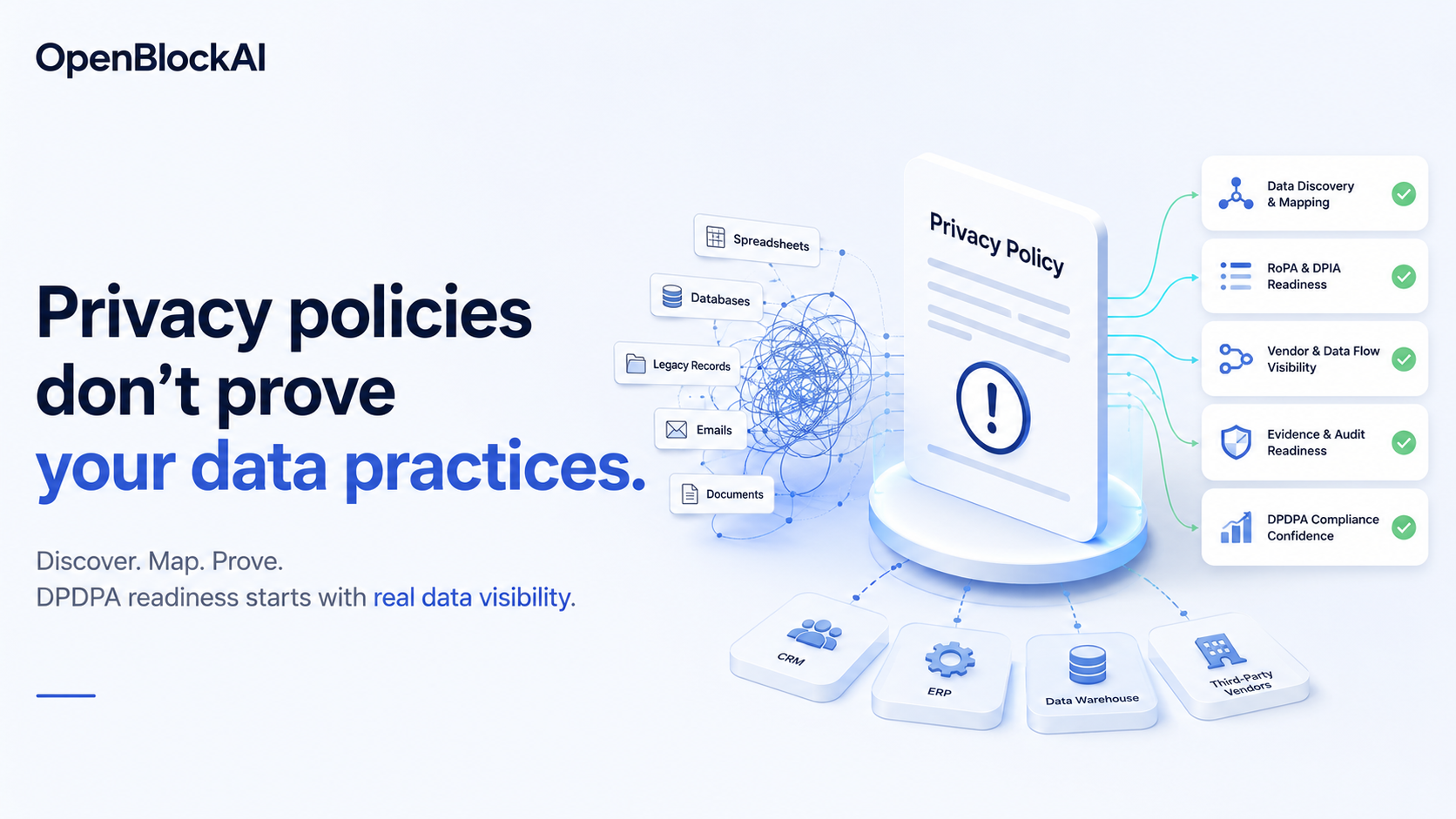
A privacy policy explains what an organisation says it does with personal data, but it does not prove what actually happens across systems, files, vendors, AI workflows and legacy records. This blog explains why DPDP readiness needs evidence-based validation of real data practices — and how Discovery Studio helps enterprises build a verified data inventory, processing baseline, vendor map, retention view and audit-ready evidence layer.
Overview
Most organisations preparing for India’s DPDP framework begin with the documents they can see.
They review the privacy policy. They update terms. They add consent language. They assign a DPO or privacy owner. They circulate questionnaires to department heads.
That work is necessary.
But it does not answer the most important operational question:
Does the organisation’s actual use of personal data match what its privacy policy says?
A policy may state that customer information is collected for onboarding, service delivery, fraud prevention, communication and legal compliance.
It may say that data is shared with authorised service providers and retained only for as long as required.
But the policy cannot prove whether an old KYC export is still sitting in a shared drive, whether a marketing vendor received more fields than required, whether a support tool stores identity documents, whether an AI workflow uses historical customer conversations, or whether a processor retained data after the business purpose ended.
That is the difference between privacy documentation and privacy readiness.
For enterprises that want to move beyond document-level compliance, the first step is to validate declared privacy practices against real systems, files, teams and vendors through a DPDP Readiness Assessment.
Why is a privacy policy not enough for DPDP readiness?
A privacy policy is an external communication document.
It tells customers, employees or users what the organisation says it does with personal data.
But it is not a full internal data inventory.
It normally does not identify every database, spreadsheet, mailbox, shared drive, SaaS tool, API, branch process, AI dataset, vendor export or legacy archive containing personal data.
It also cannot prove whether the stated purpose, retention rule and sharing description are consistently followed in daily operations.
An operational DPDP readiness baseline must go deeper.
It should identify:
- Which categories of personal data are processed.
- Which business activity uses that data.
- What purpose each activity serves.
- Which system, file or repository stores the data.
- Where the data comes from and where it goes.
- Which internal roles and external processors can access it.
- How long the data is retained.
- What deletion or archival control applies.
- Which evidence supports each answer.
- Whether the activity may require deeper risk assessment.
Without this visibility, a company may have polished policy language but no reliable way to demonstrate that its teams, systems and vendors follow it.
This is where Discovery Studio by OpenBlockAI helps enterprises move from declared practices to verified processing records.
Where do privacy policy and data reality usually diverge?
The gap between policy and practice rarely begins with deliberate misuse.
It usually develops through normal business growth.
A sales team adopts a new CRM extension. A support team uploads customer documents to a ticket. Finance exports payment records into a spreadsheet. A branch scans paper forms. Product sends events to a new analytics platform. An AI team uses historical conversations to test a model. A vendor creates a troubleshooting copy of production data.
Each decision may appear small.
Together, they create a processing environment that no single privacy policy can fully describe.
The most common gaps appear in five areas.
1. Unstructured and legacy data
Core databases are only part of the picture. Personal data also appears in CSV files, employee mailboxes, Google Drive, Microsoft 365, scanned forms, archived folders, call recordings and local exports.
A system-only review can miss these repositories entirely.
2. Downstream vendor use
A contract may identify the service provider, but it may not show the exact fields transferred, the sub-processors involved, the operational copies created or the retention applied after termination.
Vendor governance becomes meaningful only when contracts are connected to actual data flows. This is why vendor and processor mapping should be part of the DPDP readiness assessment process, not a separate spreadsheet exercise.
3. Product and AI changes
Privacy documentation often changes after a product release. Data processing changes before it.
A new recommendation engine, fraud model, chatbot, identity workflow or analytics integration may introduce new purposes, data categories, access paths or DPIA triggers.
4. Retention without deletion evidence
A retention schedule can say that records should be deleted after a defined period. That does not prove deletion occurs across primary systems, backups, vendor environments, exports and archives.
5. Ownership without validation
Legal knows the stated purpose. Technology knows the system. Operations knows the manual steps. Procurement knows the vendor. Security knows the access model.
The complete processing record emerges only when these views are reconciled.
What does an evidence-backed DPDP baseline include?
A useful readiness baseline is not a score produced by a short questionnaire.
It is a structured view of what the enterprise knows, what it can prove and what remains uncertain.
For each processing activity, the baseline should connect:
Purpose → personal data categories → source → system → internal owner → vendor or processor → retention → deletion method → risk trigger → supporting evidence.
Evidence may include system screenshots, field lists, API documentation, data dictionaries, vendor contracts, workflow diagrams, retention configurations, deletion tickets, consent notices, access records and business-owner approvals.
The goal is not to collect documents for their own sake.
The goal is to make every important statement testable.
For example, a privacy policy may say: identity documents are used only for onboarding and verification.
But the validation questions are more practical:
- Where are the documents uploaded?
- Are copies created in CRM, support tools, email or shared drives?
- Which vendor receives them?
- Can marketing or analytics teams access them?
- How long does each copy remain?
- What happens when the account closes?
- Which evidence confirms deletion or restriction?
This is how a policy statement becomes an operational processing record.
Discovery Studio helps enterprises build this evidence-backed baseline by connecting discovery, data mapping, vendor review, RoPA inputs, DPIA trigger assessment, retention review and evidence collection inside one DPDP readiness workspace.
Validate Your Data Practices
Spreadsheets are useful for starting an inventory, but they become difficult to defend when the programme needs cross-functional validation, evidence, version history and connected risk outputs.
A row can say CRM — customer data — service purpose.
But that row may not show which fields are involved, which integrations receive them, which owner approved the entry, what evidence was checked, which retention gap remains open or which DPIA trigger was identified.
The problem is not the spreadsheet format itself.
The problem is treating the first collected answer as final truth.
Discovery Studio by OpenBlockAI is designed as a pre-implementation DPDP readiness workspace.
It helps enterprises bring together business, legal, security, product, technology, HR, procurement and operations inputs and convert them into structured compliance outputs.
Discovery Studio supports:
- Personal data discovery across structured and unstructured sources.
- Data inventory and data-flow mapping.
- Purpose and processing-activity validation.
- RoPA draft preparation.
- Vendor and processor mapping.
- Legacy consent and data assessment.
- Retention and deletion gap identification.
- DPIA trigger identification.
- Evidence collection and approval.
- Risk heatmaps and audit-readiness views.
- Implementation planning based on validated findings.
The value is not another statement that the organisation is ready.
The value is knowing why a gap exists, which processing activity it affects, who owns it, what evidence is missing and what must be implemented next.
A privacy policy is an important trust document.
But it should not be expected to carry the burden of an internal data inventory, risk assessment and audit trail.
The organisations best prepared for DPDP will not be those with the longest policies.
They will be those that can connect every material statement about personal data to a real process, system, owner, vendor, control and piece of evidence.
Before adding another policy clause, verify the data practice behind it.