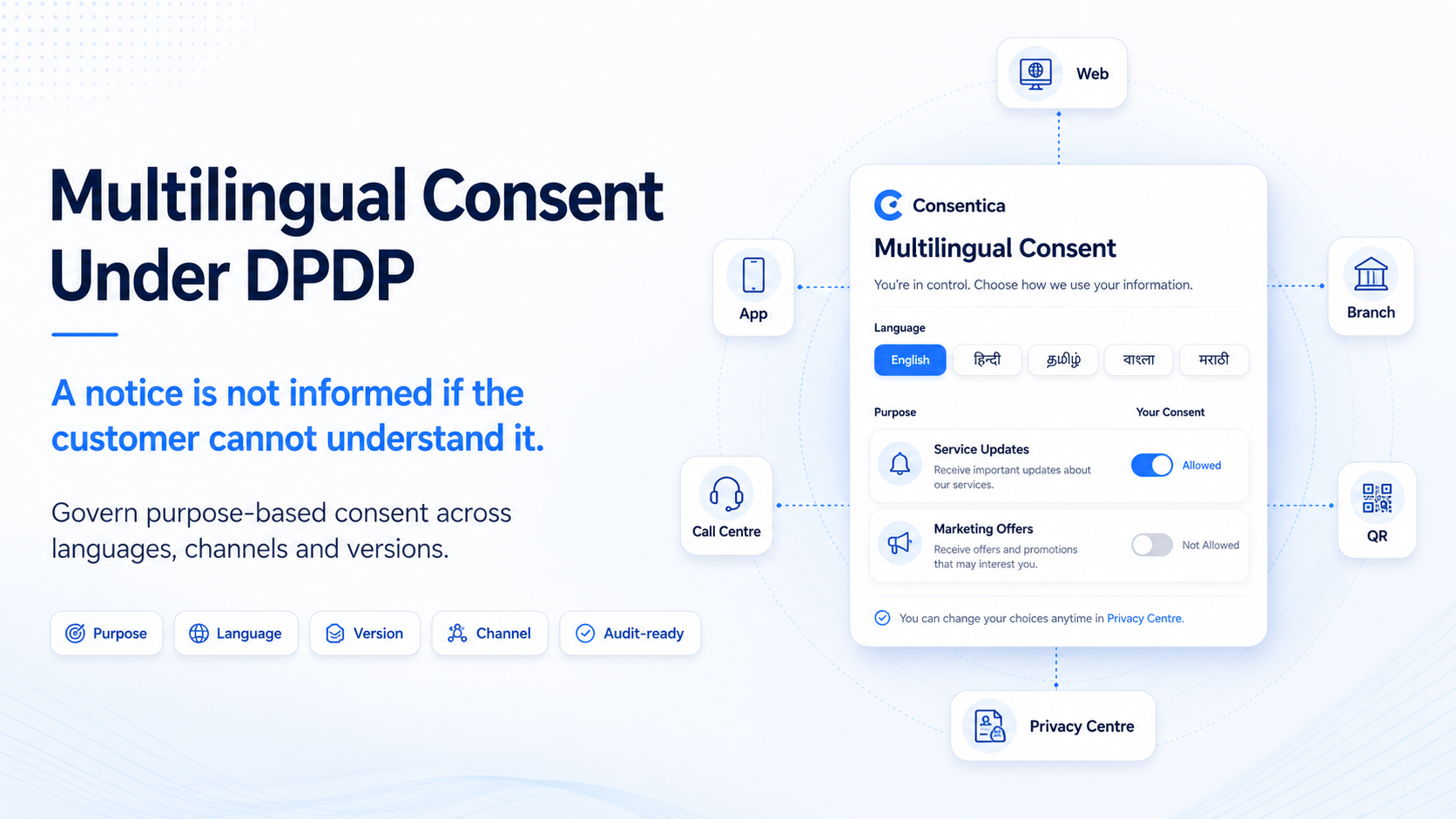
A consent notice is not truly informed if the customer cannot understand the language, purpose or consequence of the choice. This blog explains why DPDP-ready enterprises need multilingual, purpose-based consent governance across web, app, branch, call-centre, QR and assisted journeys — and how Consentica helps maintain versioned notices, language-aware records, preference updates and audit-ready evidence.
Overview
A customer walks into a branch and speaks in Hindi.
The relationship manager explains the product in Hindi. The repayment schedule is discussed in Hindi. The customer asks questions in Hindi.
Then the consent request appears on a tablet in dense English.
The customer taps I agree.
Technically, a consent event has been captured.
But what exactly has been proven?
That the customer touched a button?
Or that the customer understood which personal data would be used, for what purpose, by whom, and how the choice could later be changed?
This distinction matters because consent is not only a database field.
It is a communication, choice and evidence process.
For Indian enterprises preparing for DPDP readiness, that process must work across languages, channels and customer journeys.
A translated privacy policy may be useful, but it is not the same as a governed multilingual consent system.
Why does understandable consent matter under DPDP?
Consent is not meaningful if the customer cannot understand the request.
A user should be able to understand what data is being collected, why it is being collected, whether the purpose is essential or optional, whether it will be shared with a partner or processor, and how the choice can later be changed or withdrawn.
This becomes especially important in India because customer journeys are rarely limited to one language or one channel.
- A borrower may speak to a branch team in Hindi but receive a notice in English.
- A fintech user may complete onboarding in a regional language but see marketing consent in English.
- A telecom customer may accept a service notice in one language but find withdrawal options in another.
- A patient may rely on a hospital staff member or family member to understand what is being approved.
- A marketplace customer may accept a translated checkbox without seeing separate choices for delivery, marketing, seller sharing and profiling.
The key issue is not only language availability.
The key issue is whether the customer can make a clear, purpose-specific and informed choice.
That requires more than publishing a privacy policy.
It requires consent journeys that are understandable, version-controlled, purpose-linked and enforceable across downstream systems.
Why is translation alone not enough?
Many organisations begin with a reasonable step: they translate the privacy policy.
The English document is sent to a translator. Regional-language PDFs are created. Links are placed in the website footer. The internal checklist says multilingual notice is complete.
But the live journey may still remain broken.
- The mobile app still shows English buttons.
- The call-centre script uses a different explanation.
- The branch form bundles several purposes together.
- The QR journey points to an outdated notice.
- The withdrawal page is available only in English.
- The CRM records only consent = yes without language, purpose, channel or notice version.
That is localisation at the content layer, not governance at the consent layer.
The hidden risk is version drift.
Suppose a fintech adds a new analytics partner. The English notice is updated. Legal approves the new version. The app team deploys the English text.
But the Hindi, Tamil, Bengali and Marathi versions remain on the old wording. The call-centre script still uses a previous version. A partner journey displays a custom paragraph written months ago.
Now the organisation does not have one consent notice.
It has several inconsistent explanations of the same processing activity.
This creates three problems.
- Customers may receive materially different information depending on language or channel.
- Support and privacy teams may not be able to reproduce what the user actually saw.
- Downstream systems may treat all consent events as equal even when the underlying notice was different.
This is why multilingual consent needs controlled versions, common purpose IDs and audit-ready records.
How does Consentica govern multilingual consent?
Consentica by OpenBlockAI is designed for purpose-based, DPDP-ready consent governance across enterprise customer journeys.
It helps organisations move from translated documents to governed multilingual consent workflows.
With Consentica, enterprises can manage consent across web, app, QR, offline, assisted and API-led journeys while maintaining one consistent consent model across languages and channels.
A strong multilingual consent record should not store only yes or no.
It should capture:
- Who gave the consent.
- Which purpose was presented.
- Which language was shown.
- Which notice version was used.
- Which channel captured the decision.
- Whether the choice was accepted, declined, updated or withdrawn.
- Whether downstream systems received the latest status.
For example, a stronger consent record may show that a customer declined promotional loan offers in Hindi through a branch-assisted tablet journey, under a specific notice version, with CRM and campaign suppression updated.
This is the difference between having a consent flag and having defensible consent evidence.
Consentica helps enterprises:
- Create and manage purpose-based consent notices.
- Deliver journeys in 22 Indian languages.
- Capture consent across web, app, QR, offline, assisted and API-led channels.
- Record language, purpose, notice version, timestamp and channel.
- Let users review, update and withdraw consent through a Privacy Centre.
- Synchronise consent status across CRM, marketing, support, analytics and vendor systems.
- Maintain audit-ready consent and request history.
The goal is not to create twenty-two disconnected translations.
The goal is to maintain one governed consent meaning that every customer can understand in the language and channel appropriate to them.
Book Demo
Consent cannot be informed when the user cannot understand the decision.
But understanding is not solved by translation alone.
Enterprises need consistent purposes, controlled versions, usable interfaces, multi-channel capture, preference management, downstream enforcement and audit-ready evidence.
For BFSI, fintech, telecom, e-commerce, healthcare and digital platforms, multilingual consent should work across app, branch, call-centre, QR, partner and assisted journeys.
Consentica helps enterprises build that operating layer.
Explore Consentica for purpose-based multilingual consent governance.
Book a Consentica walkthrough with OpenBlockAI.
If your organisation has translated notices but cannot prove which language, purpose, version and channel the customer actually saw, this is the right place to start.