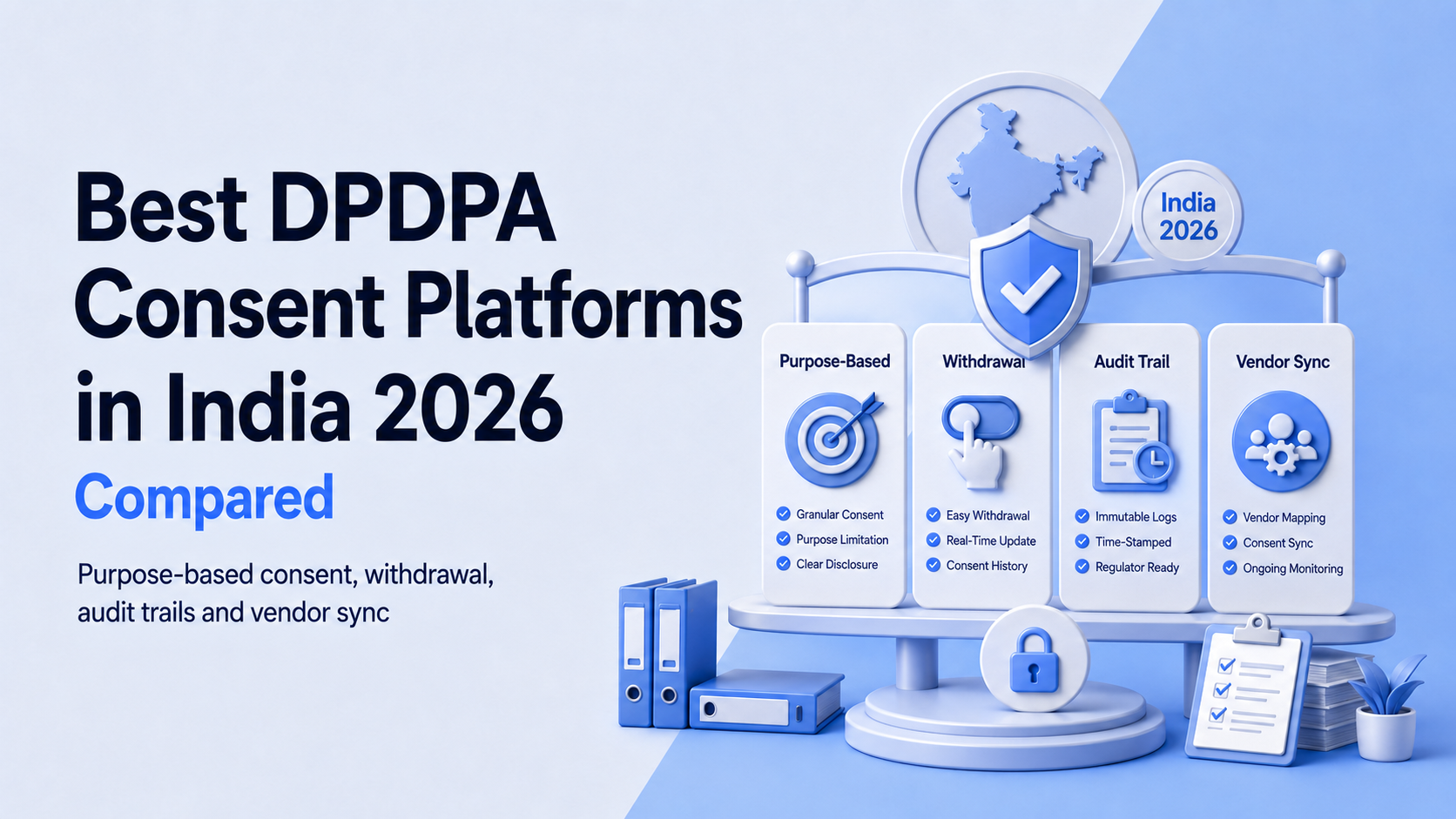
Compare the best DPDPA consent management platforms in India for purpose-based consent, withdrawal, audit trails, vendor sync and DPDP readiness.
Overview
Searching for the best consent management platform in India is no longer only about finding a cookie banner.
Under India’s DPDP framework, consent needs to be clear, purpose-specific, easy to withdraw and supported by operational evidence.
A platform that only shows a pop-up on a website may help with basic notice and preference capture, but it may not be enough for enterprises that need purpose-level consent records, multilingual journeys, withdrawal propagation, vendor sync, audit trails and Data Principal request workflows.
The official DPDP framework also recognises the role of Consent Managers as entities through which Data Principals may give, manage, review and withdraw consent. You can review the official government explanation here: DPDP Rules 2025 overview by PIB.
For Indian organisations, the buying question should not be: Which tool can show a consent banner?
The better question is:
Which platform can help us govern consent across web, app, branch, QR, call-centre, CRM, campaign systems, vendors and audit evidence?
This comparison reviews the main consent management platform categories Indian businesses are likely to consider in 2026, including India-first DPDP platforms, global privacy suites, cookie-consent tools and enterprise consent infrastructure.
If your organisation wants purpose-based consent governance across customer journeys, explore Consentica by OpenBlockAI.
What Makes a Consent Management Platform DPDPA-Ready?
A DPDPA-ready consent management platform should do more than collect a one-time yes or no.
It should help the organisation prove what the user was told, what purpose they accepted, which notice version was shown, which language was used, which channel captured the choice and whether the latest status was enforced downstream.
For Indian enterprises, especially BFSI, fintech, healthcare, telecom, e-commerce, SaaS and consumer platforms, the following capabilities matter most:
- Purpose-based consent: consent should be linked to specific purposes, not one generic marketing or privacy flag.
- Notice and version management: the platform should preserve the notice or consent statement shown at the time of consent.
- Multilingual journeys: Indian users may need notices and consent journeys in English and Indian languages.
- Withdrawal and preference management: withdrawal should be as easy as capture and should not depend only on email support.
- Downstream enforcement: CRM, marketing, support, analytics and vendor systems should receive the latest consent state.
- Audit trail: teams should be able to reconstruct consent history during disputes, audits and internal reviews.
- Data Principal rights support: consent should connect with access, correction, deletion, grievance and privacy-centre workflows.
- Vendor and processor sync: processors using personal data for a specific purpose should receive updated status.
- APIs and integrations: the platform should support product, engineering, marketing operations and compliance workflows.
- India fit: the platform should understand DPDP operating requirements, Indian customer journeys and assisted/offline channels.
This is why many organisations are moving beyond cookie-only CMPs toward consent infrastructure.
If your current consent system cannot prove what the customer agreed to, read our guide on DPDP consent proof and audit trails.
Best Consent Management Platforms in India
The right platform depends on the organisation’s size, regulatory exposure, channels, data flows and integration requirements.
This comparison is based on public product positioning, DPDP relevance and practical buyer fit. It should be used as a shortlist, not as a substitute for security, legal, procurement and technical due diligence.
1. Consentica by OpenBlockAI
Consentica is built for purpose-based consent governance across Indian enterprise journeys. It is a strong fit for organisations that need consent capture, withdrawal, Privacy Centre interactions, multilingual journeys, QR or assisted consent flows, downstream system checks and audit-ready records.
Consentica is especially relevant for BFSI, fintech, healthcare, telecom, SaaS and e-commerce teams that do not want consent to remain trapped inside a website banner or CRM checkbox.
Best for: Indian enterprises that need DPDP-aligned consent infrastructure, purpose-level status and downstream enforcement.
Consider if: your business needs consent to travel across web, app, branch, call-centre, CRM, marketing tools, vendors and audit evidence.
2. Privy by IDfy
Privy by IDfy positions itself as an India-first privacy and DPDP compliance platform covering areas such as consent management, data discovery, DPIA, third-party risk and audit evidence. IDfy’s public materials highlight DPDP-aligned consent notices, versioning, expiry controls and privacy governance workflows.
Best for: enterprises that want a broader DPDP privacy-governance suite with consent as one module.
Consider if: your organisation is evaluating a full-stack DPDP compliance platform and wants India-specific privacy operations.
3. OneTrust
OneTrust is one of the best-known global privacy platforms. Its consent and preference management products are positioned around giving users control over how their data is shared, used and accessed, with broad privacy-management capabilities across global regulations.
Best for: large multinational enterprises that need global privacy, preference, data governance and compliance tooling.
Consider if: your organisation operates across multiple jurisdictions and already has mature privacy operations, procurement capacity and implementation teams.
4. Securiti
Securiti offers a consent management platform as part of a broader data and AI governance suite. Its public product pages emphasise automated consent collection, management and synchronisation across channels, combined with broader privacy and data intelligence capabilities.
Best for: large enterprises that want consent management connected with data intelligence, privacy automation and broader data-governance workflows.
Consider if: consent is one part of a larger data security, AI governance or privacy automation roadmap.
5. Transcend
Transcend positions its consent management platform around collecting and enforcing user consent across websites, apps, systems and regions, going beyond cookie banners for privacy operations across global frameworks.
Best for: technology-led companies that need technical privacy workflows, system-level enforcement and global consent or preference operations.
Consider if: your team wants a developer-friendly consent and privacy-rights platform for distributed systems.
6. CookieYes
CookieYes is widely known for cookie consent and website consent management. It may be a good fit for businesses that primarily need website banner management, tracker scanning and basic consent configuration.
Best for: startups, marketing websites and smaller teams that need a faster cookie-consent implementation.
Consider if: your immediate problem is website cookie consent rather than full enterprise consent governance across systems and vendors.
7. India-focused DPDP platforms such as ConsentOS, Complynz, ConsentiQo and similar tools
The Indian DPDP software market is expanding quickly, with several platforms positioning themselves around DPDP consent, privacy workflows, DSAR or Data Principal request handling, breach workflows, gap checks, evidence and local implementation.
Best for: organisations comparing India-first DPDP tooling with different levels of pricing, implementation depth and workflow coverage.
Consider if: you need to evaluate multiple local options before choosing between a lightweight tool, full DPDP suite or enterprise consent infrastructure.
How to Choose the Right Platform
The best DPDPA consent management platform depends on what problem your organisation is solving.
If you only need a website cookie banner, a cookie-first tool may be enough for the first phase. But check whether it supports consent withdrawal, purpose history, notice versioning, language and downstream enforcement.
If you need DPDP consent across customer journeys, look for a purpose-based consent platform that can work across web, app, QR, branch, assisted journeys, call-centre and API-led workflows.
If you need enterprise privacy governance, evaluate whether the platform also supports Data Principal rights, privacy-centre workflows, vendor sync, breach readiness, RoPA, DPIA and audit evidence.
If you are in BFSI, fintech, healthcare or telecom, do not choose only on banner design. You need to test whether consent can be enforced across CRM, campaign tools, support systems, partners, processors and legacy systems.
If you use vendors or processors, confirm whether withdrawal, preference changes and purpose restrictions can be communicated to downstream processors.
If you operate in multiple Indian languages, ask whether the platform supports multilingual notices and whether the consent record preserves the language shown to the user.
If audits or disputes matter, check whether the platform can reconstruct the exact consent event: purpose, notice version, language, channel, timestamp, action, validity state and downstream use.
Before buying a platform, ask vendors these questions:
- Does the platform support purpose-level consent or only category-level preferences?
- Can users withdraw consent as easily as they gave it?
- Can consent status be checked by downstream systems through API?
- Does the platform preserve notice versions and language shown?
- Can it support app, web, QR, branch, call-centre and assisted journeys?
- Can it sync consent status to CRM, marketing, support and vendor tools?
- Does it support Data Principal rights or Privacy Centre workflows?
- Can it provide audit-ready consent event history?
- Does it support India-specific DPDP implementation needs?
- Can it scale beyond a cookie banner as the organisation matures?
If you are still unclear whether your business needs consent capture, consent governance or broader readiness mapping, begin with a DPDPA readiness assessment before finalising the tool.
Choose Consent Infrastructure, Not Just a Banner
The best consent management platform in India is not always the one with the most features.
It is the one that matches your operating model.
A startup with a simple marketing site may need cookie consent and basic preference capture.
A BFSI, fintech, healthcare, telecom, SaaS or marketplace business may need something deeper: purpose-based consent records, multilingual journeys, withdrawal propagation, vendor sync, APIs, Privacy Centre workflows and audit evidence.
Under DPDPA, consent should not remain a front-end event.
It should become an enforceable instruction that follows the customer journey.
Consentica by OpenBlockAI is designed for organisations that want consent to operate as infrastructure: purpose-based, versioned, multilingual, auditable and connected to downstream systems.
It can support:
- Purpose-based consent capture.
- Consent notice versioning.
- Multilingual consent journeys.
- Consent withdrawal and preference management.
- Privacy Centre and customer self-service workflows.
- Web, app, QR, assisted and API-led journeys.
- Consent audit history.
- Downstream status checks through APIs.
- Vendor and processor sync.
- DPDP-ready evidence for disputes and audits.
If your organisation is comparing consent management platforms in India, do not stop at the banner.
Test whether the platform can answer one operational question:
When a customer gives, refuses or withdraws consent, can every relevant system and vendor act on that choice?