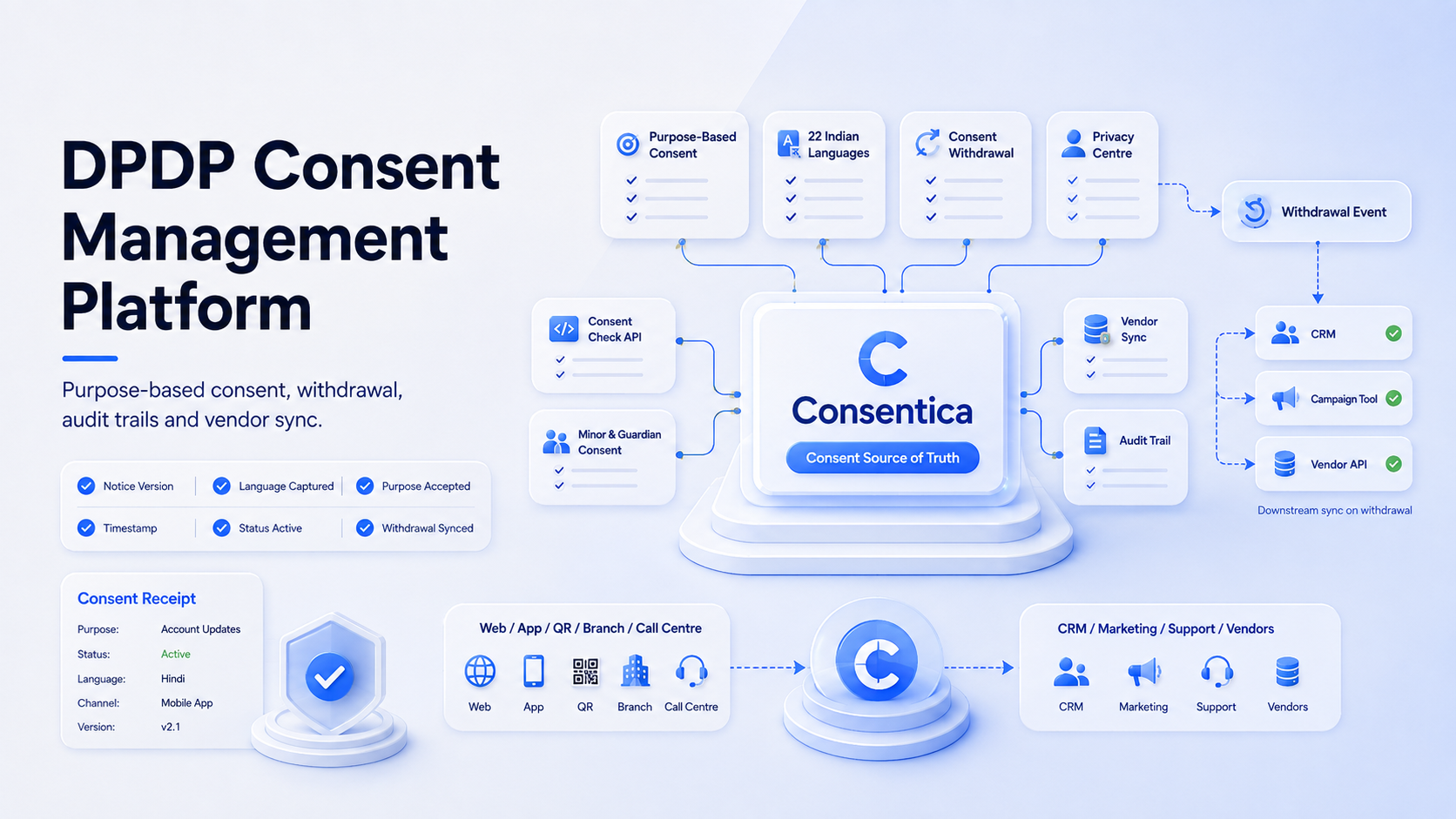
Learn the key features a DPDP consent management platform in India should offer, including purpose-based consent, withdrawal, audit trails, APIs and vendor sync.
Overview
Searching for a DPDP consent management platform usually starts with a simple requirement: collect user consent.
But for Indian enterprises, consent management under DPDP cannot stop at a checkbox, banner or CRM field.
A business must be able to show what the user was told, which purpose they agreed to, when the consent was captured, which language or channel was used, whether the consent is still valid, and whether withdrawal or preference changes were reflected across downstream systems.
This is why a DPDP consent management platform should work as consent infrastructure.
It should support consent capture, purpose governance, withdrawal, preference management, Privacy Centre workflows, audit logs, vendor sync, APIs and evidence across customer journeys.
If your organisation is evaluating consent tools for DPDP readiness, start with Consentica by OpenBlockAI, built for consent capture, withdrawal and audit evidence across Indian enterprise journeys.
This guide explains the key features Indian businesses should look for when choosing a DPDP consent management platform.
What Is a DPDP Consent Management Platform?
A DPDP consent management platform is software that helps an organisation collect, manage, update, withdraw, enforce and prove user consent under India’s Digital Personal Data Protection framework.
It is different from a basic cookie banner or static form.
A practical platform should connect consent to:
- The specific purpose of processing.
- The notice or consent statement shown to the user.
- The language and channel used during capture.
- The user’s accept, reject, update or withdraw action.
- The current validity status of the consent.
- The systems, teams and vendors that rely on that consent.
- The audit record needed for disputes, reviews and compliance reporting.
For example, a bank may collect consent during onboarding, KYC, bureau checks, account servicing, marketing, cross-sell, collections and partner workflows.
A healthcare platform may need different consent journeys for patient communication, diagnostics, insurance, teleconsultation and optional health updates.
A SaaS company may need consent and preferences across product analytics, marketing communication, AI features, integrations and customer workspaces.
In all these cases, a single yes/no field is not enough.
The consent platform must preserve purpose, status, history and downstream enforceability.
For a comparison of consent platforms in India, read Best DPDPA Consent Management Platforms in India 2026.
Essential Features Indian Enterprises Should Look For
The best DPDP consent management platform for Indian enterprises should support more than consent capture.
It should help teams manage the complete consent lifecycle.
1. Purpose-based consent management
Consent should be tied to specific purposes, not one broad privacy acceptance. Users may agree to account servicing but decline marketing, profiling or partner offers. The platform should preserve those choices separately.
2. Clear consent notice and versioning
A consent record should show which notice or policy version was displayed when the user gave consent. If notice language changes later, the earlier version should remain available for audit and dispute resolution.
3. Multilingual consent journeys
India is not a one-language market. A strong DPDP consent management platform should support consent journeys in Indian languages and preserve the language shown to the user.
Consentica supports consent journeys in 22 Indian languages, helping enterprises make consent easier to understand across customer segments.
4. Easy consent withdrawal
Withdrawal should be as easy as giving consent. If consent was captured on app, web, QR, branch or assisted journey, the user should have a clear way to review, update or withdraw their choice.
5. Privacy Centre for customers
A Privacy Centre gives users a place to view consent, update preferences, withdraw consent and raise related requests. It also gives the organisation a clearer evidence trail for consent-related actions.
6. Consent audit trail
A DPDP consent platform should capture every consent action with purpose, status, timestamp, channel, language, notice version and request history. This helps teams prove what the user actually agreed to.
7. Downstream consent sync
Consent status should not stay trapped inside one database. It should sync with business systems, third-party tools, webhooks, Consent Check APIs, reports and operational workflows.
8. Vendor and processor updates
If a user withdraws consent or changes preferences, relevant vendors and processors should receive the updated instruction. Otherwise, the front-end consent flow may look compliant while downstream processing continues incorrectly.
9. Minor and guardian consent workflows
Where children’s data or guardian approval is relevant, the platform should support age verification, parental or guardian approval, and time-stamped records for minor and guardian actions.
10. Scalable consent infrastructure
Enterprise consent systems must handle high-volume journeys across campaigns, apps, partner traffic, seasonal spikes and large user bases. Low-latency status checks and reliable consent storage become important as volume grows.
Why Consent Management Must Work Across Systems
The biggest DPDP consent risk is not only whether the user clicked accept.
The bigger risk is whether every system acted on the latest consent status.
In many organisations, consent is fragmented across:
- Website banners.
- Mobile app journeys.
- CRM fields.
- Marketing automation tools.
- Customer-support systems.
- Branch or assisted journeys.
- Call-centre workflows.
- QR-based forms.
- Vendor exports.
- Partner APIs.
- Data warehouses and reporting systems.
This creates a practical problem.
The app may show withdrawal as completed, but the campaign tool may still mark the customer as contactable. The CRM may show an old preference. A vendor may continue using yesterday’s file. A support team may not see the latest status.
This is why a DPDP consent management platform should operate as a source of consent truth.
Systems should be able to check current consent status by purpose before processing data.
Updates should flow to internal tools and relevant processors.
Audit logs should show when consent was captured, changed, withdrawn, checked or enforced.
For enterprises, the platform should answer one operational question:
Can every system and vendor understand the customer’s latest consent choice?
If the answer is no, the organisation may need a consent governance layer such as Consentica.
DPDP Consent Platform Checklist
Use this checklist when evaluating a DPDP consent management platform in India.
- Purpose-level consent: Can the platform capture consent separately for each purpose?
- Notice versioning: Can it preserve the exact notice shown at the time of consent?
- Language evidence: Can it record which language version was displayed?
- Multi-channel capture: Does it support web, app, QR, assisted, branch, call-centre and API-led journeys?
- Easy withdrawal: Can users withdraw or update consent through a visible mechanism?
- Privacy Centre: Can users view, update or withdraw consent from one interface?
- Consent audit logs: Does the platform record action, status, timestamp, purpose, channel and history?
- Consent Check API: Can downstream systems check current consent status before processing?
- Webhooks: Can consent changes trigger updates in other systems?
- Vendor sync: Can withdrawal, deletion or suppression instructions be sent to processors?
- Minor consent: Does it support age-gating, parent or guardian approval and minor consent records where required?
- Rights workflows: Can consent-related access, correction, erasure, withdrawal and grievance requests be tracked?
- Audit exports: Can the organisation produce evidence for compliance, disputes and internal reviews?
- Scalability: Can the system handle large volumes of consent events and status checks?
- Implementation speed: Can the platform go live quickly without long integration cycles?
A platform that only collects consent but cannot enforce, sync or prove it may not be enough for enterprise DPDP readiness.
If your organisation is still comparing platforms, read Best Consent Management Platforms in India for DPDPA.
Build Consent Governance with Consentica
Consentica by OpenBlockAI is designed for enterprises that need DPDP consent management beyond banners and forms.
It helps organisations collect, manage, update, withdraw, sync and prove consent across customer journeys.
Consentica supports:
- Purpose-based consent capture.
- Consent journeys in 22 Indian languages.
- Simple 2-click consent journeys designed to reduce drop-offs.
- Consent status sync across business systems.
- Webhooks and Consent Check API.
- Privacy Centre for user review, update and withdrawal.
- Audit-ready consent records with timestamps and request history.
- Automated deletion or suppression instructions when consent is withdrawn.
- Minor and guardian consent workflows.
- Rights and grievance workflows.
- Scalable consent infrastructure for high-volume journeys.
- Zero-integration setup options for faster deployment.
For Indian enterprises, consent governance should not be treated as a one-time interface.
It should be a connected system that carries the customer’s choice across apps, CRMs, campaigns, vendors, processors and audit records.
Explore Consentica for DPDP consent management.
Book a Consentica walkthrough with OpenBlockAI.
The best DPDP consent management platform is not the one that only captures consent.
It is the one that helps your organisation prove, enforce and respect consent wherever personal data moves.