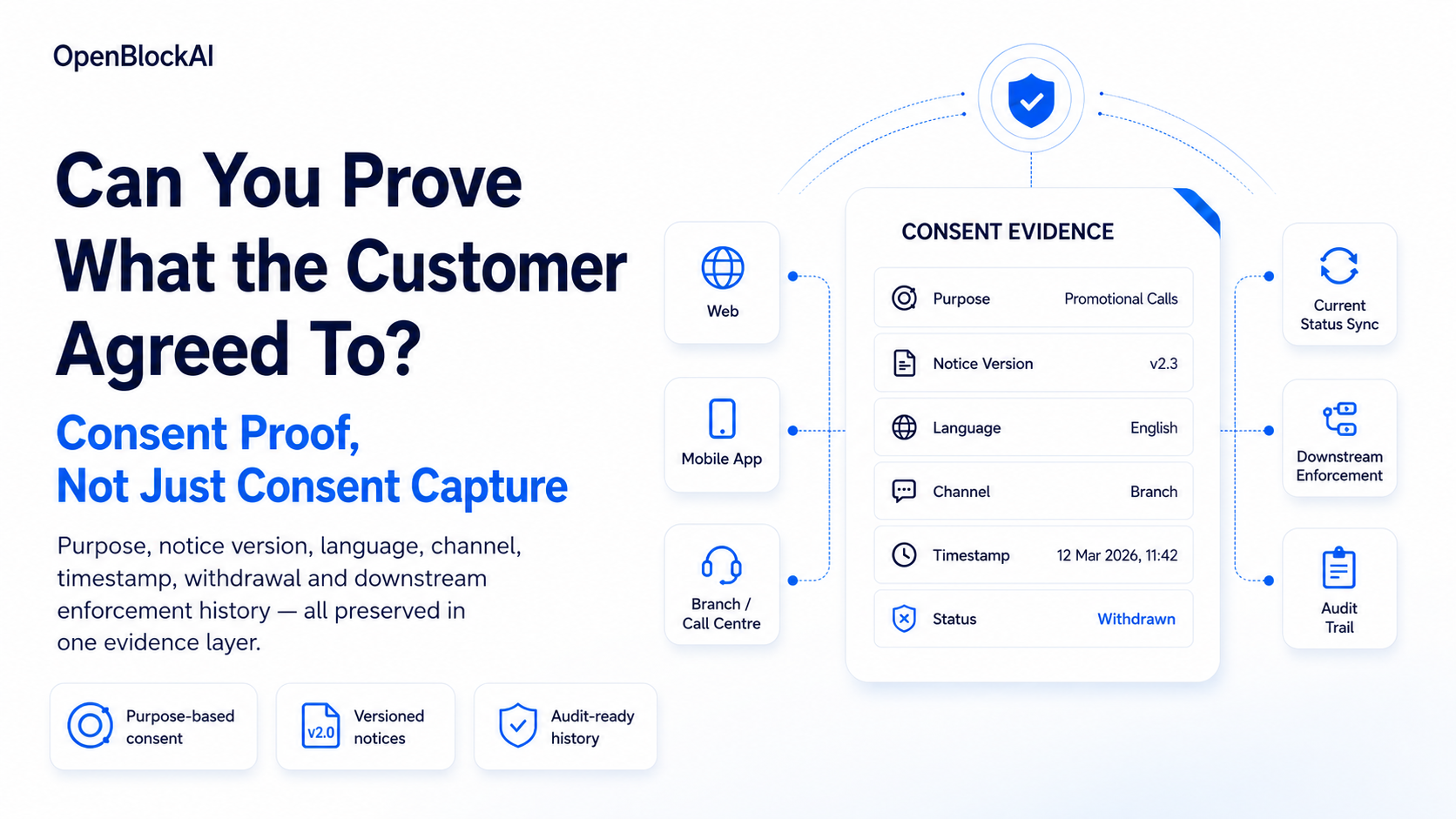
A timestamp and a consent yes/no field are not enough to prove what a customer actually agreed to. This blog explains why DPDP-ready consent records must preserve the exact purpose, notice version, language, channel, timestamp, validity state, withdrawal history and downstream enforcement — and how Consentica helps enterprises build audit-ready consent evidence across web, app, branch, call-centre, QR and assisted journeys.
Overview
A customer raises a complaint six months after onboarding.
They say they agreed to receive account updates, but never agreed to promotional calls.
Your CRM shows consent: yes.
The marketing platform shows the customer as contactable.
A branch employee remembers presenting a form, but nobody can confirm which version it was.
The privacy notice has since changed.
At this point, the problem is no longer whether a checkbox existed.
The real question is: can your organisation reconstruct the customer’s decision?
For many enterprises, consent is still stored as a single field: yes, no, accepted or declined.
That may support a workflow, but it is weak evidence.
A meaningful consent record should explain what the person was told, what they chose, which purpose the choice applied to, when the choice was made and what happened afterward.
This is why enterprises preparing for DPDP need more than consent capture.
They need consent proof.
Consentica by OpenBlockAI helps enterprises manage purpose-based consent with versioned notices, multilingual journeys, consent history, withdrawal and audit-ready evidence across customer touchpoints.
Why is a timestamp not enough?
A timestamp answers one question: when did an event occur?
It does not answer the questions that matter during an audit, complaint, dispute or internal review.
- Which notice was displayed?
- Which purpose was requested?
- Was the choice optional or bundled?
- Which language did the customer read?
- Was the journey completed on web, app, branch, call centre, QR or assisted device?
- Was the customer acting for themselves or through a parent, guardian or nominee?
- Did the consent later expire or get withdrawn?
- Which systems and vendors relied on that consent?
When these details are missing, teams are forced to rebuild the story from screenshots, campaign records, call recordings, PDFs, CRM notes and employee memory.
That is slow, expensive and unreliable.
In a DPDP operating model, the organisation should be able to show not only that a customer clicked something, but what they actually agreed to.
This is especially important in BFSI, fintech, telecom, healthcare, SaaS and e-commerce, where customers interact across multiple channels and where consent may affect marketing, service communication, partner sharing, analytics, profiling or optional product journeys.
A consent record that cannot explain the exact customer decision is not audit-ready.
What should a strong consent record capture?
There is no value in collecting excessive metadata merely for the sake of it.
The objective is to preserve the evidence needed to understand and govern the customer’s decision.
A strong consent event should ordinarily capture:
- The individual or account: the relevant customer, user or data principal, without unnecessarily exposing raw personal data in every downstream system.
- The specific purpose: the purpose for which consent was requested, using a consistent purpose name across notices, APIs, CRM, analytics, campaigns and vendor workflows.
- The exact notice version: the privacy notice, consent statement or purpose explanation shown at the time of consent.
- The language: the language version displayed to the customer, especially for multilingual journeys.
- The channel and context: whether consent was captured through web, app, QR, branch, call centre, assisted device or partner journey.
- The action and timestamp: whether the customer accepted, rejected, partially accepted, updated or withdrew the choice.
- The validity state: whether the consent is currently active, expired, withdrawn, replaced or invalidated by a purpose change.
- The downstream effect: which systems, campaigns, workflows or vendors used the consent status and whether the latest status was enforced.
Policy versioning is also a governance control.
Many organisations update privacy text directly in a CMS or application screen. The new wording replaces the old wording, and the previous version becomes difficult to retrieve.
That creates an evidence gap.
Versioning should preserve the relationship between the notice text, purpose requested, language, effective period, channel and consent events collected under that version.
This does not mean every wording update automatically requires fresh consent. That depends on the nature of the change and the applicable legal basis.
But the organisation should still know which version governed each decision.
A purpose registry is equally important. If one team calls a purpose offers, another calls it promotions, a vendor calls it engagement and the CRM stores only marketing, the organisation creates ambiguity.
Consent proof becomes stronger when every system works from the same purpose model.
This is where a purpose-based consent management platform becomes operational infrastructure, not just a front-end consent screen.
How does Consentica create consent proof?
Consentica by OpenBlockAI is designed to help enterprises move from consent capture to consent proof.
It supports purpose-based consent across digital and assisted journeys, with versioned notices, multilingual consent experiences, current consent status, withdrawal, privacy-centre interactions, audit history and downstream enforcement.
The objective is not simply to collect more consent.
The objective is to make every consent decision understandable, traceable and usable across the enterprise.
With Consentica, organisations can structure consent around:
- Purpose-level consent records.
- Notice and policy version history.
- Language-specific consent journeys.
- Web, app, branch, call-centre, QR and assisted capture.
- Consent validity, expiry, update and withdrawal.
- Privacy Centre review and preference changes.
- APIs and workflows for downstream consent checks.
- Vendor and processor status sync.
- Audit-ready history of consent events and enforcement.
This matters because consent evidence must travel beyond the collection screen.
A common failure occurs after consent capture.
The website records a choice, but the campaign tool receives only a nightly export. The CRM has a separate field. The call centre uses an older customer profile. A vendor receives a spreadsheet without the latest withdrawal status.
This is why consent management must operate as infrastructure.
Systems should be able to request the current consent state by purpose. Updates should propagate to relevant downstream tools. Vendors should receive only the permissions and data necessary for their role. Audit logs should show when consent status was checked, updated or enforced.
For a detailed walkthrough of enterprise consent governance, explore OpenBlockAI Consentica.
Make Consent Audit-Ready
Choose one live customer journey and try to answer these questions:
- Can we retrieve the exact notice shown?
- Can we identify its version and language?
- Can we identify the purpose the customer accepted or rejected?
- Can we see every later update or withdrawal?
- Can we confirm which systems and vendors used that permission?
- Can we show that current processing reflects the latest consent state?
If the answer requires several teams, screenshots, spreadsheets and memory, the organisation does not yet have a dependable consent evidence layer.
This is especially relevant for banks, NBFCs, insurers, fintech platforms, payment companies, telecom operators, SaaS platforms, healthcare providers and marketplaces.
In BFSI, a customer may interact through branch, mobile, web, call centre and partner channels. Consent evidence must remain consistent even when the journey changes.
In fintech and payments, consent decisions may be captured inside fast API-led flows. The system must preserve context without adding unnecessary friction.
In telecom and consumer internet, scale makes manual evidence reconstruction impossible. Versioning and event-level records become essential.
In healthcare, purpose distinctions are critical because treatment, claims, communication, research and marketing involve different contexts.
In SaaS, consent and preferences may need to govern product analytics, AI features, integrations and customer communication across several workspaces.
A timestamp and checkbox may prove that an interaction happened.
They do not always prove what the customer understood, accepted or later withdrew.
Consentica helps enterprises build purpose-based consent governance and audit-ready consent history across channels, languages, versions, systems and vendors.