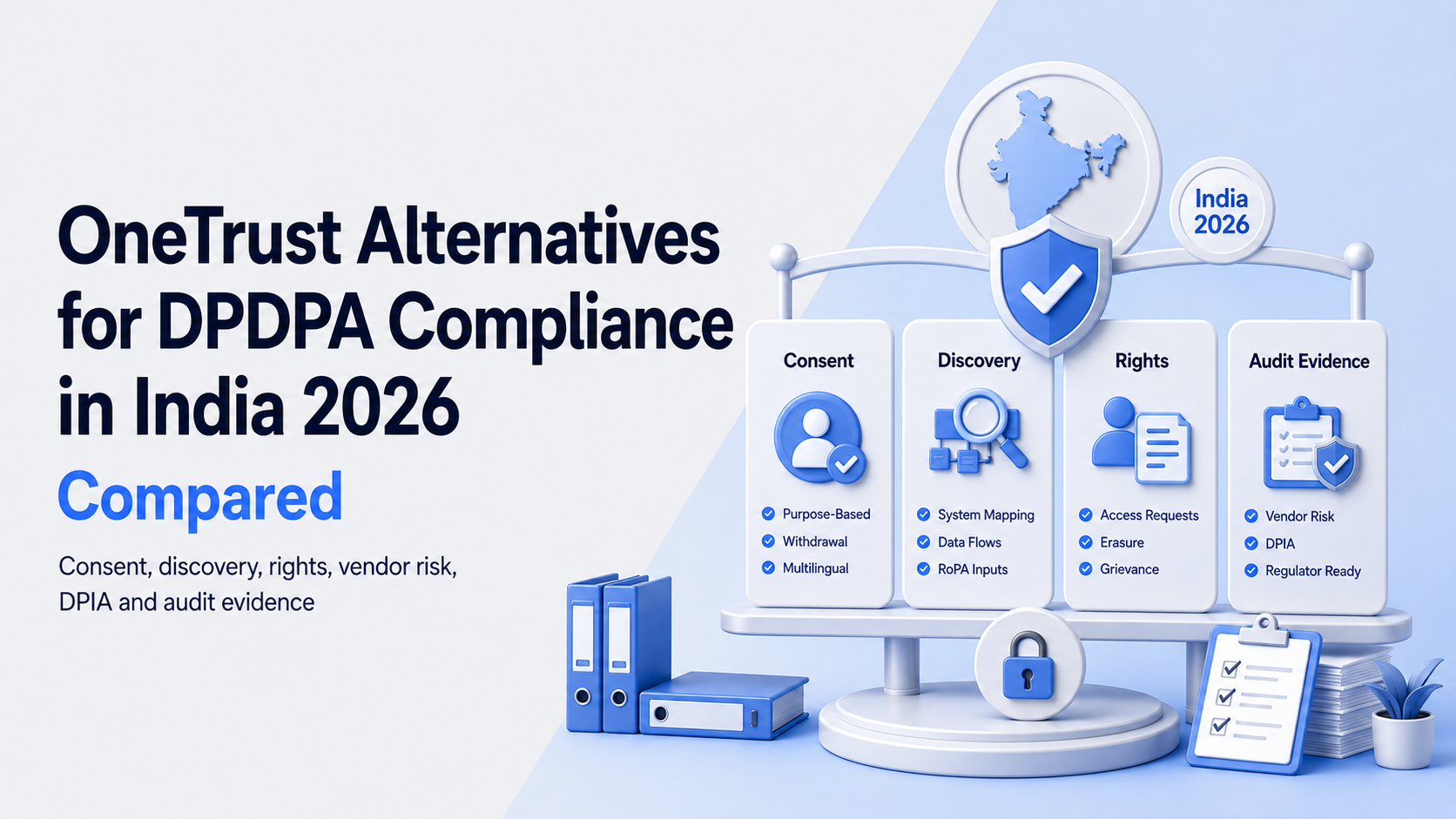
Compare OneTrust alternatives for DPDPA compliance in India across consent, data discovery, rights, vendor risk, DPIA and audit evidence.
Overview
OneTrust is one of the best-known global privacy and trust platforms.
For multinational enterprises, it can support broad privacy, consent, preference, assessment and governance workflows across multiple jurisdictions.
But Indian organisations preparing for the Digital Personal Data Protection Act often ask a more specific question:
Is there a OneTrust alternative that is more aligned to DPDPA compliance in India?
The answer depends on what the organisation needs.
A large global enterprise may want a wide privacy platform that covers GDPR, CCPA, global privacy operations, third-party risk and consent.
An Indian bank, NBFC, fintech, healthtech, SaaS company, telecom operator, e-commerce business or HR platform may need something more focused: DPDPA readiness assessment, data discovery, consent management, Data Principal rights workflows, vendor mapping, DPIA triggers, audit evidence and India-specific implementation support.
This comparison is written for teams searching for OneTrust alternatives in India and trying to understand which platform category fits their DPDPA roadmap.
If your immediate goal is to validate your DPDP gaps before buying a larger system, start with OpenBlockAI Discovery Studio for DPDPA readiness assessment.
Why Indian Teams Look for OneTrust Alternatives
Most teams do not look for a OneTrust alternative because OneTrust lacks capability.
They look because their buying context is different.
Indian DPDP implementation is not only about cookie banners or global privacy policy management. It often requires practical work across fragmented systems, vendors, consent journeys, legacy files, unstructured data, offline processes, assisted journeys and local operational teams.
Common reasons Indian teams compare alternatives include:
- India-specific DPDP workflows: teams need consent, withdrawal, grievance, breach, DPIA and vendor governance aligned to Indian operations.
- Faster implementation: mid-market and regulated Indian businesses may want a readiness-first deployment instead of a large global privacy transformation.
- Local channels: web, app, QR, branch, call centre, assisted onboarding, DSAs, TPAs, HRMS, payroll, collection agencies and field operations create India-specific data journeys.
- Cost and complexity: some teams find global platforms broader than what they need for the first phase of DPDPA readiness.
- Evidence gaps: organisations need to prove where personal data sits, which vendors receive it, what consent applies and what remediation is pending.
- Operational ownership: compliance needs legal, privacy, IT, security, product, marketing, HR, operations and vendors to work from the same baseline.
The best alternative is not always the biggest platform.
It is the one that fits the organisation’s current DPDP maturity, implementation capacity and evidence requirements.
If you are unsure whether your gap is consent, data mapping or vendor governance, use this DPDPA readiness self-assessment before shortlisting vendors.
Best OneTrust Alternatives for DPDPA Compliance in India
The platforms below solve different parts of the DPDPA problem. Some are broad DPDP compliance suites. Some are consent-first. Some focus on readiness, discovery or privacy operations.
This is a buyer guide, not a live product audit. Teams should validate pricing, deployment, data residency, integrations, security, contractual terms and product depth directly with each vendor.
1. OpenBlockAI — Discovery Studio, Consentica and Privault
OpenBlockAI is a strong fit for organisations that want to move from DPDP uncertainty to an implementation-ready baseline.
Discovery Studio helps enterprises discover personal data, map systems and vendors, identify evidence gaps, prepare RoPA inputs, detect DPIA triggers and create a readiness baseline before implementation.
Consentica supports purpose-based consent capture, withdrawal, multilingual consent journeys, Privacy Centre workflows, downstream status checks and audit-ready consent history.
Privault helps reduce raw PII exposure through tokenisation, masking, controlled reveal and audit logs.
Best for: Indian enterprises that need DPDP readiness, consent governance, data discovery, vendor mapping and privacy infrastructure rather than only a global privacy dashboard.
Consider if: your organisation needs to know what personal data exists, where it moves, what consent applies, which vendors receive it and what evidence is missing.
2. Redacto
Redacto positions itself as an AI privacy and compliance platform built for DPDPA workflows, and it is actively publishing comparison content around OneTrust alternatives for India.
Best for: teams evaluating India-focused DPDP compliance automation and looking for a packaged alternative to global privacy platforms.
Consider if: your organisation wants an India-first DPDP software option and is comparing local platforms for consent, governance and compliance workflows.
3. Privy by IDfy
Privy by IDfy positions itself as a DPDP compliance platform for enterprises, covering consent, data discovery, DPIA, third-party risk and audit evidence.
Best for: larger Indian enterprises that want a broad DPDP compliance and privacy-governance suite.
Consider if: your organisation wants an India-specific full-stack privacy platform and has the internal capacity to implement a wider compliance programme.
4. Securiti
Securiti is a global data and AI governance platform with privacy, consent, data intelligence and automation capabilities. It may be relevant for enterprises that want DPDP support as part of a wider global data-governance architecture.
Best for: large organisations that need data intelligence, privacy automation, AI governance and global privacy operations in one broader platform.
Consider if: your DPDPA roadmap is connected to enterprise data governance, data security posture management or AI governance.
5. Consentin by Leegality
Consentin positions itself around consent and privacy management, including consent management, Privacy Centre, data discovery, mapping, DPIA and third-party risk assessments.
Best for: Indian organisations that want consent and privacy workflows with DPDP-focused operational modules.
Consider if: your priority is consent, rights, assessments and privacy operations in one India-focused platform.
6. ConsentOS
ConsentOS positions itself as DPDP compliance software and managed infrastructure, with consent management, discovery, workflows and buyer-guide positioning for Indian teams.
Best for: startups and mid-market organisations comparing DPDP compliance software options by implementation speed and price sensitivity.
Consider if: you need a lighter or managed DPDP compliance layer and want to compare pricing and scope before selecting a platform.
7. CookieYes
CookieYes is widely known for cookie consent and website consent management. It may be useful for businesses that mainly need website tracker consent and cookie-banner implementation.
Best for: startups, websites and marketing teams with a narrower cookie-consent requirement.
Consider if: your immediate issue is website cookie consent rather than full DPDPA readiness across systems, vendors, Data Principal rights and consent governance.
8. OneConsent, ConsentiQo and other India-first CMPs
The Indian consent-management category is growing quickly, with several platforms positioning themselves around DPDP consent capture, notices, withdrawal and consent records.
Best for: organisations that want to compare local consent-first products before committing to a broader privacy stack.
Consider if: your main requirement is consent capture and preference management, and you do not yet need deeper data discovery, DPIA, vendor governance or privacy infrastructure.
How to Choose the Right DPDPA Platform
Choosing a OneTrust alternative should start with the problem you are solving.
If your main gap is consent management, evaluate whether the platform supports purpose-based consent, notice versioning, multilingual journeys, withdrawal, preference management, audit trails and downstream enforcement.
If your main gap is data discovery, check whether the platform can identify personal data across databases, SaaS tools, email, spreadsheets, shared drives, cloud storage, logs, scanned forms and vendor exports.
If your main gap is Data Principal rights, check whether it can route access, correction, erasure, withdrawal, grievance and nomination workflows to internal teams and processors.
If your main gap is vendor risk, test whether the platform maps actual data fields, transfer methods, retention, sub-processors, deletion obligations and evidence — not only vendor names.
If your main gap is audit evidence, check whether the platform can prove what was found, who approved it, which control is missing and what remediation remains open.
If your main gap is raw PII exposure, evaluate whether tokenisation, masking and access controls are required in addition to privacy workflow software.
Before shortlisting vendors, ask these questions:
- Is the platform built mainly for global privacy operations or India-specific DPDPA implementation?
- Does it support the DPDP Rules 2025 timeline and operational requirements?
- Can it map personal data across structured and unstructured sources?
- Can it create a Record of Processing Activities or processing register?
- Can it support purpose-based consent and withdrawal propagation?
- Can it handle Data Principal rights workflows and grievance tracking?
- Can it map vendors and processors to actual personal-data flows?
- Can it identify DPIA triggers and evidence gaps?
- Can it integrate with CRM, HRMS, marketing, support, cloud and data systems?
- Can it provide audit-ready evidence rather than only maturity dashboards?
- Does implementation require a large global privacy transformation?
- Can the platform scale from readiness assessment to operational controls?
If your team is still unsure which gaps are real and which are assumed, run a Discovery Studio readiness assessment before committing to a large platform rollout.
Build India-Specific DPDP Readiness
OneTrust may be the right fit for organisations that need a broad global privacy platform across many jurisdictions.
But Indian DPDPA implementation often starts with a more immediate need:
Can we prove what personal data we process, where it sits, which purpose applies, which vendors receive it and what evidence supports our readiness claim?
For many Indian organisations, the first phase should not be a large software rollout.
It should be a validated readiness baseline.
OpenBlockAI helps teams move from scattered assumptions to implementation-ready evidence through three layers:
- Discovery Studio: data discovery, system mapping, vendor mapping, RoPA inputs, DPIA triggers, retention gaps and evidence baseline.
- Consentica: purpose-based consent, withdrawal, multilingual journeys, Privacy Centre, downstream status checks and audit-ready consent records.
- Privault: tokenised PII, PHI and PCI protection, masking, controlled reveal and audit logs for sensitive-data access.
This makes OpenBlockAI especially relevant for BFSI, fintech, healthcare, telecom, SaaS, HRTech, e-commerce, marketplaces and regulated enterprises that need DPDP implementation depth in India.
If your team is comparing OneTrust alternatives, do not only ask which vendor has the most modules.
Ask which platform can help you answer the regulator, the Board, the auditor and the customer with evidence.
Explore Discovery Studio for DPDPA readiness assessment.
Explore Consentica for DPDPA consent management.
Speak with OpenBlockAI about DPDPA compliance implementation in India.