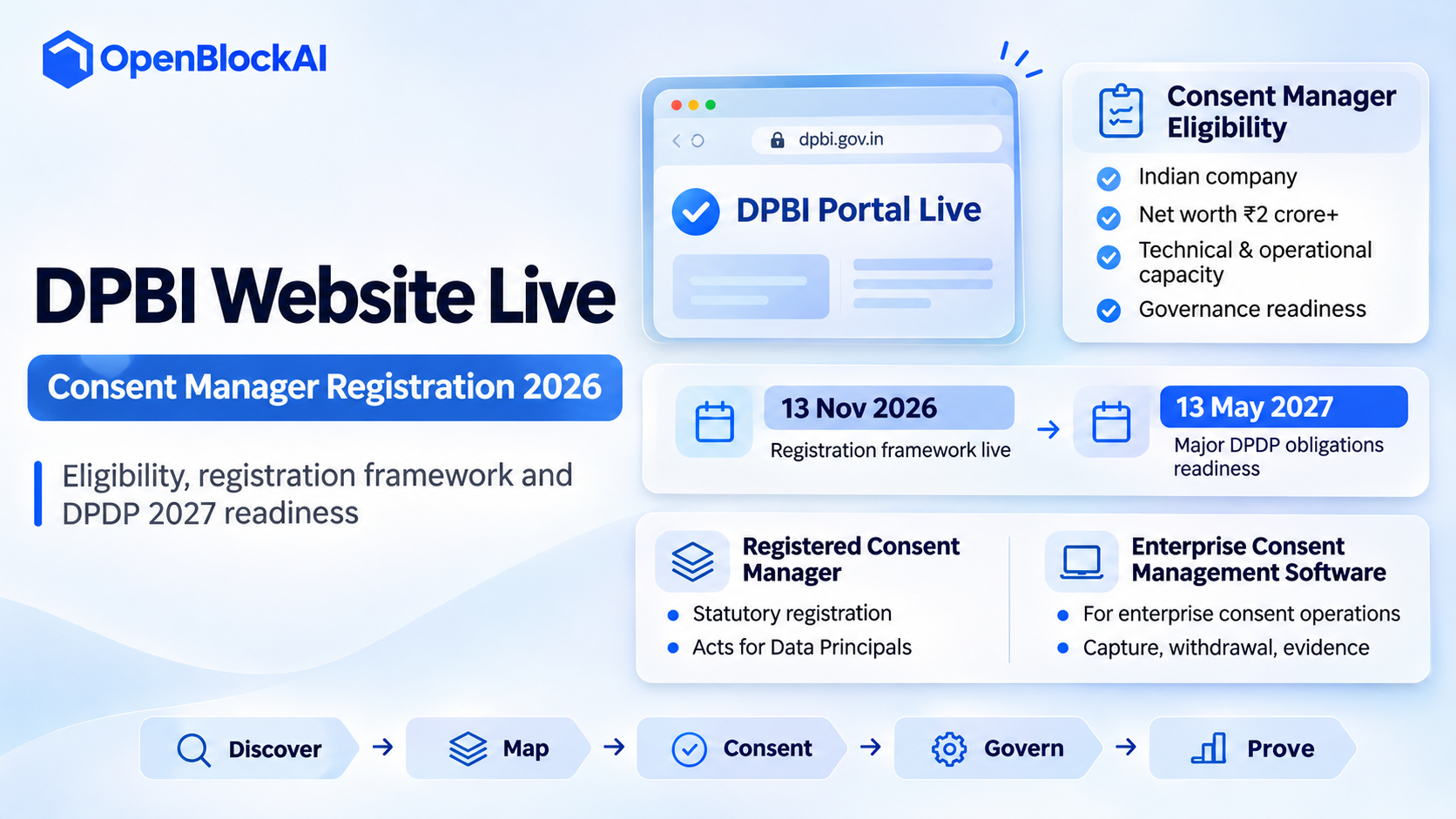
DPBI portal is live for Consent Manager registration. Explore eligibility, ₹2 crore net worth, DPDP 2027 deadlines and Significant Data Fiduciary readiness.
Overview: Data Protection Board of India Website Is Live
India's DPDP framework has entered an important new implementation phase.
The Data Protection Board of India (DPBI) website is now live at dpbi.gov.in, and the online application process for Consent Manager registration has opened.
On 14 November 2026, the Ministry of Electronics and Information Technology (MeitY) announced that the Consent Manager registration framework had come into effect on 13 November 2026.
Eligible Indian companies can now seek registration as Consent Managers under the Digital Personal Data Protection Act, 2023 and DPDP Rules, 2025.
For enterprises, this development is significant even if they do not intend to become registered Consent Managers.
It signals progress in India's institutional data-protection framework while bringing attention to the next implementation milestone: 13 May 2027, when major Data Fiduciary obligations are scheduled to take effect.
For CISOs, DPOs, compliance heads, CIOs and technology teams, the immediate question is not simply whether the DPBI portal is live.
It is whether their organisation can demonstrate where personal data exists, why it is processed, how consent is managed and what evidence supports compliance.
Is your organisation ready for the next DPDP implementation milestone?
Assess Your DPDP Readiness with Discovery Studio
Discover personal data, map processing activities, identify RoPA and DPIA gaps, review vendors and prepare an evidence-backed compliance roadmap.
Explore Consentica for Enterprise Consent Governance
Manage purpose-based notices, consent capture, withdrawal, downstream synchronisation and verifiable consent records.
This guide explains the DPBI portal launch, Consent Manager registration eligibility, application preparation, the difference between statutory Consent Managers and enterprise consent software, Significant Data Fiduciary obligations and the practical steps Indian enterprises should take before May 2027.
DPBI Portal Live: What Changed on 13 November 2026?
The launch of the DPBI website and Consent Manager registration process marks a new stage in the implementation of India's Digital Personal Data Protection framework.
The official government announcement confirms three important developments.
1. Consent Manager registration has commenced.
The registration framework became effective on 13 November 2026. Eligible companies can apply to the Data Protection Board of India for registration as Consent Managers.
2. An online registration portal is available.
The government has launched dpbi.gov.in as the official portal through which eligible applicants can pursue Consent Manager registration.
3. Applications are subject to regulatory assessment.
Submitting an application does not automatically make an organisation a registered Consent Manager. The Board must assess the application against applicable conditions and determine whether registration should be granted.
Details of registered Consent Managers are to be published on the Board's website.
What does this mean for businesses?
For companies seeking registration, it creates an application pathway under Rule 4 of the DPDP Rules, 2025.
For banks, NBFCs, fintech companies, insurers, healthcare providers, SaaS platforms, marketplaces and other Data Fiduciaries, it provides an important reason to review existing consent and data-governance arrangements.
However, the opening of Consent Manager registration should not be confused with the commencement of every substantive DPDP obligation. The Act and Rules follow a phased implementation schedule.
Important clarification: The availability of an online application portal does not, by itself, establish that the Board has completed appointments, approved applicants or begun every inquiry and penalty function. These are separate operational and statutory matters.
DPDP Act Implementation Timeline: Phase 1, Phase 2 and May 2027
Understanding the DPDP implementation timeline is essential because different provisions become operative at different stages.
The DPDP Act, 2023 and DPDP Rules, 2025 establish a phased commencement structure rather than a single universal compliance date.
| Implementation Stage | Effective Date | Major Development |
|---|---|---|
| Phase 1 | 13 November 2025 | Initial provisions relating to definitions, Board establishment and supporting institutional arrangements commenced. |
| Phase 2 | 13 November 2026 | Consent Manager registration provisions, including Rule 4 and the relevant statutory framework, commenced. The online registration portal is now available. |
| Phase 3 | 13 May 2027 | Major remaining provisions, including key Data Fiduciary obligations, notices, consent, rights, security, breach-related requirements and additional Significant Data Fiduciary obligations, are scheduled to commence. |
What is effective in November 2026?
The immediate development is the registration framework for entities seeking to become Consent Managers.
What is scheduled for May 2027?
Major operational requirements relating to personal-data processing, notices, consent, Data Principal rights, security safeguards, breach reporting and applicable Significant Data Fiduciary obligations.
These commencement dates matter because enterprises should distinguish requirements already operative from those for which implementation preparation is currently underway.
Organisations should also monitor future notifications, directions and amendments rather than assuming that every requirement applies in the same manner to every business.
May 2027 is a practical implementation deadline for enterprise readiness.
Before redesigning consent journeys, enterprises need a reliable inventory of the personal data, applications, vendors and processing purposes involved.
For Data Fiduciaries, the coming months offer an opportunity to assess existing systems, define ownership, build remediation plans and test privacy controls before the next major commencement date.
Consent Manager Registration Eligibility Under DPDP Rule 4
One of the most important questions following the DPBI portal launch is: Who is eligible to register as a Consent Manager in India?
Rule 4 and Part A of the First Schedule to the DPDP Rules, 2025 establish the conditions for Consent Manager registration.
The key requirements include:
- Indian incorporation: The applicant must be a company incorporated in India.
- Minimum net worth: The applicant must have a net worth of at least ₹2 crore.
- Technical capacity: The company must have sufficient capability to operate and maintain the proposed consent-management services.
- Operational capacity: The applicant must demonstrate the ability to fulfil the obligations applicable to registered Consent Managers.
- Financial soundness: The company's financial condition, capital structure and earning prospects must be adequate.
- Management integrity: Directors, key managerial personnel and senior management must have an appropriate reputation and record of fairness and integrity.
- Corporate governance: The memorandum and articles of association must include specified provisions supporting compliance with conflict-of-interest requirements.
- Data Principal interests: The proposed operations must be in the interests of Data Principals.
- Independent certification: The applicant must satisfy the independent certification requirements relating to its interoperable platform, applicable standards and technical and organisational safeguards.
The minimum ₹2 crore net-worth threshold is therefore only one part of the eligibility framework.
What must a registered Consent Manager be able to do?
Part B of the First Schedule describes obligations that include enabling Data Principals to give, manage, review and withdraw consent, maintaining prescribed records, providing access to those records, implementing security safeguards and avoiding conflicts of interest.
The Rules also require the arrangement for making personal data available or sharing it to ensure that its contents are not readable by the Consent Manager.
Specified consent, notice and data-sharing records must generally be maintained for at least seven years, subject to the applicable longer-retention conditions.
Other obligations address audit mechanisms, governance disclosures and restrictions on subcontracting or assigning statutory responsibilities.
These requirements illustrate why registration is a regulated business activity rather than simply the purchase or deployment of a consent-management application.
Applicants should refer to Rule 4, the First Schedule and the latest official DPBI application instructions when evaluating eligibility.
How to Apply for Consent Manager Registration on dpbi.gov.in
Companies planning to become registered Consent Managers should approach the application as a regulatory, technical and governance exercise.
The newly launched portal is available at dpbi.gov.in.
The registration journey can be understood in three steps.
Step 1: Check eligibility
Review the conditions under Rule 4 and Part A of the First Schedule. Confirm the company's incorporation status, net worth, technical and operational capabilities, management integrity, governance structure and independent certification requirements.
Step 2: Collate registration documents
Prepare the documents identified in the portal's current readiness checklist. Depending on the applicable application instructions, supporting materials may need to demonstrate:
- Corporate incorporation and constitutional documents.
- Financial position and net-worth evidence.
- Directors, management and governance arrangements.
- Technical architecture and interoperability.
- Information-security and organisational safeguards.
- Conflict-of-interest controls.
- Consent records, auditability and retention capabilities.
- Required independent assessments or certifications.
This is a practical preparation list, not a substitute for the portal's official and potentially updated document checklist.
Step 3: Submit the application
Complete the online registration application, upload the required supporting documentation and submit the application according to the instructions displayed on the official portal.
The Board may seek additional information or conduct inquiries to assess compliance with the registration conditions.
Does submitting the application guarantee registration?
No. Registration is subject to the Board's assessment. The Board may approve an eligible application or reject it with reasons, in accordance with the applicable provisions.
Important: The registration pathway is for entities seeking statutory Consent Manager status. It is not a general registration requirement for every Indian business that processes personal data or deploys enterprise consent-management software.
Registered Consent Manager vs Consent Management Software
The launch of the DPBI portal is likely to increase searches for consent managers, consent management platforms and DPDP consent software.
These terms are related, but they are not interchangeable.
A registered Consent Manager is a legal entity registered with the Data Protection Board of India under the applicable DPDP framework to provide specified consent-management services to Data Principals.
Enterprise consent management software is technology that a Data Fiduciary may use to manage notices, capture and record consent, process withdrawals, maintain preference histories and synchronise consent status across business systems.
| Area | Registered Consent Manager | Enterprise Consent Management Software |
|---|---|---|
| Nature | Regulated entity registered under the DPDP framework. | Technology platform or software used for consent governance. |
| Primary purpose | Enable Data Principals to manage consent through an accessible, transparent and interoperable platform. | Help organisations manage their own consent notices, collection journeys, records and operational enforcement. |
| Registration | Requires approval under the applicable registration framework. | Deploying consent software does not by itself require the software to be a registered Consent Manager. |
| Typical capabilities | Interoperable consent management, prescribed recordkeeping, Data Principal access and statutory governance controls. | Purpose-based notices, consent APIs, audit trails, Privacy Centre, withdrawal and processor synchronisation. |
| Primary buyer or user | Organisations seeking to operate as regulated Consent Managers and the Data Principals they serve. | Data Fiduciaries, privacy teams, product teams, compliance teams and IT teams. |
For example, a bank may need an enterprise consent-management platform to govern its customer journeys even if the bank does not seek registration as a statutory Consent Manager.
Similarly, a SaaS company may need purpose-wise consent capture, withdrawal, notices and evidence across its products without becoming a registered Consent Manager.
Where does Consentica fit?
Consentica by OpenBlockAI is an enterprise consent-governance platform designed to help organisations implement purpose-based notices, capture consent, manage withdrawal, maintain consent evidence and synchronise current consent status across systems.
Consentica should not be interpreted as claiming statutory registration with DPBI merely because it provides consent-management technology. Registered Consent Manager status is a separate regulatory determination.
Need enterprise consent governance rather than Consent Manager registration?
Explore Consentica — DPDP Consent Management, Withdrawal and Audit Evidence
Build purpose-specific consent journeys across applications, digital channels, assisted workflows and connected processors.
What Data Fiduciaries Should Do Before May 2027
The opening of Consent Manager registration is important, but most Indian enterprises have a different immediate challenge.
They need to prepare their own personal-data processing operations for the next stage of DPDP implementation.
For enterprises, this preparation should begin with five questions.
1. Where does our personal data exist?
Customer, employee, borrower, patient and user data may exist across core applications, databases, cloud storage, email, endpoints, spreadsheets, customer-support systems and vendor repositories.
Without discovery, organisations may miss data stores that require notices, access restrictions, retention controls or deletion workflows.
2. Why are we processing each data category?
A customer email address may be used for account servicing, marketing, support, fraud prevention or another purpose. Those activities must be assessed according to the applicable legal basis and operational requirements.
Purpose mapping should connect personal-data categories to business functions, collection points, systems and processors.
3. Can we prove what the Data Principal agreed to?
A basic checkbox is not the same as a reconstructable consent record. Enterprises should assess their ability to retain the notice version, purpose, language, timestamp, channel and user action associated with consent.
4. What happens when consent is withdrawn?
A withdrawal request may affect CRM, marketing, analytics, support, partner or vendor workflows. Enterprises should identify which systems need status updates and which processing activities must stop, subject to applicable legal requirements.
5. What evidence can we show?
Policies alone do not establish that controls work. Enterprises should prepare evidence of data inventories, purpose mapping, notices, consent histories, vendor arrangements, retention rules, rights requests, risk decisions and remediation.
Start with data discovery, not assumptions.
Discovery Studio helps enterprises discover and classify personal data across structured and unstructured environments, map applications and vendors, prepare RoPA inputs, identify DPIA triggers and assess compliance gaps.
Once the processing landscape is mapped, Consentica helps organisations operationalise purpose-specific consent, withdrawal and consent evidence across connected business systems.
Do you know which of your customer-data systems are ready for May 2027?
Map Your Personal Data and Identify DPDP Gaps with Discovery Studio
See How Consentica Manages Consent from Capture to Withdrawal
The right implementation sequence is to identify actual personal-data flows, define the applicable controls, implement the workflows and retain evidence of their effectiveness.
Significant Data Fiduciary Obligations: DPIA, Data Audits and Governance
Another important search topic emerging around DPDP implementation is the Significant Data Fiduciary (SDF).
Under Section 10 of the DPDP Act, the Central Government may notify a Data Fiduciary or class of Data Fiduciaries as Significant Data Fiduciaries after considering specified factors.
Those factors include:
- Volume and sensitivity of personal data processed.
- Risk to the rights of Data Principals.
- Potential impact on India's sovereignty and integrity.
- Risk to electoral democracy.
- Security of the State.
- Public order.
Is every large enterprise automatically a Significant Data Fiduciary?
No. Size or sector alone should not be treated as proof of SDF status. The statutory designation depends on government notification identifying an organisation or class of organisations.
However, organisations with extensive, complex or potentially high-impact personal-data processing should prepare for the possibility of additional obligations.
What additional obligations apply to Significant Data Fiduciaries?
The DPDP Act and Rule 13 provide for additional requirements, including:
- Data Protection Officer: An SDF must appoint a Data Protection Officer meeting the statutory conditions, including being based in India and reporting to the Board of Directors or equivalent governing body.
- Independent data auditor: An SDF must appoint an independent data auditor to assess compliance.
- Periodic DPIA: Rule 13 requires a Data Protection Impact Assessment once every twelve months from the applicable notification or inclusion.
- Periodic audit: Rule 13 also requires an audit once every twelve months, with significant observations reported to the Board in the prescribed manner.
- Algorithmic due diligence: SDFs must assess whether relevant technical measures, including algorithmic software, are likely to pose risks to Data Principal rights.
- Potential data-transfer restrictions: Additional requirements may apply to specific personal data identified by the Central Government under the relevant provisions.
Is DPIA mandatory for every Indian enterprise?
The periodic DPIA requirement in Rule 13 is directed at Significant Data Fiduciaries. Other businesses may still use DPIA-style assessments as a prudent governance practice, but should not assume that the same statutory periodic duty automatically applies to every Data Fiduciary.
Why should enterprises prepare now?
A meaningful DPIA requires visibility into processing activities, personal-data categories, purposes, systems, vendors, exposure pathways and risks to individuals.
If an enterprise cannot establish that data landscape, an assessment may become a paperwork exercise instead of an evidence-based review.
This is where Discovery Studio's data mapping, RoPA preparation, risk analysis and DPIA readiness capabilities can support the underlying work.
Preparing for Significant Data Fiduciary obligations or DPIA reviews?
Assess Data Flows, Processing Records and DPIA Readiness with Discovery Studio
Identify data sources, owners, vendor exposure, higher-risk processing and evidence gaps before formal assessments.
DPDP Compliance Readiness Checklist for Indian Enterprises
The period between the November 2026 Consent Manager registration milestone and the May 2027 implementation milestone is an opportunity to assess practical enterprise readiness.
The following checklist is intended for Data Fiduciaries, technology teams, DPOs, compliance leaders and organisations preparing for possible Significant Data Fiduciary obligations.
A. Data discovery and inventory
- Identify databases, business applications, cloud storage, APIs and data warehouses processing personal data.
- Include unstructured locations such as spreadsheets, emails, documents, shared repositories and endpoints.
- Classify personal-data categories and identify higher-risk processing contexts.
- Map data owners, departments and responsible systems.
- Document sources, destinations, processing purposes and vendor exchanges.
B. Notices and consent governance
- Review whether notices explain relevant personal data and specified processing purposes.
- Identify processing activities based on consent and those relying on another applicable statutory ground.
- Separate purposes where independent choices are needed.
- Prepare understandable language-aware notices and consent requests.
- Preserve consent and notice-version evidence.
- Design withdrawal processes that reach affected systems and processors.
C. Data Principal rights
- Identify workflows for applicable access, correction, completion, updating and erasure requests.
- Define grievance-handling ownership and escalation.
- Prepare request verification and response records.
- Review how users can find contact details and exercise their rights.
D. Vendor and processor governance
- Maintain an inventory of processors receiving personal data.
- Map the data categories and purposes associated with each vendor.
- Review security arrangements, contracts, subcontracting and sharing workflows.
- Identify how relevant withdrawal and deletion instructions are communicated downstream.
E. Retention, security and breach readiness
- Review data retention schedules and applicable legal exceptions.
- Identify old exports, unnecessary copies and uncontrolled repositories.
- Assess access controls, encryption or other appropriate safeguards, and activity logging.
- Prepare breach detection, investigation, escalation and notification workflows applicable from the relevant commencement date.
- Maintain evidence of remediation decisions and completed actions.
F. RoPA, DPIA and SDF readiness
- Prepare a practical processing-activity register to support accountability.
- Map purposes, data categories, data flows, vendors and retention periods.
- Identify activities that may require deeper risk assessment.
- Review whether any future SDF notification could apply to the organisation.
- Prepare for independent data audit and periodic DPIA duties if designated.
- Review AI, profiling and other algorithmic processing that could affect Data Principal rights.
G. Evidence and governance
- Identify accountable leaders across IT, security, legal, privacy, HR, marketing and operations.
- Build a documented remediation roadmap with owners and target dates.
- Maintain evidence of discovered data, decisions, policies, vendor reviews and corrective actions.
- Reassess the inventory when systems, processing purposes or vendors change.
Important: This is an operational readiness checklist. Some activities, such as maintaining a RoPA-style register, are practical governance measures rather than an identically prescribed standalone requirement for every organisation. Applicability depends on the statutory provision, commencement date and relevant circumstances.
How many of these readiness controls can your enterprise actually evidence?
Start with Discovery Studio — Data Discovery, Classification, RoPA, DPIA and Vendor Mapping
Explore Consentica — Purpose-Based Consent, Withdrawal and Consent Evidence
Prepare for DPDP with Discovery Studio and Consentica
The DPBI Consent Manager registration portal is an important development in India's data-protection journey.
But for most enterprises, the practical challenge remains inside their own applications, databases, customer journeys and vendor ecosystem.
Can the organisation find the personal data it processes?
Can it identify the purpose behind each processing activity?
Can it demonstrate the consent notice shown to the user?
Can it process withdrawal across downstream systems?
Can it prepare reliable evidence for governance reviews, DPIAs and audits?
OpenBlockAI approaches these challenges through two complementary products.
Discovery Studio: Establish the data and compliance baseline.
Discovery Studio supports enterprise data discovery and classification across structured and unstructured sources, system and purpose mapping, RoPA inputs, DPIA trigger identification, vendor governance, retention-gap analysis and audit-ready readiness evidence.
It helps organisations understand what personal data exists and which processing activities require attention before changing technology or compliance workflows.
Consentica: Operationalise consent governance.
Consentica supports purpose-specific notices, multilingual consent journeys, web and assisted consent capture, Privacy Centre workflows, withdrawal, consent-version history, real-time consent checks, processor synchronisation and audit-grade records.
It helps organisations connect a user's consent decision to the actual systems and business processes that rely on it.
Together, the implementation approach is:
Discover personal data → Map purposes and processing → Identify gaps → Establish governance controls → Implement consent workflows → Enforce withdrawal → Maintain evidence.
Neither platform should be mistaken for regulatory registration or automatic legal compliance. They are technology capabilities intended to support enterprise implementation and governance.
Prepare your enterprise for the next phase of DPDP implementation.
Assess DPDP Readiness with Discovery Studio
Discover personal data, identify control gaps and prepare your organisation's implementation roadmap.
Explore Consentica for Enterprise Consent Management
Build consent journeys that connect notices, choices, withdrawal and audit evidence across applications and processors.
Regulatory references: Digital Personal Data Protection Act, 2023, including Sections 6 and 10; Digital Personal Data Protection Rules, 2025, including Rules 3, 4 and 13 and the First Schedule; MeitY's announcement of 14 November 2026 concerning Consent Manager registration. The official DPBI portal is dpbi.gov.in.
Last updated: 15 November 2026.