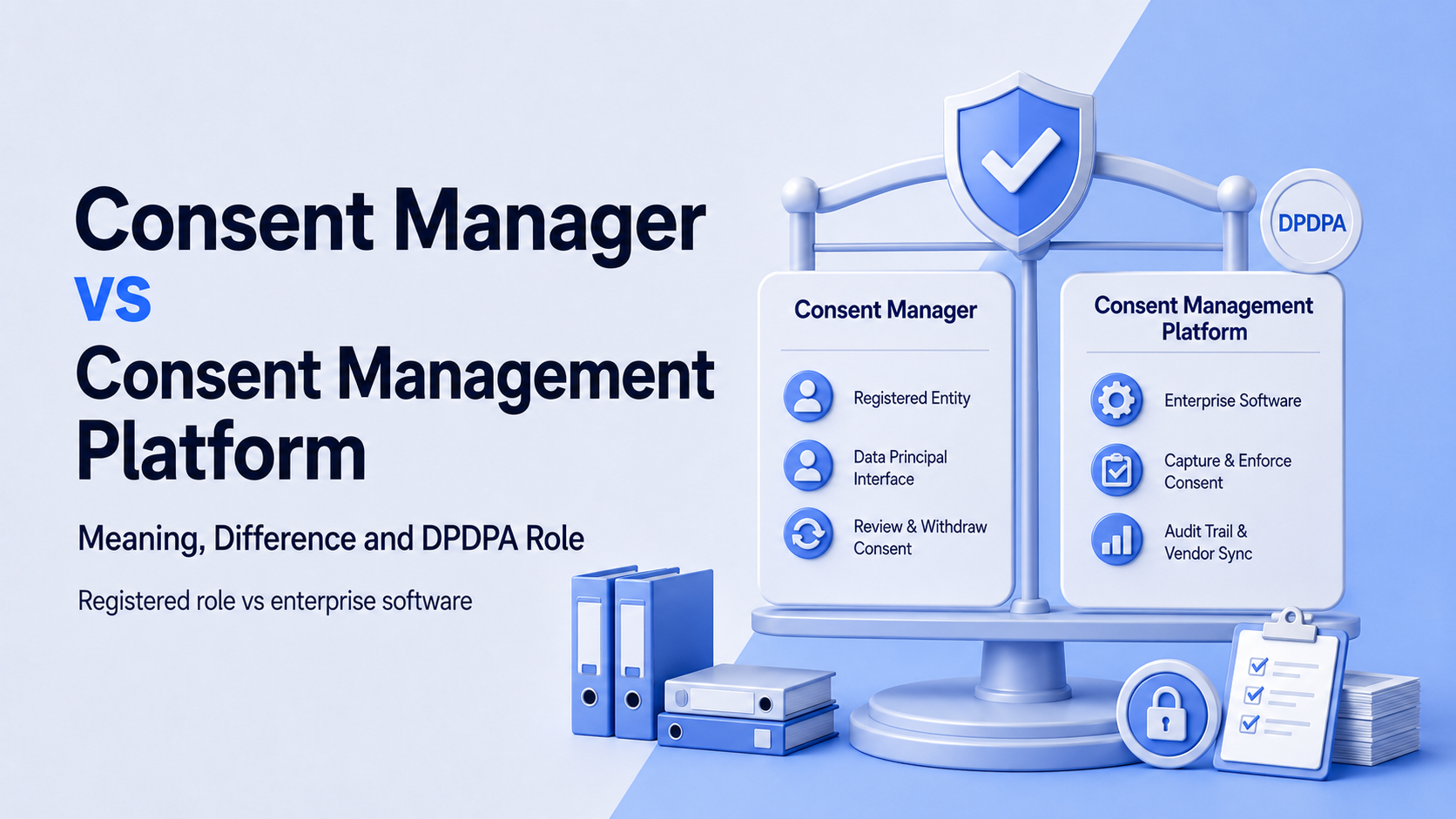
Understand the difference between a DPDP Consent Manager and a consent management platform, with examples, roles, obligations and enterprise use cases.
Overview
Many Indian organisations are using the terms Consent Manager and Consent Management Platform as if they mean the same thing.
They do not.
Under India’s DPDP framework, a Consent Manager is a specific statutory role. It refers to a person registered with the Data Protection Board who acts as a single point of contact to help a Data Principal give, manage, review and withdraw consent through an accessible, transparent and interoperable platform.
A Consent Management Platform, on the other hand, is enterprise software used by an organisation to collect, manage, store, enforce and evidence consent across customer journeys.
The distinction matters because buying consent software does not automatically make a company a registered Consent Manager.
And waiting for Consent Manager registration does not remove the organisation’s need to manage consent properly across its own systems, apps, vendors, marketing tools, CRM and customer journeys.
You can review the official DPDP Rules and government materials here: Digital Personal Data Protection Rules 2025.
If your organisation is evaluating consent infrastructure for DPDP readiness, explore Consentica by OpenBlockAI.
Consent Manager vs Consent Management Platform
The simplest way to understand the difference is this:
A Consent Manager is a regulated role.
A Consent Management Platform is software.
They can work together, but they are not the same thing.
| Point of comparison | Consent Manager | Consent Management Platform |
|---|---|---|
| Meaning | A person or entity registered with the Data Protection Board to help Data Principals manage consent. | Software used by organisations to capture, manage, sync and evidence consent. |
| Legal status | Recognised as a statutory role under the DPDP framework. | Not automatically a statutory role. It is a technology platform unless separately registered or approved where applicable. |
| Primary user | Data Principals who want to give, manage, review or withdraw consent. | Data Fiduciaries, privacy teams, product teams, marketing teams, DPOs, CISOs and compliance teams. |
| Main purpose | Acts as a single point of contact for consent management by the individual. | Helps enterprises operationalise consent across systems, channels, vendors and audit records. |
| Example use | A user manages consent across participating Data Fiduciaries through a registered consent intermediary. | A bank, fintech, hospital, SaaS company or marketplace uses software to capture consent in app, branch, web, QR, call-centre and CRM journeys. |
| Enterprise relevance | Important where Data Principals use a registered Consent Manager to manage consent. | Important for day-to-day implementation of notice, consent, withdrawal, preference management, APIs, vendor sync and audit evidence. |
A Consent Manager may use technology to provide its service.
A Consent Management Platform may support the workflows needed for consent governance.
But a CMP is not automatically a registered Consent Manager.
This is the confusion many organisations need to resolve before they choose a DPDP implementation approach.
Why the Difference Matters Under DPDPA
The difference matters because the responsibilities, users and implementation goals are different.
A Data Fiduciary cannot assume that consent compliance is solved simply because it plans to interact with a Consent Manager in the future.
The Data Fiduciary still needs to manage its own consent notices, purpose registry, customer journeys, consent records, withdrawal workflows, downstream system updates, processor sharing and audit evidence.
For example, a fintech may collect consent during onboarding for KYC, bureau checks, account servicing, promotional communication and partner offers.
Even if a Consent Manager exists in the ecosystem, the fintech still needs to know:
- Which purpose was shown to the user.
- Which notice version was accepted.
- Which language was shown.
- Which channel captured the choice.
- Whether the user later withdrew consent.
- Which systems and vendors relied on that consent.
- Whether downstream systems received the latest status.
This is the work of consent governance.
A Consent Management Platform helps the enterprise operationalise this work.
It helps connect consent capture with enforcement across CRM, marketing tools, support systems, analytics, vendors, processors and audit logs.
This distinction is especially important for BFSI, fintech, healthcare, telecom, SaaS, e-commerce, travel and marketplace businesses because consent does not live in one form or one database field.
Consent appears across apps, websites, branches, call centres, QR journeys, assisted journeys, partner journeys and API-led workflows.
If your current consent record is only a yes/no field, read this guide on how to prove what the customer actually agreed to.
What Enterprises Actually Need to Implement
For most organisations, the immediate implementation question is not only whether they understand the legal definition of Consent Manager.
The more urgent question is whether they can manage consent inside their own operating environment.
A DPDP-ready Consent Management Platform should support:
- Purpose-based consent: consent linked to specific purposes rather than one broad privacy flag.
- Notice versioning: the ability to preserve the exact notice shown at the time of consent.
- Language records: proof of which language version was displayed to the user.
- Multi-channel capture: web, app, QR, branch, call-centre, assisted and API-led journeys.
- Consent withdrawal: withdrawal that is as easy as capture and does not depend on hidden manual processes.
- Preference management: customer control over communication, marketing and purpose-level choices.
- Privacy Centre workflows: self-service review, update, withdrawal and request tracking.
- Downstream enforcement: consent status available to CRM, marketing, analytics, support and operational systems.
- Vendor and processor sync: propagation of consent changes to vendors using data for the relevant purpose.
- Audit trail: evidence of who gave consent, when, for what purpose, under which notice version and what changed later.
This is where many organisations discover the gap between front-end consent capture and real consent governance.
A banner may collect a click.
A CRM may store a status.
A marketing tool may have a preference field.
A vendor may receive a spreadsheet.
A call centre may use an older customer profile.
But unless all of these systems work from the same purpose-level consent status, the organisation may not be able to prove that the customer’s latest choice was respected.
Consentica helps enterprises manage purpose-based consent across digital and assisted journeys. It supports consent capture, withdrawal, Privacy Centre interactions, multilingual notices, audit history, downstream checks and vendor sync.
Build Consent Infrastructure Before the Deadline
The Consent Manager vs Consent Management Platform distinction matters because it prevents two common mistakes.
Mistake one: assuming that buying a consent tool automatically makes the organisation a Consent Manager.
Mistake two: assuming that the future Consent Manager ecosystem removes the need for enterprise consent governance.
Both assumptions are risky.
Organisations still need a practical consent operating layer that can answer:
- What purposes are we requesting consent for?
- Which notice version is linked to each purpose?
- Which channels collect consent?
- Where is consent stored?
- How can the user withdraw consent?
- How does withdrawal reach downstream systems?
- Which vendors rely on consent?
- Can we reconstruct the customer’s decision later?
- Can we prove that stale consent was not used?
For DPDP readiness, consent should not remain a document, banner or CRM checkbox.
It should become infrastructure.
That means purpose-level records, versioned notices, current status APIs, withdrawal propagation, vendor sync and audit-ready history.
If your organisation is still mapping where consent is collected, stored and used, start with a DPDPA readiness assessment using Discovery Studio.
If your organisation is ready to implement purpose-based consent journeys, evaluate Consentica by OpenBlockAI.
Book a Consentica walkthrough with OpenBlockAI.
The organisations that get this right will not treat consent as a one-time checkbox.
They will treat it as an enforceable customer instruction that every relevant system and vendor can understand.