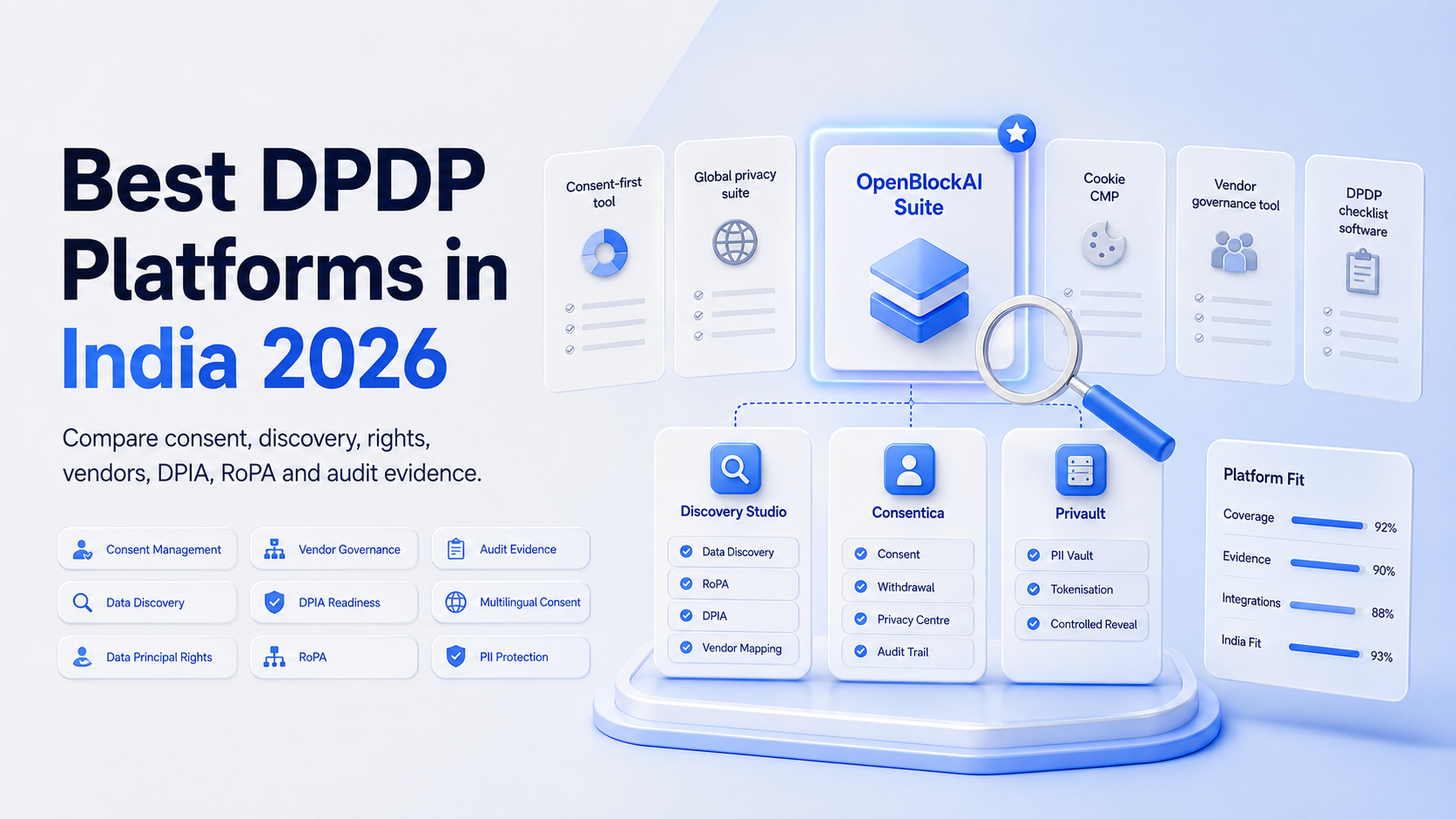
Compare the best DPDP platforms in India for consent management, data discovery, Data Principal rights, vendor governance, DPIA, RoPA and audit evidence.
Overview
Finding the best DPDP platform in India is no longer a future planning exercise.
With the Digital Personal Data Protection Rules, 2025 notified, Indian organisations now need practical systems to manage consent, discover personal data, respond to Data Principal requests, govern vendors, assess DPIA triggers, maintain RoPA inputs and create audit-ready evidence.
You can review the official MeitY material here: Digital Personal Data Protection Rules 2025.
The challenge is that most DPDP platforms sound similar on the surface.
They all mention compliance, consent, automation, dashboards and audit readiness.
But the real buying question is sharper:
Can the platform help your organisation prove how personal data is collected, used, shared, retained, protected and deleted across real systems and vendors?
If your organisation wants to first identify its DPDP gaps before choosing a full platform, start with OpenBlockAI Discovery Studio for DPDPA readiness assessment.
This guide compares the major types of DPDP platforms in India and explains how to choose between consent-first tools, discovery-led platforms, full-suite DPDP software, global privacy platforms and implementation-led compliance solutions.
What Is a DPDP Platform?
A DPDP platform is software that helps organisations operationalise requirements under India’s Digital Personal Data Protection framework.
At minimum, a practical DPDP platform should help teams manage:
- Consent notices and purpose-based consent records.
- Consent withdrawal and preference management.
- Personal data discovery across systems, files and repositories.
- Data mapping and processing records.
- Data Principal rights such as access, correction and erasure workflows.
- Vendor and processor governance.
- Retention, deletion and evidence tracking.
- Breach response and security evidence.
- DPIA trigger identification for high-risk processing.
- Audit-ready documentation and management reporting.
The best DPDP platform for one organisation may not be the best for another.
A startup may need a lightweight consent and notice tool.
A bank may need discovery, vendor governance, consent evidence, breach workflows and Board-level reporting.
A healthcare company may need patient-data mapping, multilingual consent, deletion controls and processor evidence.
A SaaS company may need product analytics governance, customer-workspace mapping, sub-processor records and privacy-centre workflows.
That is why this comparison focuses on platform fit, not only feature count.
Interactive DPDP Platform Selector
Before comparing vendors, use this quick selector to identify what type of DPDP platform your organisation likely needs.
Question 1: Do you know where personal data sits across databases, SaaS tools, emails, spreadsheets, shared drives, logs and vendors?
- No: Start with a data discovery and readiness platform.
- Partially: Choose a platform that can validate data maps and evidence gaps.
- Yes: Move to consent, rights and vendor enforcement.
Question 2: Is consent your biggest immediate gap?
- Yes: Prioritise a purpose-based consent management platform such as Consentica.
- No: Continue assessing discovery, rights, vendors and evidence.
Question 3: Do users need to withdraw consent, update preferences or raise privacy requests through a self-service interface?
- Yes: Look for Privacy Centre, consent history and downstream enforcement.
- No: Check whether this will become necessary before the May 2027 deadline.
Question 4: Do vendors, processors, DSAs, TPAs, cloud tools, HRMS, CRMs or support tools receive personal data?
- Yes: You need vendor and processor mapping, not only consent capture.
- No: Validate this assumption through discovery before relying on it.
Question 5: Can you prove your DPDP readiness with evidence?
- No: Start with Discovery Studio to build an evidence-backed readiness baseline.
- Yes: Focus on continuous monitoring and operational enforcement.
Result: If most answers show uncertainty, your first platform should not only be a dashboard. It should help discover, validate and evidence your current DPDP posture.
Best DPDP Platforms in India 2026
The Indian DPDP software market is moving quickly. Some platforms focus on consent. Some focus on data discovery. Some focus on assessments, vendor governance, DPIA, rights workflows or audit evidence. Global privacy platforms may also be relevant for multinational organisations.
This comparison is based on public product positioning and practical DPDP buyer needs. Organisations should validate features, pricing, deployment, data residency, security, integrations and legal fit directly with each vendor.
1. OpenBlockAI
OpenBlockAI is a DPDP compliance infrastructure platform for organisations that need more than a policy checklist. It combines Discovery Studio for readiness assessment, Consentica for consent management and Privault for tokenised PII protection.
Discovery Studio helps organisations discover personal data, map systems and vendors, prepare RoPA inputs, identify DPIA triggers, assess retention gaps and build audit-ready evidence.
Consentica supports purpose-based consent capture, withdrawal, multilingual consent journeys, Privacy Centre workflows, downstream consent checks and audit-ready consent history.
Privault helps reduce raw PII, PHI and PCI exposure through tokenisation, masking, controlled reveal and audit logs.
Best for: Indian enterprises that need DPDP readiness, consent governance, data discovery, vendor mapping, audit evidence and privacy infrastructure.
Consider if: your organisation wants to build an implementation-ready DPDP baseline before or alongside operational controls.
2. Privy by IDfy
Privy by IDfy is an India-focused DPDP compliance platform positioned around consent management, data discovery, DPIA, third-party risk and audit evidence.
Best for: enterprises looking for a broad India-first DPDP compliance suite.
Consider if: your organisation wants a full-stack DPDP platform and has the internal bandwidth to implement a wider privacy programme.
3. Redacto
Redacto positions itself around AI privacy and DPDPA compliance, including platform-led readiness and privacy workflows.
Best for: organisations comparing India-first DPDP compliance automation options.
Consider if: your team is evaluating local DPDP tools and wants a packaged compliance workflow.
4. ConsentOS
ConsentOS publishes actively around DPDP compliance software and positions itself around DPDP implementation, consent and compliance workflows for Indian organisations.
Best for: startups and mid-market teams looking for DPDP compliance software with India-specific positioning.
Consider if: your priority is a managed or software-led DPDP compliance layer.
5. ComplyDP
ComplyDP positions itself as an India-first DPDP compliance platform with content around compliance tools, providers and implementation guides.
Best for: Indian organisations comparing local DPDP providers and advisory-led software options.
Consider if: you want an India-focused compliance workflow and advisory-style support.
6. Securiti
Securiti is a global data and AI governance platform with privacy, consent, data intelligence and automation capabilities.
Best for: large enterprises connecting DPDP readiness with global privacy, data intelligence and AI governance programmes.
Consider if: your DPDP implementation sits inside a broader data governance or security architecture.
7. OneTrust
OneTrust is a global privacy and trust platform used by large organisations for privacy management, consent, third-party risk and governance workflows.
Best for: multinationals that need global privacy operations across several jurisdictions.
Consider if: your organisation already has mature privacy operations and needs a broad global platform rather than an India-first implementation layer.
8. Cookie and consent-first tools
Some tools focus mainly on cookie consent, website banners and preference capture. These may be useful for early-stage website consent needs, but they may not cover full DPDP readiness.
Best for: websites and smaller teams with limited consent-banner needs.
Consider if: your immediate requirement is cookie consent, not full enterprise DPDP governance.
How to Choose the Right DPDP Platform
The right DPDP platform depends on your highest-risk gap.
If you do not know where personal data sits, choose discovery first.
You need visibility across structured and unstructured sources: databases, SaaS tools, email, shared drives, spreadsheets, logs, scanned forms, cloud storage and vendor exports. A consent tool alone cannot solve a data discovery gap.
If consent is fragmented, choose purpose-based consent management.
You need notice versioning, multilingual consent journeys, easy withdrawal, consent history, downstream status checks and vendor sync. This is where Consentica fits.
If vendors receive personal data, choose processor governance.
A vendor register is not enough. The platform should map exact data fields, purposes, transfer methods, sub-processors, retention obligations, deletion requirements and evidence.
If Data Principal rights are manual, choose workflow orchestration.
Access, correction, erasure, grievance and withdrawal workflows must route to internal owners and processors with closure evidence.
If leadership wants proof, choose evidence-backed readiness.
A maturity score is weak unless it connects to actual systems, owners, vendors, policies, consent records, DPIA triggers and remediation actions.
If raw PII is spread across logs, tools and vendors, add privacy infrastructure.
Tokenisation, masking, controlled reveal and audit logs may be required to reduce unnecessary exposure. This is where Privault becomes relevant.
Before making a platform decision, ask whether the tool solves your real operating problem or only gives you another dashboard.
DPDP Platform Comparison Checklist
Use this checklist before choosing a DPDP platform in India.
- DPDP coverage: Does the platform support the DPDP Act and Rules 2025 operating requirements?
- Data discovery: Can it find personal data across structured and unstructured sources?
- RoPA support: Can it generate processing records or RoPA inputs?
- Consent management: Does it support purpose-based consent, notice versioning and withdrawal?
- Multilingual readiness: Can it support Indian language journeys and preserve language evidence?
- Data Principal rights: Can it route access, correction, erasure, grievance and nomination workflows?
- Vendor governance: Can it map processors to actual data flows and evidence?
- DPIA readiness: Can it identify high-risk processing and DPIA triggers?
- Retention and deletion: Can it track where data should be retained, deleted or restricted?
- Breach readiness: Can it support incident evidence, escalation and notification workflows?
- Audit evidence: Can it prove what was done, when, by whom and with what evidence?
- Integrations: Can it connect with CRM, HRMS, cloud, databases, marketing tools, support tools and vendor systems?
- Implementation effort: Can your team realistically deploy it before the compliance deadline?
- India fit: Does the vendor understand Indian business channels such as branch, QR, assisted consent, DSAs, TPAs, payroll, collections and field operations?
If your answers are unclear, run a DPDPA readiness assessment before buying a platform.
Build DPDP Readiness with OpenBlockAI
The best DPDP platform in India is not the one with the longest feature list.
It is the one that helps your organisation move from uncertainty to evidence-backed readiness.
For many businesses, the first step is not buying a large global privacy suite.
The first step is answering practical questions:
- Where does personal data sit?
- Which purposes apply?
- Which systems and teams use it?
- Which vendors and processors receive it?
- Which consent or notice applies?
- Can users withdraw consent easily?
- Can Data Principal requests be fulfilled with evidence?
- Which high-risk processing needs DPIA review?
- Where is raw PII unnecessarily exposed?
- Can leadership defend the organisation’s readiness score?
OpenBlockAI is designed around this implementation reality.
Discovery Studio helps organisations discover personal data, map systems and vendors, create RoPA inputs, identify DPIA triggers, assess retention gaps and build an evidence-backed readiness baseline.
Consentica helps teams manage purpose-based consent, multilingual notices, withdrawal, Privacy Centre workflows, downstream consent checks and audit-ready consent history.
Privault helps reduce raw PII, PHI and PCI exposure through tokenisation, masking, policy-bound reveal and audit controls.
Together, these capabilities help Indian organisations operationalise DPDP across discovery, consent, rights, vendors, privacy infrastructure and evidence.
Start with Discovery Studio for DPDPA readiness assessment.
Explore Consentica for DPDP consent management.
Speak with OpenBlockAI about choosing the right DPDP platform for your organisation.