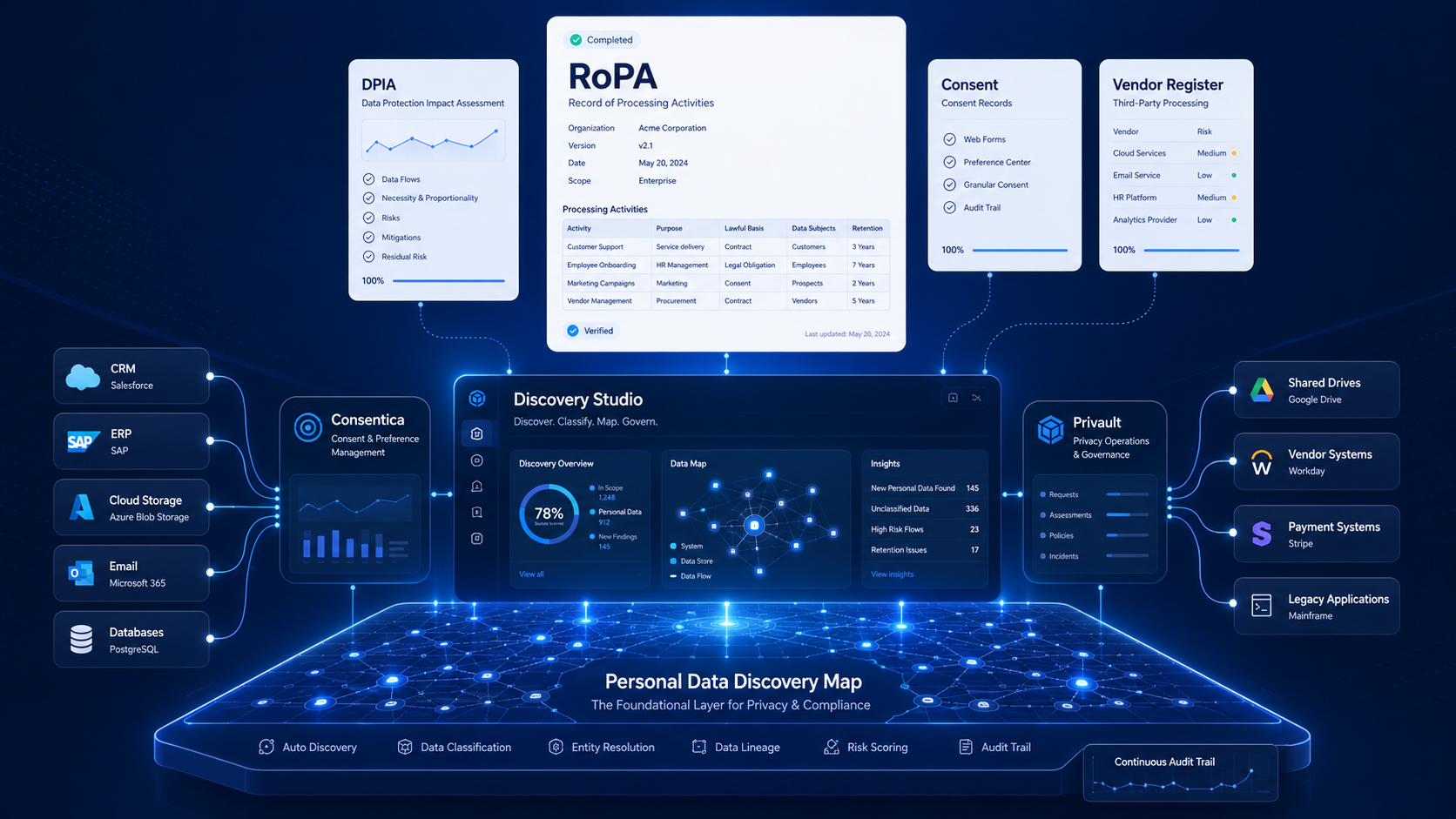
Many organisations begin DPDP implementation by drafting RoPA templates, consent notices and DPIA checklists. But documentation built without data discovery is built on assumptions. This article explains why personal data discovery must come before RoPA, DPIA, vendor registers and consent implementation — and how Discovery Studio, Consentica and Privault fit into the right readiness order.
Overview
Many organisations begin DPDP implementation by drafting documentation.
RoPA templates.
Consent notices.
Privacy policies.
Vendor questionnaires.
DPIA checklists.
These are important deliverables.
But they should not be the starting point.
The real starting point is a simpler question
Do we actually know where our personal data exists?
If the answer is unclear, every downstream DPDP artefact becomes an assumption.
A RoPA without discovery is only a best guess
A Record of Processing Activities is supposed to describe how personal data is collected, used, stored, shared, retained and protected.
But a RoPA depends on visibility.
It needs to know which systems process personal data, which databases store it, which applications collect it, which departments access it, which vendors receive it, which purposes justify processing, which retention rules apply, which fields are sensitive, and which flows may trigger DPIA review.
If this information is gathered only through internal interviews or spreadsheet templates, important data stores can be missed.
This is especially common in large or fast-growing organisations where personal data is scattered across CRMs, ERPs, email inboxes, shared drives, cloud storage, support tools, payment systems, analytics platforms, marketing tools, vendor exports and legacy databases.
The result is a RoPA that looks complete but is not evidence-backed.
That is a DPDP readiness risk.
Why discovery must come before documentation
DPDP compliance is not only about producing documents.
It is about proving control over personal data.
Before an organisation builds RoPA, DPIA, processor registers, consent journeys or audit evidence, it needs a reliable data discovery baseline.
That baseline should answer
What personal data exists? Where is it located? Who owns it internally? Which purpose is it connected to? Which vendor or processor receives it? Is it structured or unstructured? Is it duplicated in old systems or files? Does it include Aadhaar, PAN, health data, financial data, contact details, payment identifiers or other sensitive fields? Is the data still needed? Can it be linked to valid consent or another lawful processing basis?
Without this, compliance teams are forced to document what people remember, not what systems actually contain.
That is where privacy programmes start to drift from reality.
The hidden gap
unstructured personal data
Most DPDP readiness work focuses on databases and applications.
But a large amount of personal data sits in unstructured environments.
Examples include Excel files shared with vendors, email attachments containing customer lists, uploaded KYC documents, support tickets with phone numbers or IDs, diagnostic reports sent as PDFs, payment reconciliation files, old lead exports, cloud folders with onboarding documents, call-centre records and internal approval sheets.
This data is often outside formal product workflows.
But under DPDP, it still matters.
If a customer asks for correction, withdrawal, erasure, grievance support or information about processing, the organisation needs to know where relevant data exists.
If unstructured data is not discovered, the RoPA remains incomplete.
Why RoPA, DPIA and vendor registers are connected
RoPA is not an isolated document.
It is connected to other privacy obligations.
If a RoPA identifies sensitive or high-risk processing, it may create a DPIA trigger.
If the activity involves third parties, it should connect to a vendor or processor register.
If the purpose requires consent, it should connect to consent capture and withdrawal workflows.
If the data is highly sensitive, it may require tokenisation, masking, encryption or stricter access controls.
This means poor discovery affects the entire DPDP readiness chain.
One missed dataset can create an incomplete RoPA, a missed DPIA trigger, an unmapped vendor risk, a weak consent record, an audit evidence gap and unnecessary raw PII exposure.
The problem is not the template. The problem is the missing discovery layer underneath it.
Where Discovery Studio fits
OpenBlockAI Discovery Studio is built for the pre-implementation stage of DPDP readiness.
It helps enterprises discover and structure scattered knowledge about personal data before they begin full implementation.
Discovery Studio helps map personal data across databases, CRMs, ERPs, emails, files, cloud storage and vendor workflows. It identifies DPDP-relevant fields such as Aadhaar, PAN, health records, financial data, contact identifiers and payment-related data. It maps processing purposes across departments and systems, traces data flows between internal systems, teams and processors, and generates RoPA inputs, DPIA trigger areas, vendor and processor exposure, legacy consent gaps, retention and deletion risks, and audit evidence requirements.
This creates a practical DPDP readiness baseline.
The goal is not to create another questionnaire. The goal is to convert scattered enterprise knowledge into an implementation-ready privacy map.
Where Consentica fits after discovery
Consent management works best when the organisation already understands its data purposes and flows.
Consentica helps operationalise purpose-based consent, preference management, withdrawal, consent history, DSR workflows, vendor sync and audit-ready consent logs.
But consent should not be designed in isolation. It should be connected to discovered systems, purposes, vendors and processing activities.
That is how consent becomes operational instead of cosmetic.
Where Privault fits after sensitive data discovery
Once sensitive personal data is discovered, enterprises need to reduce unnecessary raw exposure.
Privault helps protect PII, PHI and PCI data through tokenisation and policy-bound access.
Instead of allowing raw Aadhaar, PAN, patient identifiers, payment data, phone numbers or financial identifiers to move freely across systems and vendors, Privault helps replace sensitive values with secure tokens.
This reduces exposure across internal workflows and third-party processing chains.
For DPDP, tokenisation supports privacy-by-design.
The right DPDP readiness order
Many organisations begin with documentation. A stronger order is: first discover personal data, then map systems, owners, vendors and purposes, then identify sensitive fields and high-risk processing, then generate RoPA inputs, then identify DPIA triggers, then build the vendor and processor register, then define consent journeys, then tokenise sensitive PII, PHI and PCI where raw exposure is unnecessary, and finally maintain audit evidence continuously.
This order matters. Documentation should reflect the real data environment, not assumptions.
Final takeaway
Your RoPA is only as good as your data discovery.
If personal data is hidden across files, emails, systems, vendors and legacy workflows, then RoPA, DPIA, consent and vendor governance will all inherit the same blind spots.
DPDP readiness should begin with visibility.
Discovery creates confidence. Documentation creates evidence. Consent creates control. Tokenisation reduces exposure.
That is the OpenBlockAI approach
Discovery Studio for DPDP readiness and personal data mapping, Consentica for consent governance and audit logs, Privault for tokenised PII, PHI and PCI protection.