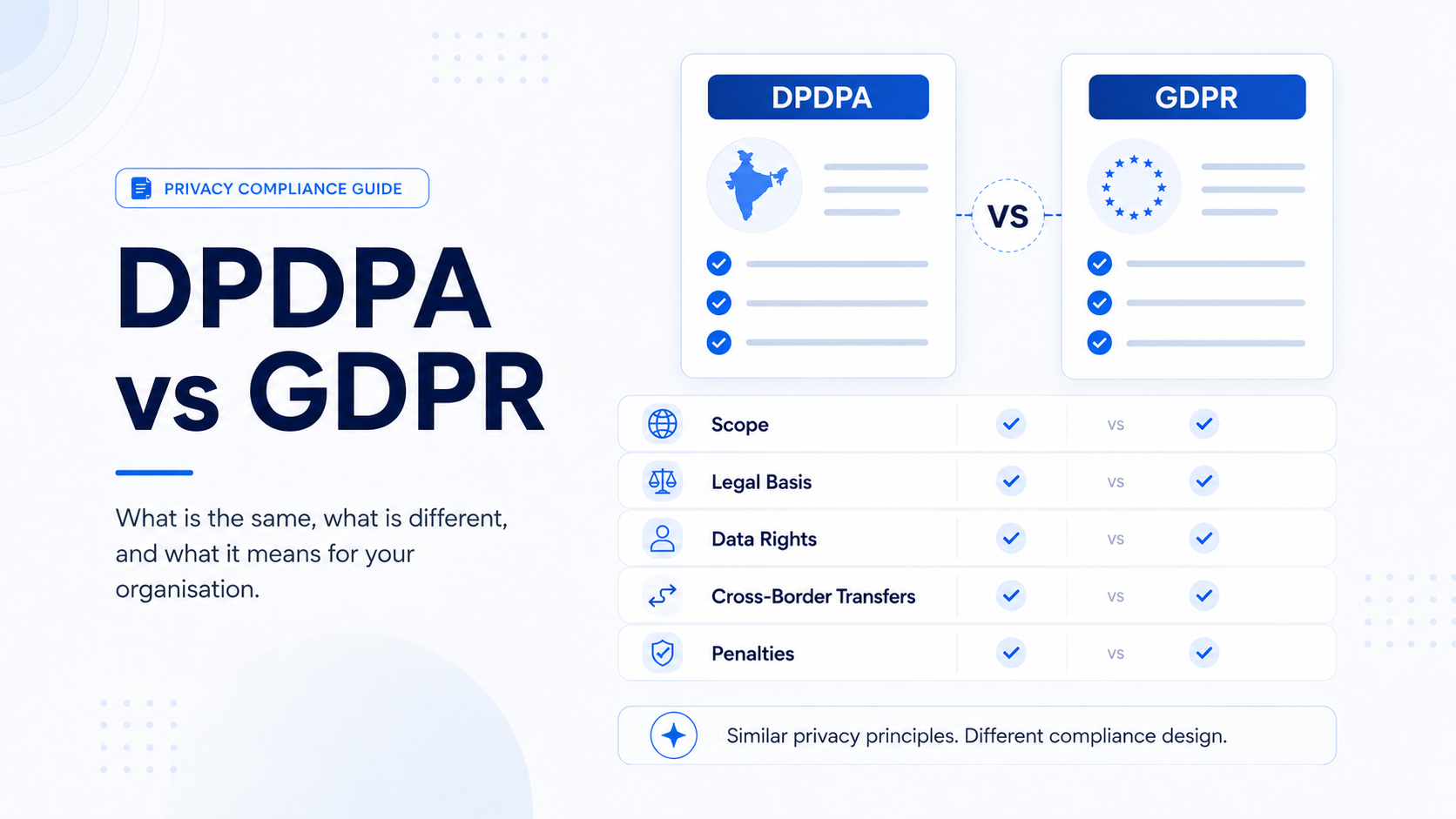
India DPDP and Europe GDPR are both landmark data privacy laws, but they are built on different foundations, use different terminology, and create different compliance obligations. This guide breaks down the key similarities and differences across scope, rights, consent, penalties, and obligations — so you can understand exactly where they align and where they diverge.
Overview
Two of the most important data privacy laws in the world are now active at the same time.
Europe has the General Data Protection Regulation, known as GDPR, which came into force in May 2018.
India has the Digital Personal Data Protection Act, known as DPDP or DPDPA, which was passed in August 2023 and moves into enforcement from November 2026 under phased rules.
Many organisations operating across both regions — or teams trying to understand their compliance obligations — frequently ask the same question:
How do DPDP and GDPR compare?
This article answers that question clearly, section by section.
A Quick Overview of Each Law
GDPR applies across the European Union and the European Economic Area. It covers any organisation that processes personal data of EU residents, regardless of where that organisation is based. It is one of the most comprehensive and heavily enforced privacy frameworks in the world.
DPDP applies to the processing of digital personal data in India and to processing that takes place outside India if it involves personal data collected within India. It is built on principles similar to GDPR but adapted to the Indian regulatory and constitutional context.
Both laws exist to give individuals meaningful control over their personal data and to create accountability obligations for organisations that collect and process that data.
Terminology
Same Concepts, Different Words
One of the first things that confuses people comparing these two laws is that they use different terms for the same concepts.
Under GDPR, the person whose data is processed is called the Data Subject. Under DPDP, the same person is called the Data Principal.
Under GDPR, the organisation that decides why and how personal data is processed is called the Data Controller. Under DPDP, the equivalent is called the Data Fiduciary.
Under GDPR, an organisation that processes data on behalf of a controller is called a Data Processor. Under DPDP, the equivalent is called a Data Processor as well, so this term is consistent.
Under GDPR, a minor is generally defined as a person under 16 years of age, though member states can lower this to 13. Under DPDP, a child is defined as a person under 18 years of age.
Under GDPR, the supervisory authority is each member state's national data protection authority. Under DPDP, the equivalent body is the Data Protection Board of India.
Understanding this terminology mapping makes it significantly easier to read both laws side by side.
Scope and Territorial Application
GDPR has a broad extraterritorial scope. It applies to any organisation anywhere in the world that processes personal data of individuals located in the EU, whether the organisation is offering goods or services to them or monitoring their behaviour.
DPDP also has extraterritorial application. It applies to processing of digital personal data within India, and to processing outside India if the data was collected from individuals in India in connection with offering goods or services to them.
The key practical difference is that GDPR applies to personal data in any format, including paper records. DPDP currently applies specifically to digital personal data, which means data that is in digital form or that has been digitised.
For most modern organisations, this distinction has limited practical impact since the majority of personal data processing is already digital. But it is a meaningful structural difference in the two frameworks.
Legal Bases for Processing
This is one of the most significant differences between the two laws.
GDPR provides six legal bases for processing personal data: consent, contract, legal obligation, vital interests, public task, and legitimate interests. Organisations can choose whichever basis applies to their specific processing activity. Legitimate interests is frequently used by companies to process data without collecting explicit consent, as long as the individual interest does not override the company interest.
DPDP takes a different approach. It is built primarily around two bases: consent and certain legitimate uses.
Consent under DPDP must be free, specific, informed, unconditional, and unambiguous. It must be given through a clear affirmative action. Bundled or assumed consent is not valid.
Legitimate uses under DPDP cover specific situations such as the state performing functions under law, compliance with court orders, medical emergencies, public health, employment-related processing, and certain other defined purposes. These are narrower than the legitimate interests basis under GDPR.
This means DPDP places a heavier emphasis on explicit consent as the default mechanism for most private sector processing, whereas GDPR provides more flexibility in choosing a legal basis.
Consent
Similarities and Differences
Both GDPR and DPDP require that consent be freely given, specific, informed, and unambiguous. In this respect they are aligned.
Both laws also give individuals the right to withdraw consent at any time. Under both laws, withdrawal must be as easy as giving consent in the first place.
However, there are meaningful differences in how consent is managed.
Under GDPR, organisations must be able to demonstrate that consent was given. There is no prescribed format.
Under DPDP, organisations must provide a notice in clear and plain language before or at the time of collecting consent. The notice must explain what data is collected, the purpose, how to withdraw consent, and how to file a complaint with the Data Protection Board. This notice requirement is more prescriptive than the general GDPR transparency requirement.
DPDP also requires that the notice and consent mechanism be available in languages listed in the Eighth Schedule of the Indian Constitution, which includes 22 official languages. GDPR does not mandate specific language availability in the same way, though organisations are expected to communicate with individuals in a clear and accessible manner.
Rights of Individuals
Both laws give individuals rights over their personal data, but the scope differs.
GDPR provides eight rights
the right to be informed, the right of access, the right to rectification, the right to erasure, the right to restrict processing, the right to data portability, the right to object, and rights related to automated decision-making and profiling.
DPDP provides the right to access information about processing, the right to correction and erasure, the right to grievance redressal, and the right to nominate a person to exercise these rights on death or incapacity. This last right, the nomination right, has no direct GDPR equivalent and is unique to DPDP.
Notable differences
Data portability is a GDPR right but is not explicitly included in DPDP in the same way.
The right to object to processing exists clearly under GDPR. DPDP does not frame this as a general objection right, though the right to withdraw consent and the right to erasure serve similar functions.
Automated decision-making protections are a significant part of GDPR, including the right not to be subject to solely automated decisions that produce legal or similarly significant effects. DPDP does not include a specific equivalent provision in its current form.
Obligations on Organisations
Both laws place significant obligations on organisations.
Under GDPR, organisations must implement privacy by design and by default, maintain records of processing activities, conduct data protection impact assessments for high-risk processing, appoint a Data Protection Officer in certain circumstances, report data breaches within 72 hours to the supervisory authority and in certain cases to affected individuals, and meet cross-border data transfer restrictions.
Under DPDP, Data Fiduciaries must obtain valid consent before processing, provide a clear notice, implement appropriate security safeguards, report personal data breaches to the Data Protection Board and affected individuals, ensure accuracy and completeness of data, erase data when consent is withdrawn or the purpose is fulfilled, and ensure that their Data Processors provide sufficient guarantees of compliance.
Significant Fiduciaries under DPDP are a higher category of Data Fiduciary that the government can designate based on volume of data processed, sensitivity of data, risk to individual rights, national security implications, or other criteria. Significant Fiduciaries face additional obligations including appointing a Data Protection Officer based in India, appointing an independent data auditor, and conducting periodic data protection impact assessments.
This concept of a tiered compliance obligation based on the nature and scale of an organisation has some parallels in GDPR, where larger organisations and those handling sensitive data face more stringent requirements, but the Significant Fiduciary designation under DPDP is more formally defined.
Children and Sensitive Data
Both laws treat children as requiring additional protection.
GDPR sets the age of digital consent at 16 by default, with member states able to lower it to 13. For children under this age, parental consent is required for processing their personal data in the context of information society services.
DPDP sets the age of a child at 18. Before processing any personal data of a child, the Data Fiduciary must obtain verifiable parental consent. DPDP also prohibits processing that could be detrimental to the well-being of a child and specifically prohibits behavioural monitoring or targeted advertising directed at children.
On sensitive data, GDPR has a specific category of special category data, which includes health data, racial or ethnic origin, political opinions, religious beliefs, trade union membership, genetic data, biometric data, sexual orientation, and criminal convictions. Processing special category data requires one of a limited set of legal bases and generally carries higher obligations.
DPDP does not create a distinct special category in the law itself. However, it empowers the central government to notify certain categories of personal data as sensitive, which will attract additional safeguards when those categories are notified. The specific list is expected to be defined in rules.
Data Localisation and Cross-Border Transfers
This is one of the most practically significant differences for multinational organisations.
GDPR prohibits transfers of personal data outside the European Economic Area unless adequate protections exist. These protections include adequacy decisions, standard contractual clauses, binding corporate rules, or other approved mechanisms. The framework for cross-border transfers under GDPR is detailed and actively enforced.
DPDP takes a different approach. It allows the central government to restrict transfers to certain countries or territories by notification, but by default personal data can be transferred internationally unless specifically restricted. This is essentially the reverse of the GDPR model: GDPR restricts by default, DPDP permits by default subject to government restrictions.
For organisations that have built GDPR-compliant cross-border transfer mechanisms, this means DPDP may initially create fewer transfer-related restrictions. However, as the government begins notifying restricted countries, this position could change.
Penalties
Both laws carry significant financial penalties.
GDPR can impose fines of up to 20 million euros or 4 percent of global annual turnover, whichever is higher, for the most serious violations. Smaller violations carry fines of up to 10 million euros or 2 percent of global annual turnover.
DPDP can impose financial penalties of up to 250 crore rupees per violation, which is approximately 30 million US dollars, for the most serious breaches. Different penalty amounts apply for different types of violations as set out in the Schedule to the Act.
GDPR penalties are calculated based on global turnover, which means they can be enormous for large technology companies. DPDP penalties are fixed amounts per violation rather than a percentage of turnover, which means the ceiling is lower in absolute terms for very large organisations but could be proportionally severe for smaller ones.
Enforcement under GDPR has been active and widely publicised since 2018. Enforcement under DPDP will begin as the Data Protection Board becomes operational and the rules framework is implemented.
Key Similarities Between DPDP and GDPR
Despite the differences, the two laws share a common foundation.
Both are built on the principle that personal data belongs to the individual, not the organisation collecting it.
Both require organisations to be transparent about how they collect and use personal data.
Both give individuals meaningful rights to access, correct, and erase their data.
Both require valid consent for most private sector processing, and both require that consent be freely given and easily withdrawn.
Both impose obligations on organisations to implement appropriate security measures and to report breaches.
Both create regulatory bodies with enforcement powers.
Both treat children as requiring additional protections.
For organisations that have already built GDPR-compliant frameworks, many of the foundational elements will transfer. The principles, the consent management infrastructure, the breach response processes, and the individual rights workflows are all recognisable across both laws.
Key Differences at a Glance
GDPR covers all personal data including paper records. DPDP currently covers digital personal data.
GDPR provides six legal bases for processing. DPDP centres primarily on consent and defined legitimate uses.
GDPR age of consent for minors varies between 13 and 16 by member state. DPDP sets 18 as the age of a child.
GDPR restricts cross-border transfers by default. DPDP permits transfers by default unless restricted by government notification.
GDPR penalties are calculated as a percentage of global turnover. DPDP penalties are fixed amounts per violation up to 250 crore rupees.
GDPR includes explicit rights around automated decision-making. DPDP does not currently include a directly equivalent provision.
GDPR includes a right to data portability. DPDP does not include an identical provision.
DPDP includes a right to nominate a person to exercise rights after death or incapacity. GDPR does not have a direct equivalent.
DPDP introduces the concept of Significant Fiduciaries with additional obligations. GDPR has higher obligations for certain categories but does not use this formal designation.
What This Means for Organisations
If your organisation already complies with GDPR, you have a strong foundation for DPDP compliance. The core principles are aligned. Your consent management infrastructure, your breach response processes, your individual rights workflows, and your data inventory practices will all apply.
However, you will need to review several areas specifically for DPDP: your consent notice format and language options, your child data handling and parental consent mechanisms, your cross-border transfer approach under the DPDP model, your obligations if you are designated as a Significant Fiduciary, and your breach notification timelines and processes under DPDP rules.
If your organisation operates only in India and is building a privacy programme for the first time, DPDP is your primary framework. Understanding where GDPR has more established practices can be a useful reference, but your obligations are defined by DPDP and its rules.
Final Takeaway
DPDP and GDPR are more similar than they are different at the level of principles. Both laws exist to protect individuals, create accountability, and require organisations to treat personal data responsibly.
The differences lie in scope, legal bases, terminology, cross-border transfer rules, penalty calculation, and specific rights. These differences matter for compliance design and operational implementation.
For any organisation building a privacy programme that spans both India and Europe, the good news is that a well-designed consent and data governance framework can serve both laws. The underlying requirements — know your data, collect consent properly, respect individual rights, respond to breaches, manage vendors, and maintain evidence — are common to both.
Understanding exactly where the two laws align and where they diverge is the first step toward building that programme effectively.
Explore how Consentica supports purpose-based consent, withdrawal, DSR workflows, and audit-ready logs for DPDP compliance: https://www.openblockai.com/consent-management
Book a DPDP readiness conversation with OpenBlockAI: https://calendly.com/openblockai/consentica