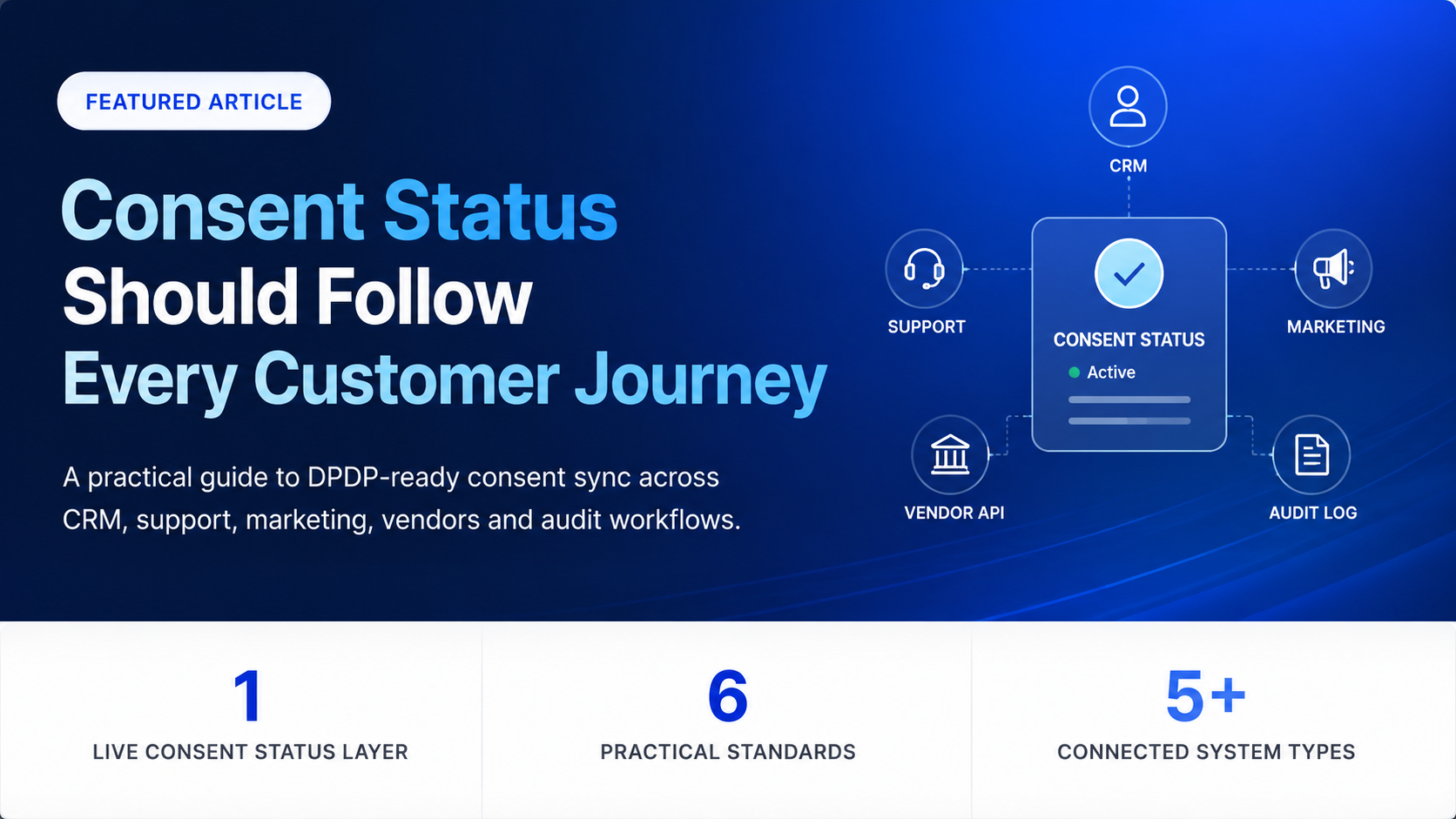
DPDP consent management needs live consent status sync across CRM, marketing, support, vendors, APIs and audit logs. Consentica helps enterprises prove it.
Overview
Most organisations think of consent as something that happens at the start of a customer journey.
A user signs up.
A checkbox is selected.
A notice is accepted.
A preference is recorded.
A CRM field is updated.
Then the business moves on.
But the customer journey does not stay inside that one form.
The same user may later speak to support, receive marketing messages, use product features, interact with a vendor, complete a payment, raise a service request, update a preference or withdraw consent.
If every system has a different view of that user’s consent status, the organisation does not have consent governance.
It has consent fragmentation.
What is the real problem with consent capture?
Consent capture answers one question.
What did the user agree to at a specific moment?
Consent status answers a more operational question.
What is the user allowed to be contacted about, profiled for, shared with or processed for right now?
That second question is where enterprises struggle.
Because user data does not stay in one place.
It moves into CRM.
It moves into campaign tools.
It moves into customer support platforms.
It moves into analytics systems.
It moves into payment systems.
It moves into vendors and processors.
It moves into dashboards, exports and partner APIs.
If consent status does not move with it, teams begin making decisions on stale records.
That is a DPDP readiness risk.
Where does consent status usually break?
In a typical enterprise, consent is captured by one team and used by many teams.
The product team collects consent during onboarding.
The marketing team runs campaigns from a CRM or automation platform.
The support team handles assisted journeys.
The analytics team studies user behaviour.
The compliance team maintains evidence.
The vendor management team works with processors.
The business team launches new journeys.
Each team may have its own tool, database and workflow.
Now imagine a user changes a preference.
The app knows the new status.
But the CRM does not.
The CRM updates, but the campaign platform does not.
The campaign platform updates, but a vendor export remains unchanged.
The support desk cannot see the latest status.
The analytics system continues processing for an old purpose.
The compliance team has to chase logs across systems.
That is how consent becomes unreliable.
Why does this matter under DPDP?
Under DPDP, enterprises need more than policy documents.
They need operational proof.
They need to show that consent was captured for a clear purpose.
They need to show that user choices were respected.
They need to show that processing was aligned with the current consent status.
They need to show that changes, withdrawals and preference updates reached the systems that act on user data.
A static consent record cannot do this alone.
A live consent status layer can.
What is the business cost of stale consent?
Stale consent does not only create compliance risk.
It creates customer-experience risk.
A customer who opted out still receives a promotional email.
A support agent cannot answer a consent question during a service call.
A campaign team suppresses too many users because the status is unclear.
A vendor keeps processing data after a preference change.
A product team cannot safely launch a new analytics or AI feature because consent status is not available at the point of use.
A DPO cannot quickly produce evidence during an internal audit.
This slows teams down.
It also weakens trust.
What should modern consent governance look like?
Consent status should become a live operational signal.
Before a campaign is sent, the system should know whether the user has consented to that purpose.
Before a vendor receives data, the system should know whether sharing is permitted.
Before support acts on an assisted journey, the agent should see the current status.
Before analytics or AI processing begins, the platform should check the relevant purpose and preference.
Before an auditor, regulator or customer asks a question, the organisation should have evidence ready.
This requires APIs, webhooks, request history, privacy-centre workflows, purpose mapping and audit logs.
It also requires one source of truth for current consent status.
How does this affect BFSI and fintech?
Banks, NBFCs, payment companies and lending apps manage consent across onboarding, KYC, servicing, collections, marketing, cross-sell and partner offers.
A customer may permit transactional communication but not promotional offers.
A borrower may consent to one purpose but not another.
A user may update preferences through a call centre but still receive app notifications.
Consent status needs to be visible across app, CRM, support, marketing and partner workflows.
For BFSI and fintech teams, the risk is not only whether consent was collected.
The bigger question is whether the latest consent status is available wherever customer data is used.
How does this affect SaaS and digital platforms?
SaaS companies use data across product analytics, support, billing, AI features, customer success, CRM and marketing.
A user’s consent status must be available when product features process personal data, when marketing teams run campaigns and when support teams handle requests.
Consent governance cannot be trapped inside the signup form.
For enterprise buyers, this is also becoming part of vendor due diligence.
A SaaS platform that cannot explain how consent status flows across product, support, CRM and analytics creates risk for its customers.
How does this affect e-commerce and marketplaces?
Marketplaces must separate order updates, delivery communication, seller sharing, loyalty programmes, promotional messages and recommendation profiling.
Consent status needs to follow the user across checkout, seller operations, logistics partners, CRM and campaign systems.
A customer may want delivery updates but not promotional messages.
A buyer may agree to order processing but not seller marketing.
A user may withdraw a preference, but the campaign or logistics partner may still have an old record.
That is why consent status must travel across the journey.
How does this affect healthcare and healthtech?
Healthcare and healthtech workflows often involve appointments, lab reports, insurance claims, pharmacy coordination, health records and patient support channels.
Patient consent may need to be visible across hospitals, labs, TPAs, pharmacies, insurers and care-coordination vendors.
When consent status changes, patient-facing systems and operational partners need reliable, traceable updates.
In healthcare, stale consent is not only a marketing issue.
It can become a trust, patient-data and governance issue.
Where does Consentica fit?
Consentica by OpenBlockAI is built for DPDP-ready consent governance across customer journeys.
It helps enterprises capture, manage, update, withdraw and prove consent across web, app, assisted, QR, API and partner-led journeys.
With Consentica, teams can capture purpose-based consent in clear customer journeys.
They can support consent notices in multiple Indian languages.
They can provide a Privacy Centre where users can review, update and withdraw consent.
They can sync consent status across business systems, third-party tools, webhooks, Consent Check API and reports.
They can send deletion, suppression or processing restriction instructions to internal and third-party systems when consent changes.
They can maintain time-stamped consent records, request history, notice versions, purpose records and audit-ready logs.
They can support DSR, grievance, vendor and processor workflows with evidence.
The goal is simple.
Consent should not sit inside one system.
Consent status should follow every customer journey.
What operational standard should enterprises aim for?
A DPDP-ready consent status layer should meet six practical standards.
First, it should be purpose-specific.
Second, it should reflect the latest user decision.
Third, it should be available to every system that processes user data.
Fourth, it should support APIs and webhooks for downstream checks.
Fifth, it should trigger suppression or restriction when consent changes.
Sixth, it should maintain audit-ready evidence.
If these standards are missing, the enterprise may have consent records.
But it does not have consent governance.
Final takeaway
Consent is not finished when the user clicks a button.
It becomes meaningful only when the current consent status controls what happens next.
Across CRM.
Across marketing.
Across support.
Across analytics.
Across vendors.
Across every customer journey.
Consentica helps enterprises turn consent from a static record into a live governance layer.
Because under DPDP, the question is not only whether consent was captured.
The better question is this.
Can every system act on the right consent status right now?
Explore Consentica for DPDP-ready consent governance: https://www.openblockai.com/consent-management
Book a demo with OpenBlockAI
https://calendly.com/openblockai/consentica
If you do not know where consent-linked personal data flows today, start with a DPDPA readiness assessment: https://www.openblockai.com/dpdpa-readiness-assessment