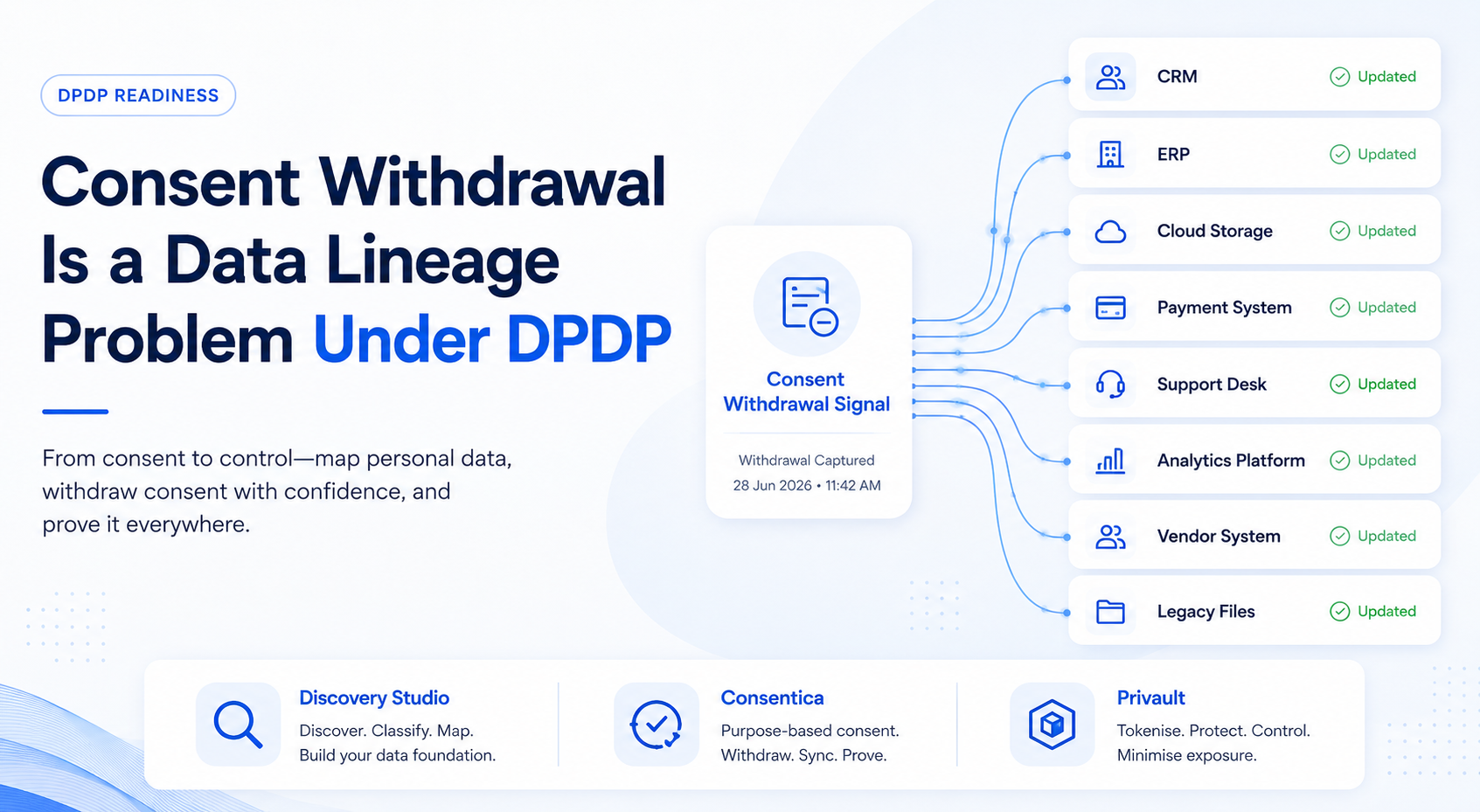
Most DPDP readiness conversations begin with consent capture. But the harder question is this: when a customer withdraws consent, can the organisation prove that withdrawal has been reflected across every system, team, vendor, file, and downstream process where that personal data is used? This article explains why consent withdrawal is a data lineage problem — and how Discovery Studio, Consentica, and Privault connect to solve it.
Overview
Most DPDP readiness conversations begin with consent capture.
Can we collect consent? Can we show a notice? Can we store a timestamp? Can we provide withdrawal?
These are important questions. But for enterprises, they are not enough.
The harder DPDP question is this
When a customer withdraws consent, can the organisation prove that the withdrawal has been reflected across every system, team, vendor, file, workflow, and downstream process where that personal data is used?
That is where DPDP consent management becomes more than a front-end consent flow.
It becomes a data lineage problem.
Why consent withdrawal is difficult in real enterprises
In most organisations, personal data does not remain in one place.
It moves through CRMs, ERPs, websites, mobile apps, payment systems, email tools, support tickets, analytics platforms, cloud folders, vendor spreadsheets, call-centre exports, API logs, warehouse tables, and legacy databases.
A customer may give consent in one channel. But that data may later be copied, enriched, exported, shared, processed, analysed, or stored somewhere else.
This creates a serious DPDP governance gap.
A consent platform may know that consent was withdrawn. But unless the organisation knows where the data travelled, the withdrawal record may not automatically stop downstream processing.
That is the difference between consent capture and consent control.
The first stores permission. The second proves operational enforcement.
The common enterprise failure pattern
A typical DPDP failure does not always begin with bad intent. It usually begins with scattered data.
A bank captures consent during onboarding, but the same customer data is already present in bureau workflows, DSA files, collection agency records, co-lending partner systems, and internal analytics tables.
A hospital receives consent for a treatment journey, but patient identifiers also exist in lab reports, TPA workflows, diagnostic integrations, pharmacy coordination, billing systems, email attachments, and old uploaded forms.
A SaaS company updates consent preferences in the product, but user data is still flowing into CRM, support, marketing automation, analytics, payment, and third-party integration tools.
A travel platform records opt-out, but passenger details may still exist in booking engines, hotel partners, payment processors, loyalty tools, support desks, and itinerary emails.
In each case, the risk is the same. Consent status changed, but the data map did not.
Why this matters under DPDP
DPDP pushes organisations toward accountability around personal data processing. The practical questions are not only legal — they are operational:
What personal data do we collect? Why do we process it? Where is it stored? Which purpose is it linked to? Which vendor or processor receives it? Can the individual withdraw consent? Can we stop processing after withdrawal? Can we prove what happened?
This is why a consent withdrawal workflow cannot work properly without personal data discovery.
If the organisation does not know where personal data exists, it cannot reliably prove that withdrawal has been honoured.
The missing layer
data lineage for consent
Data lineage means understanding the path of personal data from collection to processing, sharing, storage, retention, deletion, and downstream usage.
For DPDP, this lineage must connect at least five layers
1. Data category
What personal data is involved?
2. Purpose: Why was it collected or processed?
3. System: Where is it stored or used?
4. Vendor: Who else receives or processes it?
5. Consent status: Is the current processing still permitted?
Without this connection, a withdrawal event remains isolated. With this connection, a withdrawal event becomes enforceable.
Where Discovery Studio fits
OpenBlockAI Discovery Studio is designed for the pre-implementation stage of DPDP readiness.
Before an enterprise rolls out consent workflows at scale, Discovery Studio helps map the actual personal data environment. It identifies personal data across databases, CRMs, ERPs, emails, files, cloud folders, applications, and vendor workflows. It maps purpose-wise data usage, identifies Aadhaar, PAN, contact details, health data, financial data, payment identifiers, and other DPDP-relevant fields. It maps vendor and processor exposure, RoPA inputs, DPIA trigger areas, retention and deletion gaps, legacy consent gaps, audit evidence requirements, and operational risk areas.
This creates the baseline needed for meaningful consent governance. Because before you can control consent, you need to know what the consent applies to.
Where Consentica fits
Once data discovery is complete, Consentica helps operationalise consent management.
Consentica supports purpose-based consent capture, preference management, consent withdrawal, consent history, multilingual consent journeys, DSR workflows, vendor sync, and audit-ready logs.
The goal is not only to collect consent. The goal is to maintain a live consent state across customer journeys and internal workflows.
That means withdrawal should not sit only in a consent database. It should become a signal that downstream systems, teams, and vendors can act on.
Where Privault fits
Even with good discovery and consent governance, enterprises face another major risk. Raw personal data continues to move across too many places.
Privault addresses this through tokenisation of sensitive PII, PHI, and PCI data. Instead of exposing raw Aadhaar, PAN, patient identifiers, payment references, health records, phone numbers, or financial identifiers across multiple applications and vendors, Privault replaces sensitive values with tokens and controls access through policy-bound workflows.
This reduces the blast radius of misuse, breach, over-sharing, and unnecessary exposure. For DPDP, tokenisation supports privacy-by-design.
The right DPDP readiness sequence
Many organisations are tempted to start with a consent banner or consent form. But the stronger sequence is:
1. Discover personal data across systems and files.
2. Map purposes, owners, vendors, and processors.
3. Identify RoPA, DPIA, retention, consent, and evidence gaps.
4. Create a DPDP readiness baseline.
5. Implement consent capture and preference management.
6. Connect withdrawal to downstream systems and vendor workflows.
7. Tokenise sensitive PII, PHI, and PCI wherever raw exposure is unnecessary.
8. Maintain audit-ready proof continuously.
This sequence reduces the risk of cosmetic compliance and moves the organisation toward operational compliance.
Final takeaway
Under DPDP, consent withdrawal is not a button. It is a proof obligation.
Enterprises need to prove that when a person changes or withdraws consent, the organisation can identify the affected data, systems, purposes, vendors, and processing activities.
That proof begins with discovery. It becomes enforceable through consent governance. It becomes safer through tokenisation.
That is the OpenBlockAI approach
Discovery Studio for DPDP readiness and personal data mapping.
Consentica for consent governance and audit-ready consent workflows.
Privault for tokenised PII, PHI, and PCI protection.
Start your DPDP readiness assessment with Discovery Studio: https://www.openblockai.com/dpdpa-readiness-assessment
Explore Consentica for purpose-based consent, withdrawal, DSR, and audit logs: https://www.openblockai.com/consent-management
Book a demo with OpenBlockAI
https://calendly.com/openblockai/consentica