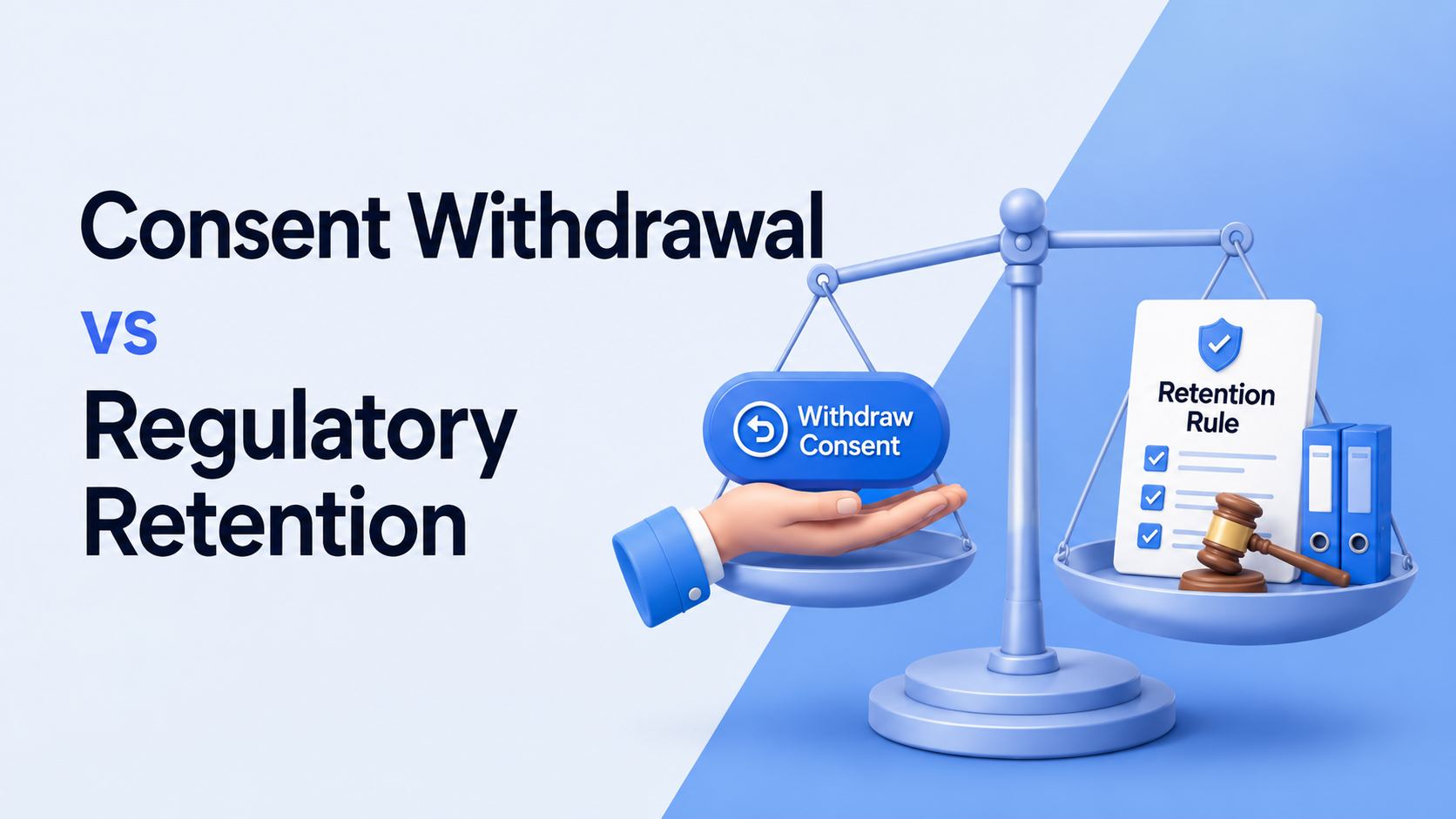
Most digital businesses make it very easy to give consent. But when the same user wants to change or withdraw consent, the journey often becomes difficult. Under DPDP, consent withdrawal must be as simple as consent capture — and it must trigger downstream suppression across CRM, marketing, vendors, and analytics. This article explains why withdrawal is the real test of consent governance, and how Consentica helps enterprises pass it.
Overview
Most digital businesses make it very easy to give consent.
A banner appears.
A checkbox is shown.
An "Accept" button is highlighted.
A signup form moves the user forward in seconds.
But when the same user wants to change or withdraw consent, the journey often becomes difficult.
The option is hidden inside account settings.
The unsubscribe link only stops one type of message.
The privacy policy says withdrawal is available, but does not make it easy.
The CRM still shows the user as marketable.
The vendor still has the old file.
The analytics tool still uses the identifier.
The support team cannot confirm what the user actually approved.
This is where consent governance fails.
Because under DPDP, consent is not only about asking once.
It is about respecting the user's choice throughout the lifecycle.
Consent capture is only half the story
Consent capture is the visible part of the journey.
It happens at signup, checkout, onboarding, app install, payment setup, loan application, diagnostic booking, newsletter subscription or account creation.
But consent does not remain static.
Users change their mind.
They withdraw marketing permission.
They update preferences.
They object to a purpose.
They ask for erasure or correction.
They raise a grievance.
They want to know what data is being used and why.
A consent system that only captures the first decision is incomplete.
The real test is whether the organisation can manage consent after the first click.
Why withdrawal is the trust moment
Withdrawal is where users learn whether the organisation truly respects choice.
If giving consent takes one click but withdrawing takes ten steps, the journey feels unfair.
If a user opts out but still receives campaigns, the brand loses trust.
If withdrawal is recorded in one system but not enforced in others, compliance risk remains.
If the organisation cannot prove when withdrawal happened and what action followed, audit readiness is weak.
This is why consent withdrawal should be treated as a core privacy operation, not a small settings-page feature.
Where withdrawal usually breaks
In most enterprises, personal data and consent records are not handled by one system.
A user may give consent through a website or app.
But that data then moves into CRM, marketing automation, customer support, analytics tools, payment systems, vendor APIs, data warehouses and internal reporting dashboards.
When the user withdraws consent, every affected system needs to know.
That is where breakdowns happen.
The website records withdrawal, but the CRM does not update.
The CRM updates, but the campaign tool still sends messages.
The campaign tool updates, but a vendor keeps processing an old export.
The support team cannot see the latest consent status.
The analytics system keeps using identifiers for a purpose the user no longer permits.
The privacy team has to manually chase logs across systems.
At that point, withdrawal exists on paper, but not in operations.
The Privacy Centre should become the user's control point
A Privacy Centre should not be a decorative page.
It should be the place where users can clearly review, update and withdraw consent.
A good Privacy Centre should show
What purposes the user has approved.
Which communication preferences are active.
Which data-sharing permissions exist.
When consent was given or changed.
How to withdraw consent easily.
How to raise a rights or grievance request.
What happens after withdrawal.
For enterprises, the Privacy Centre should also create evidence.
It should record every update with timestamp, channel, purpose, notice version, user action and request history.
It should also trigger downstream suppression, deletion or processing restriction where required.
This is how withdrawal becomes enforceable.
Why industries should care
BFSI and fintech
Banks, NBFCs, payment companies and lending apps manage consent across onboarding, KYC, marketing, cross-sell, third-party products, collections, support and partner workflows.
A customer may agree to service communication but not marketing.
A borrower may consent to one purpose but not another.
A user may withdraw consent for promotional campaigns but still need transactional communication.
Without purpose-wise consent and downstream sync, teams can easily over-process or over-communicate.
SaaS and digital platforms
SaaS businesses collect user data across product analytics, support, billing, CRM, AI features, onboarding and marketing.
Consent withdrawal must reach product systems, CRM, analytics and campaign platforms.
Otherwise, the user's choice stays trapped inside the consent screen.
E-commerce and marketplaces
Marketplaces must separate order communication, delivery updates, seller sharing, loyalty programmes, recommendation profiling and promotional messages.
A user should be able to opt out of marketing without breaking order fulfilment.
That requires granular preferences, not one bundled checkbox.
Healthcare and healthtech
Patient consent can involve appointments, diagnostics, insurance claims, pharmacy coordination and health records.
When preferences change, patient-facing systems and operational partners need clear, traceable instructions.
Healthcare consent must be simple for users and reliable for operations.
Where Consentica fits
Consentica by OpenBlockAI is designed for DPDP-ready consent governance across customer journeys.
It helps organisations capture, manage, update, withdraw and prove consent across web, app, offline, assisted, QR and API-led journeys.
With Consentica, enterprises can
Capture purpose-based consent clearly.
Support consent journeys in 22 Indian languages.
Let users review, update and withdraw consent through a Privacy Centre.
Maintain time-stamped consent records and request history.
Sync consent status across business systems, third-party tools, webhooks, Consent Check API and reports.
Send automated deletion, suppression or processing restriction instructions to internal and third-party systems when consent is withdrawn.
Maintain audit-ready evidence for consent notices, approvals, withdrawals, data flows, vendor reviews and regulatory reporting.
The goal is not only to collect consent.
The goal is to make consent controllable after collection.
The operational standard enterprises should aim for
A DPDP-ready consent system should meet five practical standards.
First, consent should be purpose-specific.
Second, withdrawal should be as easy as consent capture.
Third, preferences should be visible in one Privacy Centre.
Fourth, withdrawal should trigger downstream suppression or restriction.
Fifth, every action should be audit-ready.
If any of these five are missing, consent governance is incomplete.
Final takeaway
Consent capture starts the relationship.
Consent withdrawal tests the relationship.
If users can easily give consent but struggle to withdraw it, the system is not user-centric.
If withdrawal is recorded but not enforced across systems, the system is not operationally ready.
If the organisation cannot prove what happened after withdrawal, the system is not audit-ready.
Consentica helps enterprises move from one-time consent collection to full-lifecycle consent governance.
Because under DPDP, user choice should not be hard to reverse.
Explore Consentica for DPDP-ready consent governance: https://www.openblockai.com/consent-management
Book a demo with OpenBlockAI
https://calendly.com/openblockai/consentica
If your consent withdrawal gaps begin with unclear data flows, start with a DPDPA readiness assessment: https://www.openblockai.com/dpdpa-readiness-assessment