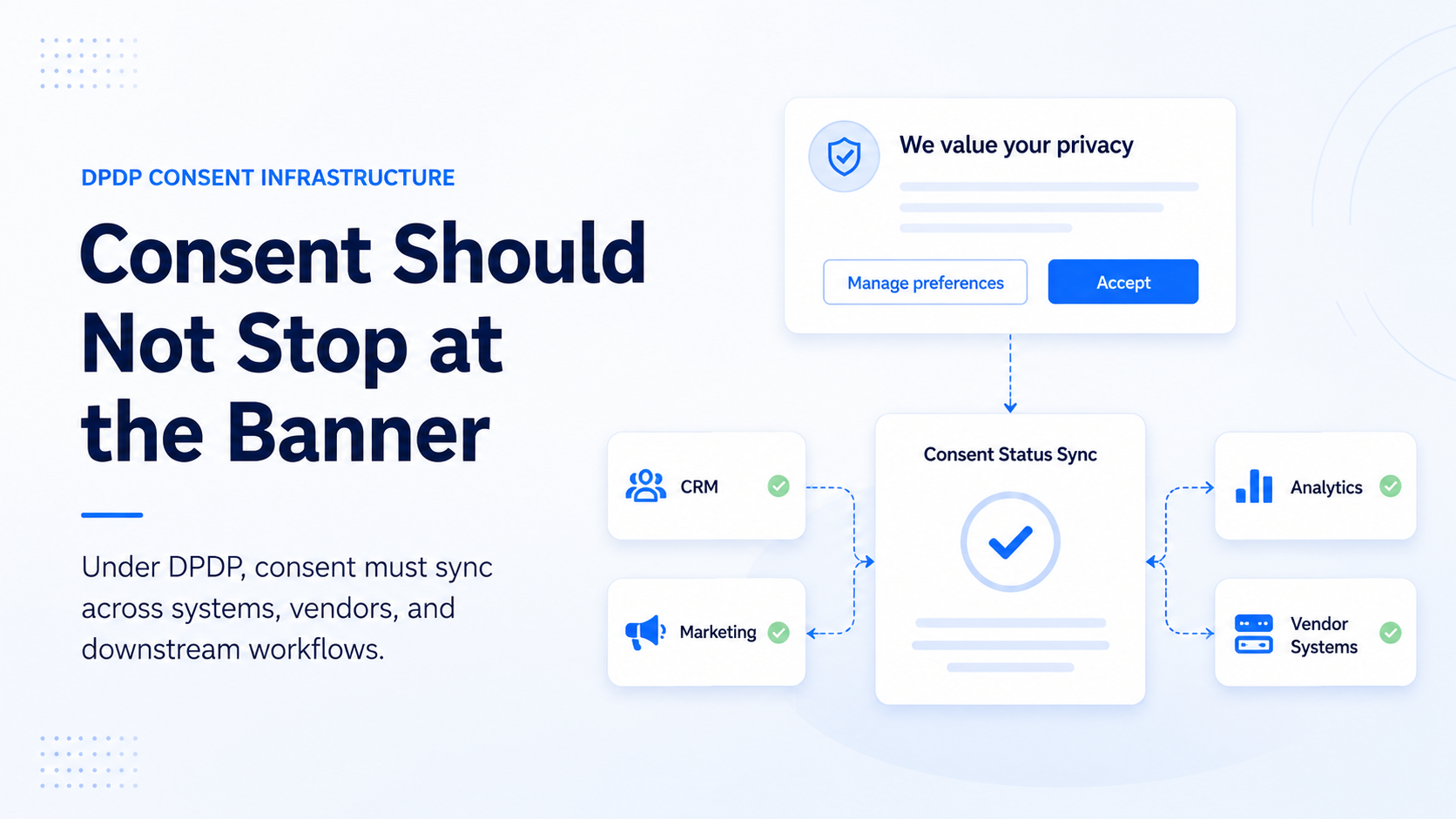
For many organisations, DPDP readiness begins with one visible action: add a consent banner. But under DPDP, a consent banner is not enough. The real compliance challenge begins after the user clicks accept, reject, or withdraw. This article explains why consent must connect to CRM, marketing, vendors, DSR workflows, and sensitive data protection — and how Discovery Studio, Consentica, and Privault build that connected privacy infrastructure.
For many organisations, DPDP readiness begins with one visible action
Add a consent banner.
It feels practical. It is easy to show. It gives teams a sense that something has been implemented.
But under DPDP, a consent banner is not enough.
The real compliance challenge begins after the user clicks accept, reject, manage preferences, or withdraw consent.
Where does that consent status go?
Does it update the CRM?
Does it stop marketing automation?
Does it reach vendors?
Does it affect analytics tools?
Does it change access to sensitive personal data?
Does it update the RoPA?
Can the organisation prove that every downstream system respected the user choice?
That is the difference between collecting consent and operationalising consent.
Why consent banners are only the surface layer
A consent banner captures a user interaction.
But enterprise data processing happens across many layers.
Customer data may move through websites, apps, CRMs, ERPs, payment systems, support tools, email platforms, marketing automation, analytics tools, vendor systems, data warehouses, spreadsheets, API logs, and legacy applications.
If consent is captured only at the front end, but not connected to these downstream systems, the organisation may still process personal data in ways that do not reflect the user current choice.
This creates a serious DPDP readiness gap.
The banner says consent is managed.
The back-end may tell a different story.
Consent must connect to business execution
Modern consent governance must answer operational questions.
If a customer opts out of marketing, does the marketing tool stop campaigns immediately?
If a user withdraws consent for a purpose, does the CRM update the purpose status?
If a patient changes a preference, do lab, TPA, pharmacy, and billing workflows receive the correct signal?
If a borrower withdraws consent for a non-essential purpose, do DSA, co-lending, bureau, analytics, and collection workflows reflect that change?
If a SaaS user deletes or changes preferences, do support, product analytics, payment, and integration systems update accordingly?
Without this connection, consent remains a record.
With this connection, consent becomes infrastructure.
The DPDP risk
consent without traceability
DPDP readiness requires more than showing that a user gave consent once.
Organisations need to maintain evidence of how consent was captured, changed, withdrawn, and acted upon.
This is where many enterprises struggle.
They may have consent logs, but not system-level traceability.
They may have a privacy notice, but not a purpose-level data map.
They may have a withdrawal button, but not downstream enforcement.
They may have a vendor register, but not live vendor consent sync.
They may have a RoPA, but not evidence that processing activities are connected to real consent status.
This is why DPDP compliance cannot be solved by banners alone.
It requires connected privacy infrastructure.
Start with Discovery Studio
know what consent applies to
Before consent can be operationalised, the organisation must know where personal data exists and how it is used.
OpenBlockAI Discovery Studio helps enterprises build this baseline before implementation.
It helps discover and map personal data across databases, CRMs, ERPs, emails, cloud storage, shared drives, files, applications, and vendor workflows. Purpose-wise data usage. Sensitive identifiers such as Aadhaar, PAN, health data, financial data, contact details, payment identifiers, and employment data. Data owners, processors, vendors, and business teams. RoPA inputs. DPIA trigger areas. Retention and deletion gaps. Legacy consent gaps. Audit evidence requirements. Risk heatmap and implementation priorities.
This matters because consent cannot be reliably governed if the organisation does not know what data, systems, vendors, and purposes it applies to.
Discovery turns consent from a front-end interaction into an enterprise-wide control map.
Then use Consentica
connect consent to real workflows
Once discovery is complete, Consentica helps operationalise consent governance.
Consentica supports purpose-based consent capture, preference management, consent withdrawal, consent history, DSR workflows, vendor sync, multilingual consent journeys, and audit-ready logs.
The goal is not just to store consent. The goal is to maintain a live consent state across customer journeys and downstream processing workflows.
That means withdrawal should not sit only in a consent database. It should become a signal that downstream systems, teams, and vendors can act on.
When consent is connected to workflows, privacy teams can move from manual evidence collection to operational proof.
Then use Privault
reduce raw personal data exposure
Even with strong consent governance, organisations still face a second risk.
Raw personal data continues to move across too many systems.
Privault helps reduce this exposure by tokenising sensitive PII, PHI, and PCI data. Instead of raw Aadhaar, PAN, patient IDs, phone numbers, payment identifiers, financial data, or health records being copied across multiple tools and vendors, Privault helps replace sensitive values with secure tokens and control access through policy-bound workflows.
This supports privacy-by-design because it reduces unnecessary exposure while preserving business usability.
In DPDP terms, it strengthens the operational layer around security, access control, and data minimisation.
The connected DPDP architecture
A practical DPDP-ready architecture should connect three layers
1. Discovery layer
Find personal data, systems, purposes, vendors, processors, risk areas, and evidence gaps.
2. Consent governance layer
Capture, manage, update, withdraw, sync, and prove consent across business workflows.
3. Data protection layer
Tokenise sensitive PII, PHI, and PCI so raw data exposure is reduced across internal and vendor systems.
This is how enterprises move beyond cosmetic compliance.
They stop treating consent as a website feature.
They start treating consent as part of privacy infrastructure.
Final takeaway
A consent banner is only the beginning.
Under DPDP, organisations need to prove that consent choices are connected to real processing activities.
That means knowing where personal data exists, what purpose it serves, which systems process it, which vendors receive it, and how sensitive data is protected after consent is captured.
OpenBlockAI helps enterprises build this connected privacy infrastructure through Discovery Studio for DPDP readiness and personal data discovery, Consentica for consent governance, withdrawal, DSR, vendor sync, and audit logs, and Privault for tokenised PII, PHI, and PCI protection.
Consent should not stop at the banner.
It should become an operating layer for privacy, governance, and trust.
Start your DPDP readiness assessment with Discovery Studio: https://www.openblockai.com/dpdpa-readiness-assessment
Explore Consentica for consent governance: https://www.openblockai.com/consent-management
Book a demo with OpenBlockAI
https://calendly.com/openblockai/consentica